Table of Contents
LED power supply headroom is the unused output capacity between the maximum LED load and the usable capacity of the power supply under the actual operating conditions.
That definition matters because three different concepts are often mixed together:
- Rated power — the nominal output rating printed on the power supply or datasheet.
- Derated usable power — the output actually permitted under the relevant temperature, input-voltage, mounting, or cooling conditions.
- Design headroom — additional capacity intentionally left above the calculated maximum load.
These are not interchangeable.
A common online rule says to “add 20%” or “load the power supply to only 80%.” Those rules can be useful as preliminary planning shortcuts, but they should not be presented as a universal electrical-code requirement or as a substitute for the actual power-supply datasheet.
The better engineering sequence is:
Calculate the real maximum LED load → check the candidate power supply’s derating and operating limits → decide whether additional project margin is useful → select the next suitable standard rating.
For the broader constant-voltage framework, start with the Constant Voltage LED Power Supply Guide. If you still need to calculate the LED load itself, use How to Size an LED Power Supply for an LED Load.
Quick Answer: Is 20% Headroom Required?
No universal 20% LED power-supply headroom rule applies to every product and installation.
A 20% planning margin can be reasonable in some projects, but the correct capacity depends on:
- the maximum connected LED load;
- the exact power-supply rating;
- the manufacturer’s permitted continuous loading;
- ambient and case temperature;
- enclosure ventilation;
- AC input voltage;
- mounting orientation;
- dimming/control behavior;
- expected future expansion;
- project-specific reliability targets.
MEAN WELL’s LED power-supply technical guidance recommends adding margin to actual power usage while also showing that operating load, temperature, and lifetime are related. It separately emphasizes that rated power must be derated when the operating conditions exceed the full-load thermal region: MEAN WELL — LED Power Supply Selection, Load Margin and Derating.
The important point is that the manufacturer recommends margin plus operating-condition review, not a universal percentage that overrides the datasheet.
Start With Maximum LED Load, Not With a Margin Percentage
Before discussing headroom, calculate the maximum connected load.
For LED strip:
Maximum load = W/ft × total powered feet
or:
Maximum load = W/m × total powered meters
For LED modules:
Maximum load = watts per module × number of modules
For several compatible branches:
Maximum load = Branch A + Branch B + Branch C + …
Example:
| Branch | Maximum Load |
|---|---|
| A | 32W |
| B | 28W |
| C | 20W |
| Total | 80W |
The system’s calculated maximum load is 80W.
Only after that number is known does the headroom discussion become meaningful.
If multiple branches share one supply, see Can Multiple LED Loads Share One Power Supply? for the branch-current and distribution checks that must occur alongside total wattage.
Rated Capacity Is Not Always Usable Capacity
Suppose a power supply is labeled 150W.
That does not automatically mean that 150W can be delivered continuously under every allowed ambient temperature, input voltage, mounting orientation, or cooling condition.
Power-supply manufacturers commonly publish derating curves that reduce permissible output when thermal or electrical conditions become more demanding.
RECOM describes thermal derating as reducing maximum output power as ambient temperature increases because the power supply has less ability to dissipate internally generated heat: RECOM — Understanding Thermal and Load Derating in Power Supplies.
For LED power supplies specifically, MEAN WELL makes the same point: operating temperature and load affect lifetime, and output capability may have to be reduced outside the full-load region. MEAN WELL — LED Power Supply Temperature, Load and Lifetime Guidance.
Therefore:
Headroom should be calculated against usable capacity at the project condition, not blindly against the nameplate number.
Nominal Headroom vs Usable Headroom
Assume:
- nominal power-supply rating: 150W;
- LED maximum load: 120W.
Nominal unused capacity:
150W − 120W = 30W
Nominal utilization:
120W ÷ 150W = 80%
Now assume the exact datasheet permits only 80% of rated output under the project’s actual temperature/input condition.
Usable capacity:
150W × 0.80 = 120W
Usable headroom:
120W − 120W = 0W
The same product that appeared to have comfortable nameplate headroom now has no usable headroom under that assumed derated condition.
This example is hypothetical and is not FAHOLD product data.
The correct sequence is:
Load → operating condition → derating → usable capacity → headroom
not:
Load × generic percentage → finished.
A Real Manufacturer Example: Derating Depends on the Exact Product
MEAN WELL’s current HLG-150H datasheet includes both an Output Load vs Temperature curve and a Static Characteristics curve. The published data shows that permissible output depends on ambient temperature and input voltage: MEAN WELL HLG-150H Datasheet — Output Load vs Temperature and Input Voltage.
The correct lesson is not to copy HLG-150H’s curve to another product.
The lesson is:
Every candidate product must be checked against its own derating curve.
FAHOLD product recommendations should follow the same rule: use the current FAHOLD catalog and exact model datasheet rather than transferring another manufacturer’s loading limits to FAHOLD products.
“Add 20%” and “Use 80%” Are Not the Same Calculation
Suppose the LED load is 100W.
Method A — Add 20% to the load
100W × 1.20 = 120W
Required planning capacity = 120W
Method B — Make the LED load 80% of the supply rating
Required supply rating = 100W ÷ 0.80 = 125W
Required planning capacity = 125W
These two calculations are close, but they are not mathematically identical.
Why?
- “20% added to the load” uses the load as the percentage base.
- “20% unused supply capacity” uses the power-supply rating as the percentage base.
A professional specification should therefore state watt values alongside percentages.
Headroom Formula 1: Margin Added to Load
If a project intentionally adds a margin m to the calculated load:
Planning capacity = Maximum load × (1 + m)
Example:
- maximum load = 96W;
- planning margin = 20%.
96W × 1.20 = 115.2W
This gives a preliminary planning requirement of 115.2W.
You would then evaluate available standard ratings and check their actual datasheets.
Headroom Formula 2: Target Supply Utilization
If the requirement is that maximum load should use no more than a specified fraction of usable supply capacity:
Required usable capacity = Maximum load ÷ Target utilization
Example:
- maximum load = 96W;
- target utilization = 80%.
96W ÷ 0.80 = 120W
Required usable capacity = 120W.
Again, this is a project planning target—not a universal requirement.
Headroom Formula 3: Check Actual Unused Capacity
Once a candidate is known:
Unused usable capacity = Usable supply capacity − Maximum LED load
Example:
- usable capacity = 144W;
- maximum load = 110W.
144W − 110W = 34W
Unused usable capacity = 34W.
As a percentage of usable supply capacity:
34W ÷ 144W × 100 ≈ 23.6%
As a percentage above the load:
34W ÷ 110W × 100 ≈ 30.9%
Both describe the same 34W gap but use different percentage bases.
Why Environmental Derating Comes Before Optional Design Margin
Imagine two projects using the same 100W LED load.
Project A
- indoor;
- moderate ambient temperature;
- good airflow;
- candidate supply operates inside its full-output region.
Project B
- enclosed sign cabinet;
- elevated internal temperature;
- restricted airflow;
- candidate supply requires thermal derating.
A generic “add 20%” rule gives:
100W × 1.20 = 120W
But if the selected 120W unit cannot provide 120W at Project B’s actual temperature, the arithmetic is meaningless.
The order should be:
- calculate the real maximum load;
- identify actual ambient/enclosure conditions;
- read the exact derating curve;
- establish usable capacity;
- add project margin if appropriate;
- select the standard rating.
This is particularly relevant for Sign Lighting and enclosed architectural installations.
Ambient Temperature Means the Temperature Around the Power Supply
A frequent design error is to use room temperature instead of the environment the power supply actually experiences.
A supply inside:
- a sealed sign cabinet;
- a ceiling cavity;
- a compact luminaire;
- an outdoor enclosure heated by solar exposure;
may operate in a much warmer environment than the surrounding room or outdoor air.
RECOM’s thermal-derating guidance makes this distinction explicitly: for a power supply inside a cabinet, ambient temperature refers to the air surrounding the power supply inside that cabinet. RECOM — Ambient Temperature and Thermal Derating.
Use the environmental condition relevant to the actual installation.
Input Voltage Can Also Affect Usable Output
Thermal derating is not the only limitation.
Some power supplies publish different load capability at the low end of their AC input range.
That means:
“The AC input is inside the stated input range” does not always prove that full output power is available at that input.
The exact candidate datasheet determines this.
The MEAN WELL HLG-150H datasheet, for example, publishes a separate static-characteristics curve showing output-load capability versus AC input voltage. MEAN WELL HLG-150H Static Characteristics.
Do not transfer that curve to another product.
Use it as an example of why input-voltage conditions belong in the headroom calculation.
Headroom Is Not the Same as Derating
These terms should remain separate.
| Concept | Meaning |
|---|---|
| Rated power | Manufacturer’s nominal output rating |
| Derating | Reduction in permitted output because of specified operating conditions |
| Usable capacity | Output allowed after relevant derating |
| Headroom | Capacity intentionally unused above the maximum LED load |
| Oversizing | Selecting a nominal supply rating higher than the minimum load requirement |
A power supply can be oversized on paper while having little usable headroom after derating.
Conversely, a properly selected higher-rated unit can have intentional headroom without being “excessively oversized.”
For that separate question, see Can You Use a Higher-Wattage LED Power Supply?.
Headroom Is Not a Substitute for Voltage Matching
Suppose:
- LED load = 24V, 80W.
A 12V, 150W supply has more wattage than required.
It is still the wrong supply voltage.
Headroom only becomes relevant after the electrical architecture is correct.
The selection order remains:
- constant voltage vs constant current;
- output voltage;
- maximum load;
- usable output capacity;
- headroom;
- input, control, environment, certification and dimensions.
For the broader sequence, use How to Choose an LED Power Supply.
Headroom Does Not Solve Voltage Drop
A 24V, 150W supply powering a 70W remote strip does not automatically solve a long-run voltage-drop problem merely because the supply has 80W of unused nominal capacity.
Voltage drop depends primarily on:
- current;
- conductor resistance;
- run length;
- connections;
- load-internal resistance.
See Voltage Drop in Constant-Voltage LED Systems for the dedicated calculation and troubleshooting workflow.
Headroom and Multiple LED Loads
When several loads share one supply, calculate headroom against the maximum simultaneous combined load.
Example:
| Branch | Maximum Load |
|---|---|
| A | 30W |
| B | 25W |
| C | 35W |
| Total | 90W |
Do not calculate the supply from the average operating load if all three branches can run simultaneously.
Start with the 90W maximum simultaneous load.
Then check:
- branch current;
- supply usable capacity;
- derating;
- controls;
- distribution;
- project margin.
The system architecture is covered in Can Multiple LED Loads Share One Power Supply?.
Headroom for LED Strip Lighting
For LED Strip Lighting, first calculate the actual strip load from the manufacturer’s specified watts per foot or meter.
Then consider:
- total powered length;
- controller load;
- maximum simultaneous brightness/output;
- power injection;
- conductor voltage drop;
- power-supply thermal environment.
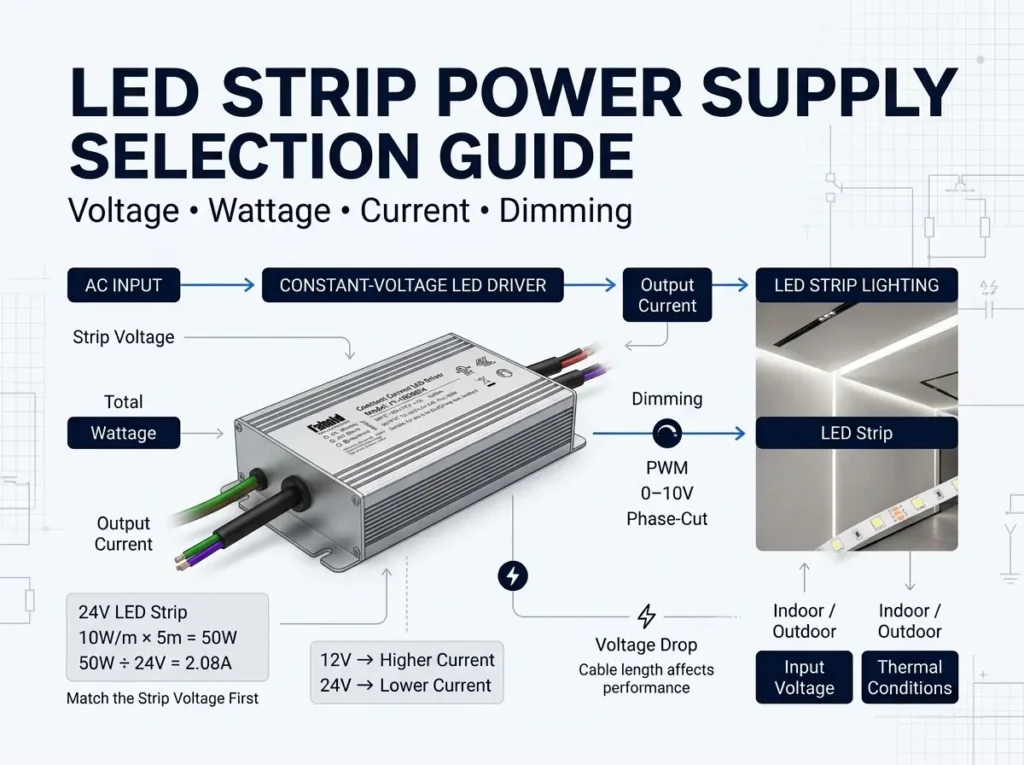
FAHOLD’s LED Strip Power Supply Selection Guide already covers the practical strip-sizing sequence and similarly cautions against turning a generic 20% recommendation into a universal rule.
P02-05 therefore focuses on how to interpret headroom, not on repeating the entire LED-strip selection article.
Headroom for Sign Lighting
For signage, the maximum load may come from many modules distributed across several branches.
Important conditions include:
- total module wattage;
- branch configuration;
- cabinet temperature;
- power-supply mounting location;
- available ventilation;
- service access;
- future sign modifications.
A sign cabinet is a good example of why thermal derating and optional design margin are separate decisions.
Do not calculate “20% extra” and then ignore the internal cabinet temperature.
Should You Leave More Headroom for 24/7 Operation?
Long operating hours can justify closer attention to thermal loading and reliability, but this article should not invent a fixed percentage such as:
“24/7 operation always requires 30% headroom.”
The defensible approach is:
- establish maximum continuous load;
- verify thermal conditions;
- review manufacturer lifetime/load/temperature data where available;
- apply project reliability targets;
- select a rating that satisfies those conditions.
MEAN WELL explicitly links LED power-supply lifetime to operating temperature and load level and recommends considering margin as part of selection: MEAN WELL — Load, Temperature and LED Power Supply Lifetime.
The actual percentage remains product- and project-specific.
What About Future Expansion?
Future load growth is a legitimate reason for additional capacity.
For example:
- current maximum load = 80W;
- planned future branch = 20W;
- future maximum load = 100W.
Do not call the 20W future capacity “headroom” if it is already assigned to a known future load.
It is better to calculate:
Future design load = current load + planned expansion
Then apply operating-condition and headroom decisions to the future design load.
This prevents a project from consuming its intended reliability margin during a later expansion.
Can Too Much Headroom Be Wasteful?
Yes.
A dramatically oversized power supply may create:
- unnecessary cost;
- larger physical dimensions;
- lower utilization;
- potentially different efficiency at the actual load point;
- control/load-range considerations on some products;
- more available fault energy in some distribution architectures.
Power-supply efficiency is not always flat across the load range.
For example, MEAN WELL’s HLG-150H datasheet publishes an efficiency-versus-load curve rather than one identical efficiency value at every load point: MEAN WELL HLG-150H Efficiency vs Load.
Do not conclude from that one product that all supplies share the same efficiency curve.The correct lesson is to check the selected product at the intended operating point.
A Better Alternative to the Universal “80% Rule”
Instead of writing:
“Always use only 80% of an LED power supply.”
Use a documented selection statement:
“The project maximum load is 96W. The selected power supply must provide at least 96W of usable output under the specified input, temperature, mounting and cooling conditions. Additional capacity should be retained where justified by manufacturer guidance and project reliability or expansion requirements.”
This is more precise because it separates:
- the electrical minimum;
- environmental derating;
- optional design margin.
Practical Headroom Decision Workflow
Step 1 — Confirm the LED load architecture
Verify constant voltage vs constant current.
Step 2 — Match the output voltage
Headroom cannot compensate for the wrong output voltage.
Step 3 — Calculate maximum simultaneous load
Use manufacturer load data.
Step 4 — Identify the operating environment
Record:
- ambient temperature;
- enclosure;
- cooling/airflow;
- mounting;
- AC input.
Step 5 — Read the exact power-supply derating curves
Determine usable capacity at the project condition.
Step 6 — Decide whether additional project margin is needed
Possible reasons include:
- reliability target;
- known future expansion;
- load tolerance/uncertainty;
- procurement standardization;
- continuous operating profile.
Step 7 — Select the nearest suitable standard rating
Do not automatically select the largest available supply.
Step 8 — Verify remaining specifications
Check:
- current capability;
- dimming/control;
- IP/environment;
- certification;
- dimensions;
- wiring;
- application-specific requirements.
Headroom Calculation Checklist
| Question | Required Answer |
|---|---|
| What is the maximum LED load? | W |
| What output voltage is required? | VDC |
| What current does the load require? | A |
| What is the candidate nominal rating? | W / A |
| Is temperature derating required? | Yes / No / Curve |
| Is input-voltage derating required? | Yes / No / Curve |
| What is usable capacity at the project condition? | W |
| Is additional reliability/expansion margin required? | Project-specific |
| What is the final selected standard rating? | Verified model/series |
| Are controls/environment/certifications compatible? | Verified |
Once these project conditions are known, contact FAHOLD for specification-based matching.
FAQ
How much headroom should an LED power supply have?
There is no single percentage that applies to every product and installation. Calculate maximum load, determine usable capacity after relevant derating, and then apply any additional project margin justified by manufacturer guidance and operating requirements.
Is 20% headroom required for LED power supplies?
Not as a universal rule. A 20% planning margin is a common rule of thumb, but it should not replace the exact power-supply loading and derating requirements.
Is adding 20% the same as running a supply at 80% load?
No. Adding 20% to a 100W load gives 120W. Making 100W equal to 80% of supply capacity requires 125W. The percentage bases are different.
Does derating count as headroom?
No. Derating reduces the supply’s permitted usable capacity under specified operating conditions. Headroom is the remaining intentional capacity above the maximum load after those limits are considered.
Should I oversize an LED power supply for high temperature?
A higher nominal rating may be required when the exact datasheet shows thermal derating, but the final selection must use the manufacturer’s derating curve rather than a generic oversizing percentage.
Does more headroom improve LED life?
Headroom by itself does not directly determine LED life. Power-supply load and temperature can affect power-supply thermal stress and lifetime, while LED lifetime depends on the LED load’s own thermal and electrical operating conditions.
Can I use a much larger power supply than the LED load?
Potentially, if the output voltage and every other specification are compatible, but excessive oversizing can add cost, size, and load-point considerations. See Can You Use a Higher-Wattage LED Power Supply? for that separate decision.
Need Help With Your LED Power Supply Project?
Tell us what you are working on. We will review your application and recommend the most relevant FAHOLD solution.