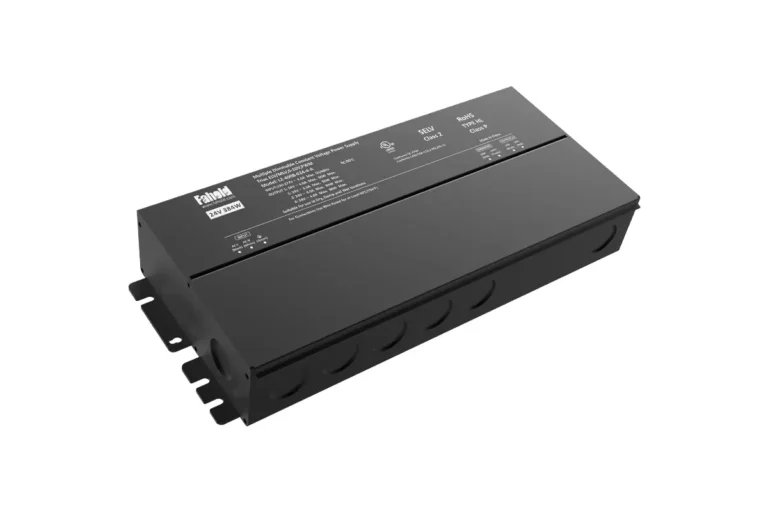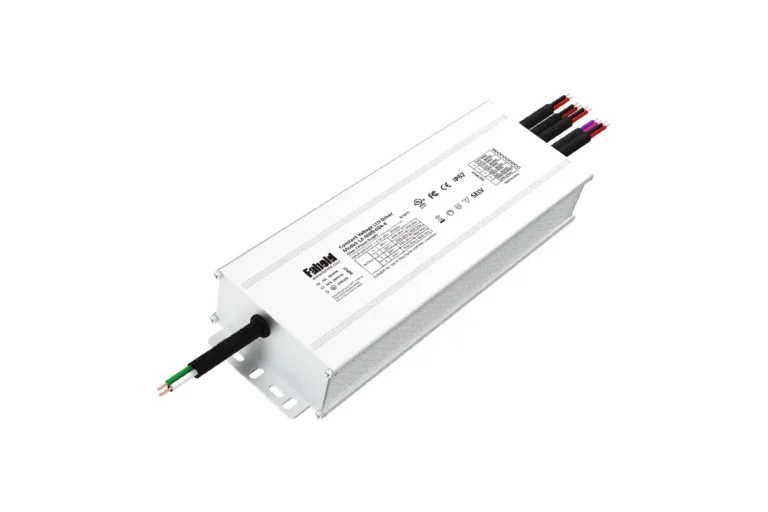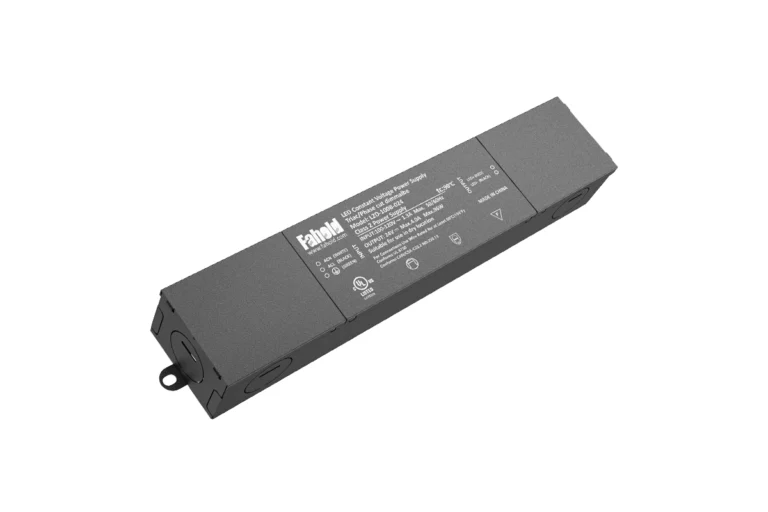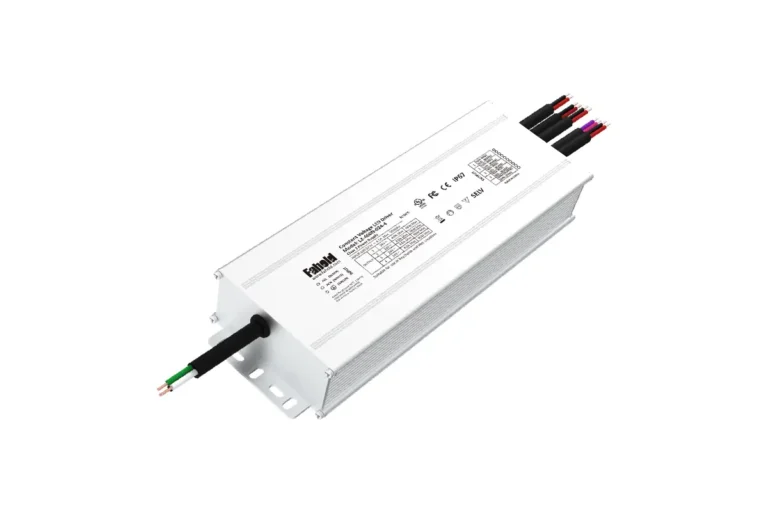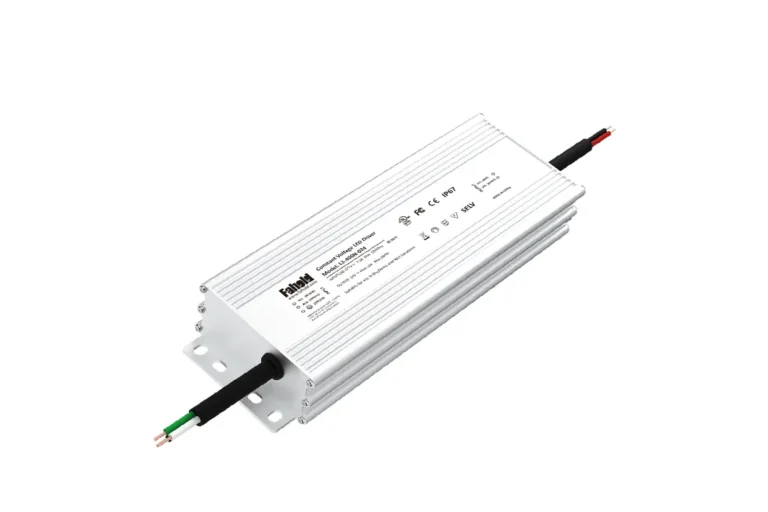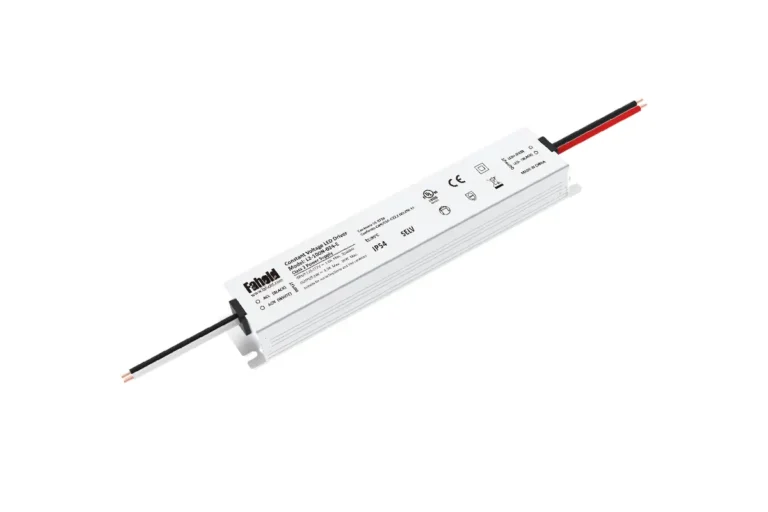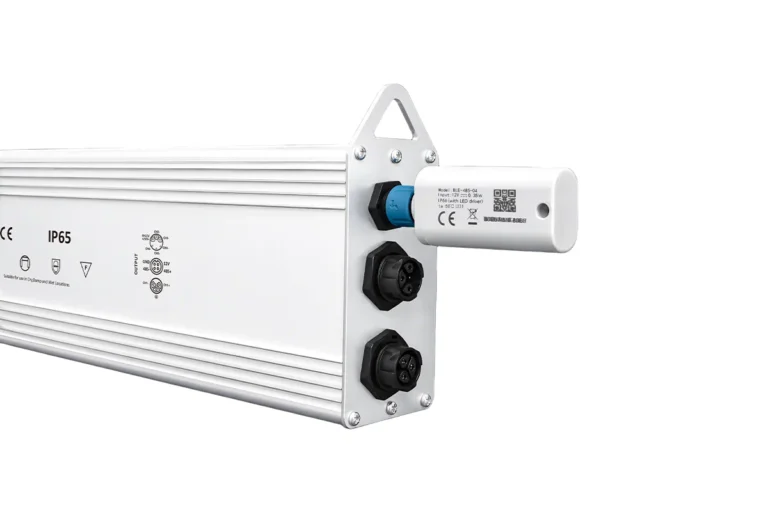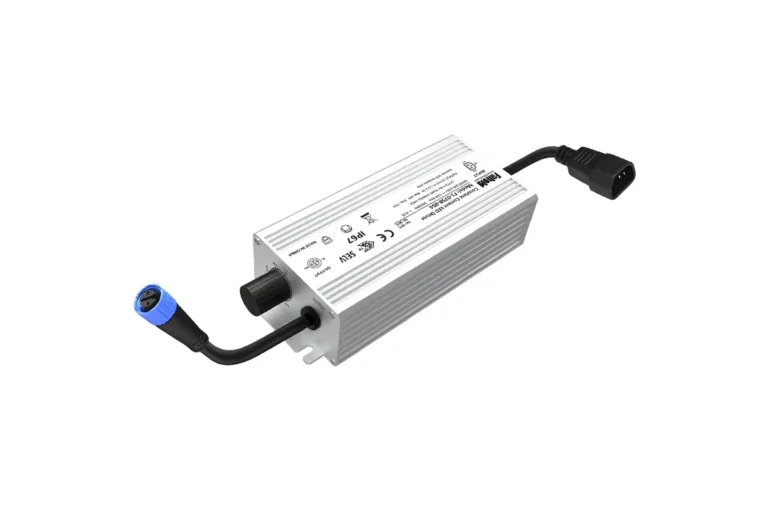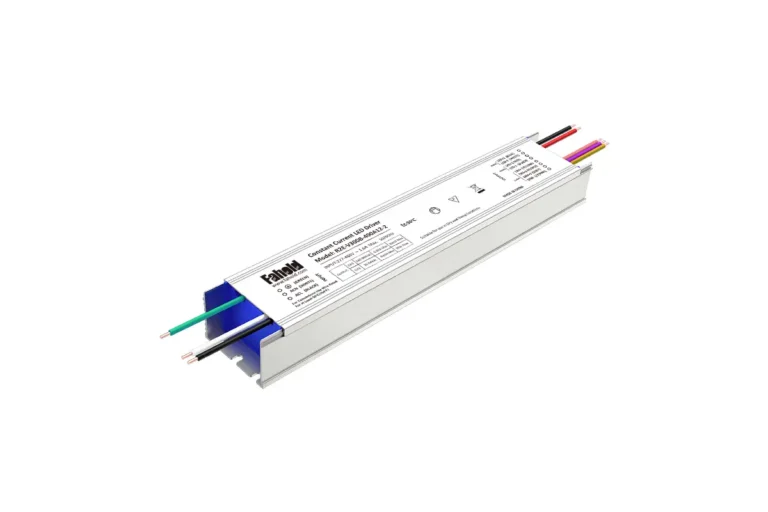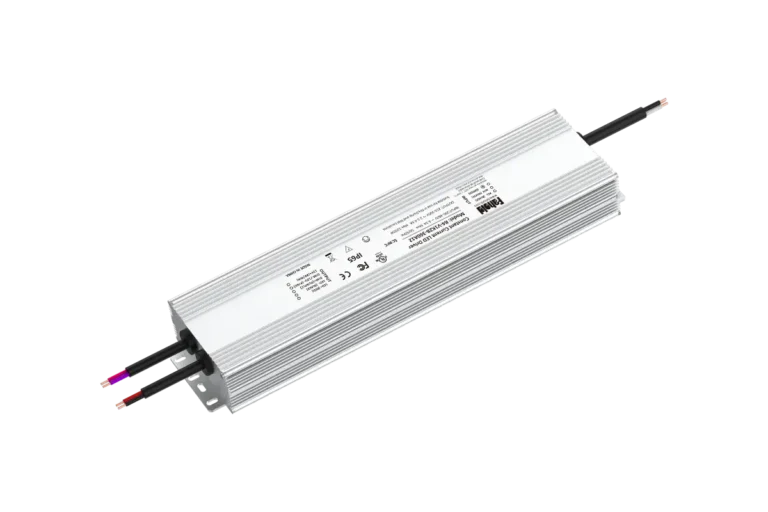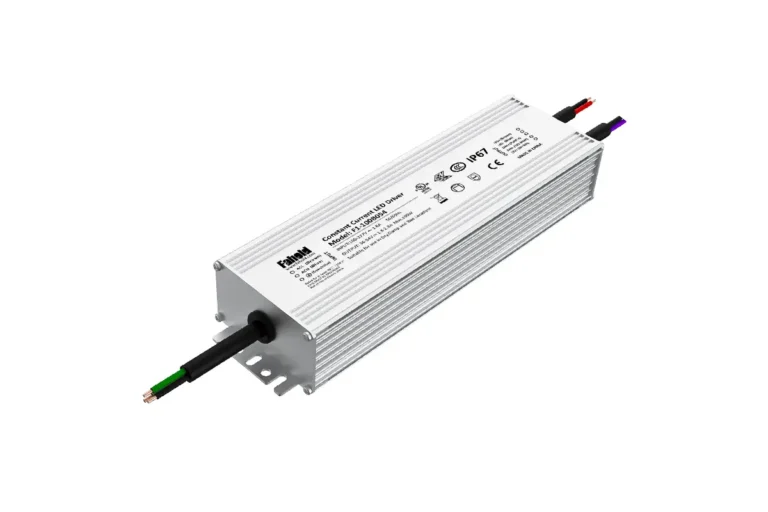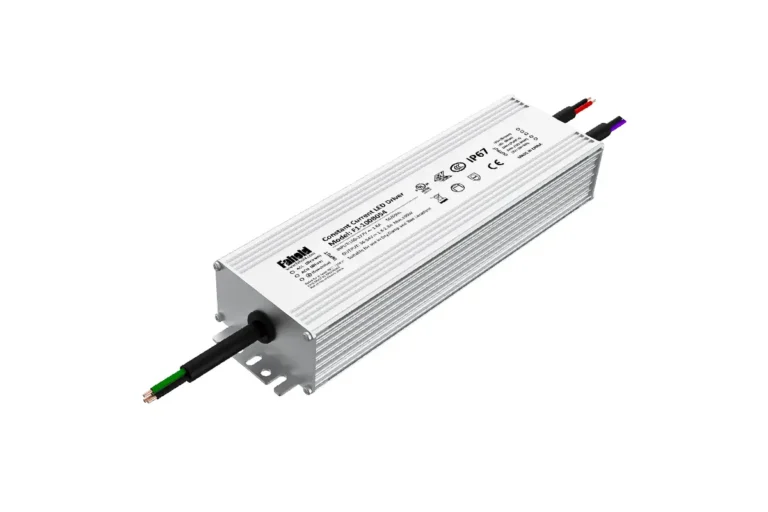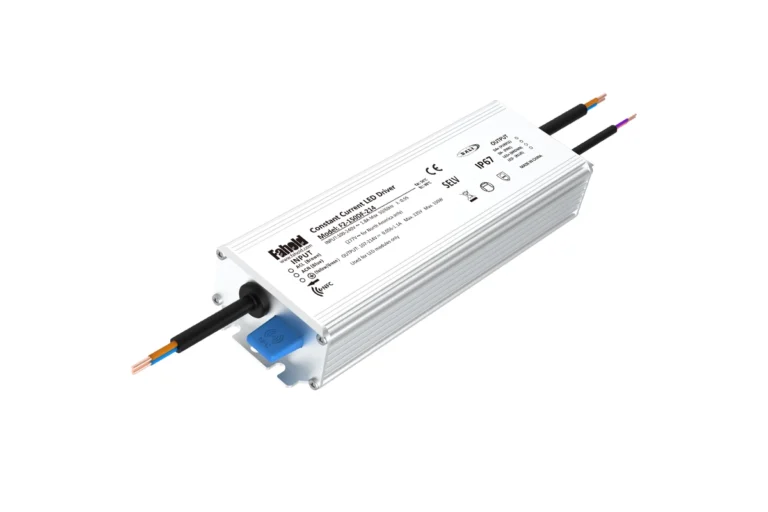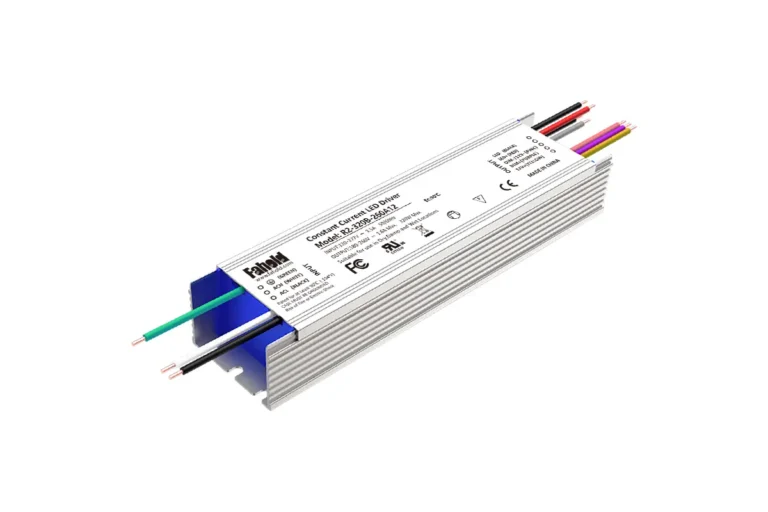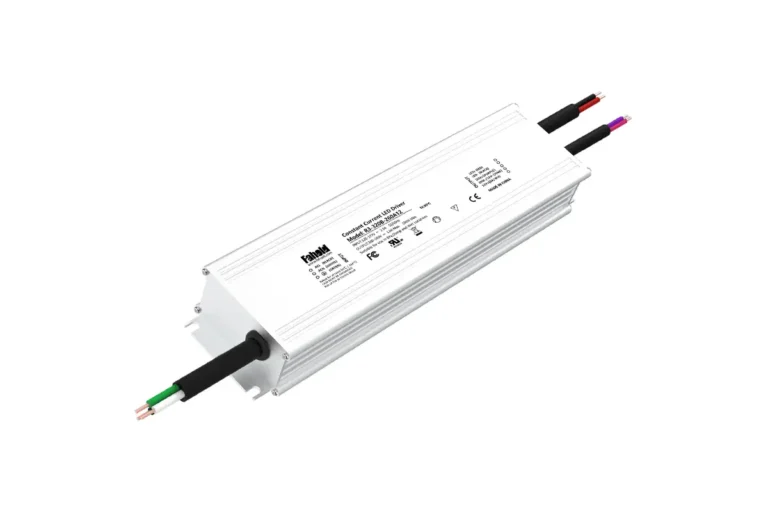
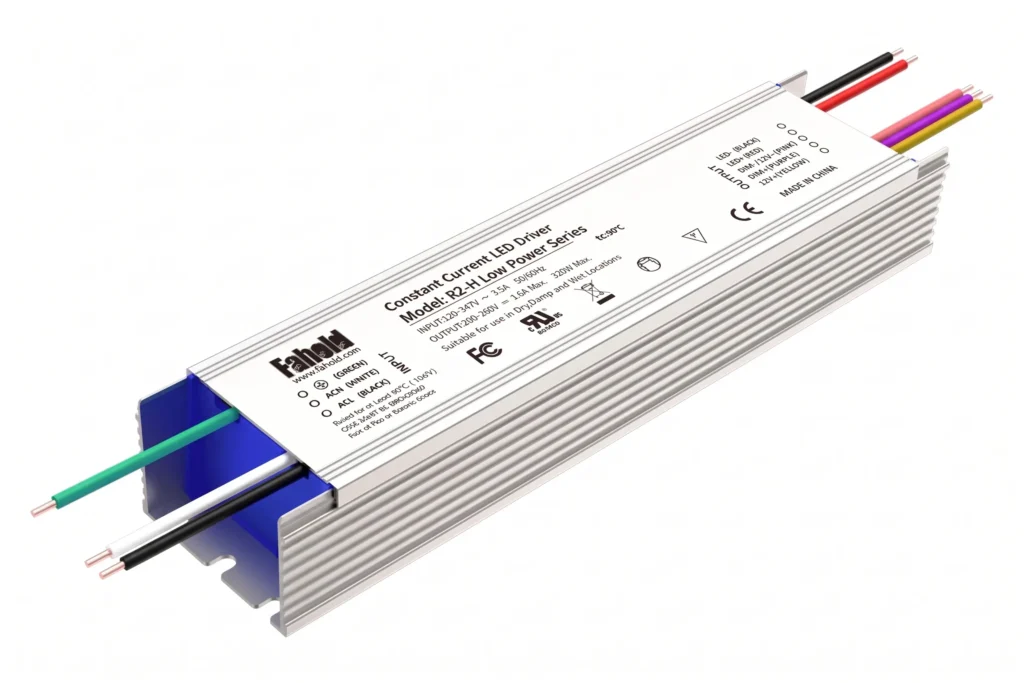
R2-060B-260Z-H 60W 180-260V Inter-Canopy Horticulture LED Driver
- Power60W
- Input120-277Vac
- Output Voltage180-260Vdc
FAHOLD non-isolated single-channel grow light drivers provide one regulated constant-current output for inter-canopy fixtures, LED bar lights, commercial indoor grow lights and high-power horticulture luminaires. The portfolio includes compact R2-H platforms for lower-power linear lighting and programmable R4 platforms for high-output commercial grow-light systems.
Current products cover approximately 60W to 1200W with rated-input options including 120–277Vac, 200–277Vac and 200–480Vac. R2-H uses a 180–260Vdc output platform for inter-canopy lighting, while R4 / R4E / R4-V use a 210–360Vdc high-voltage output architecture with offline programming and flexible dimming on compatible configurations.
Compare products below by application, AC input, wattage, LED voltage window, output current and control requirements. FAHOLD also supports electrical matching, programmable-output evaluation, datasheets, samples and OEM/ODM horticulture-lighting projects.
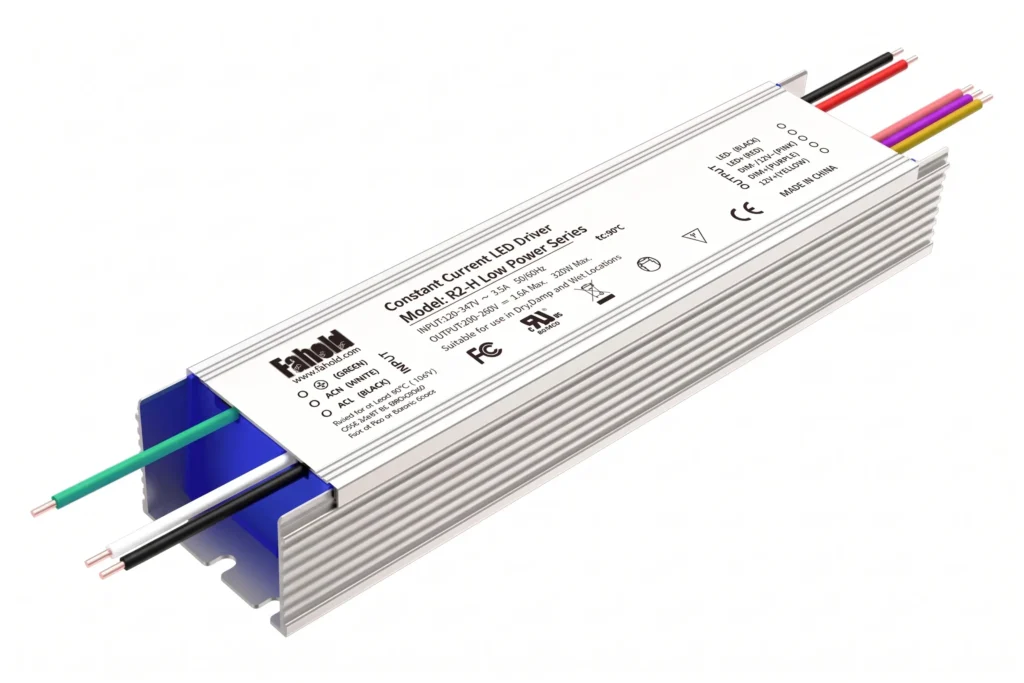
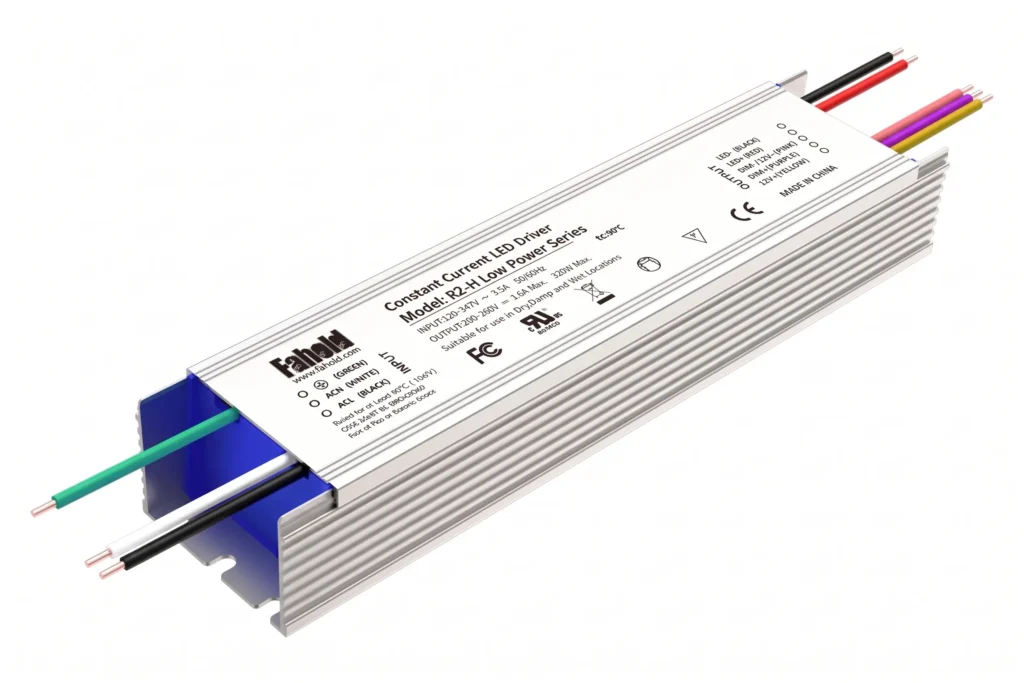
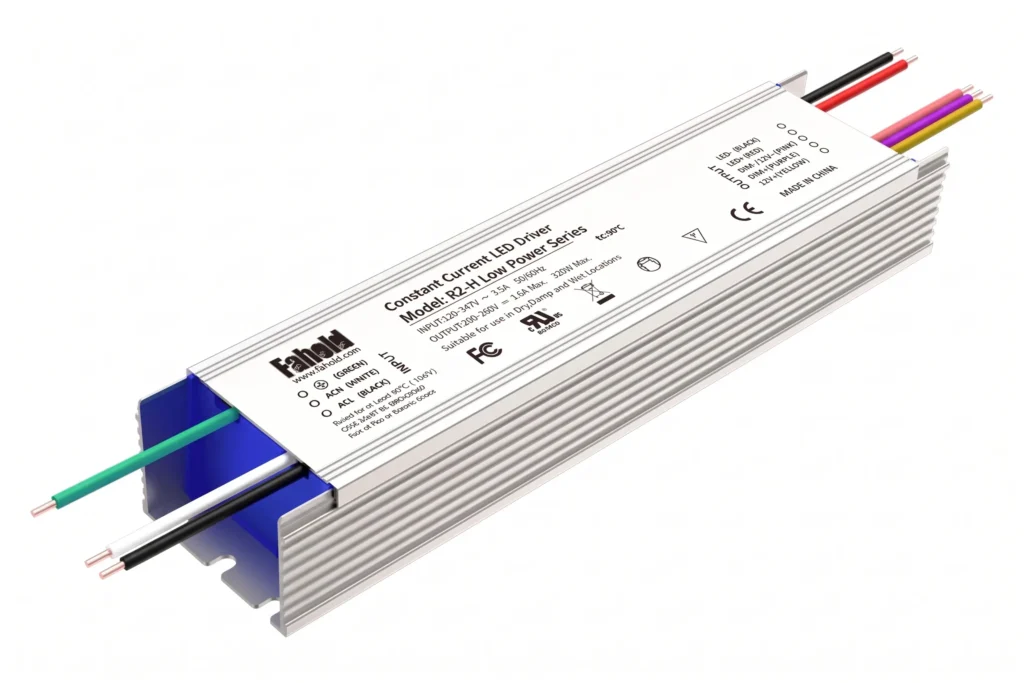
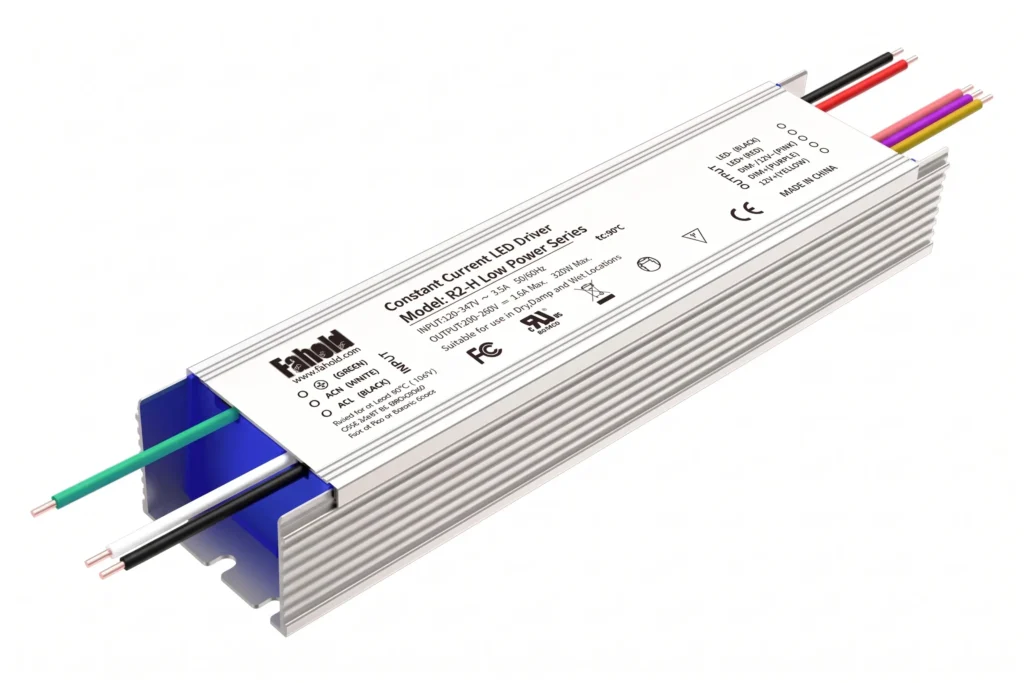
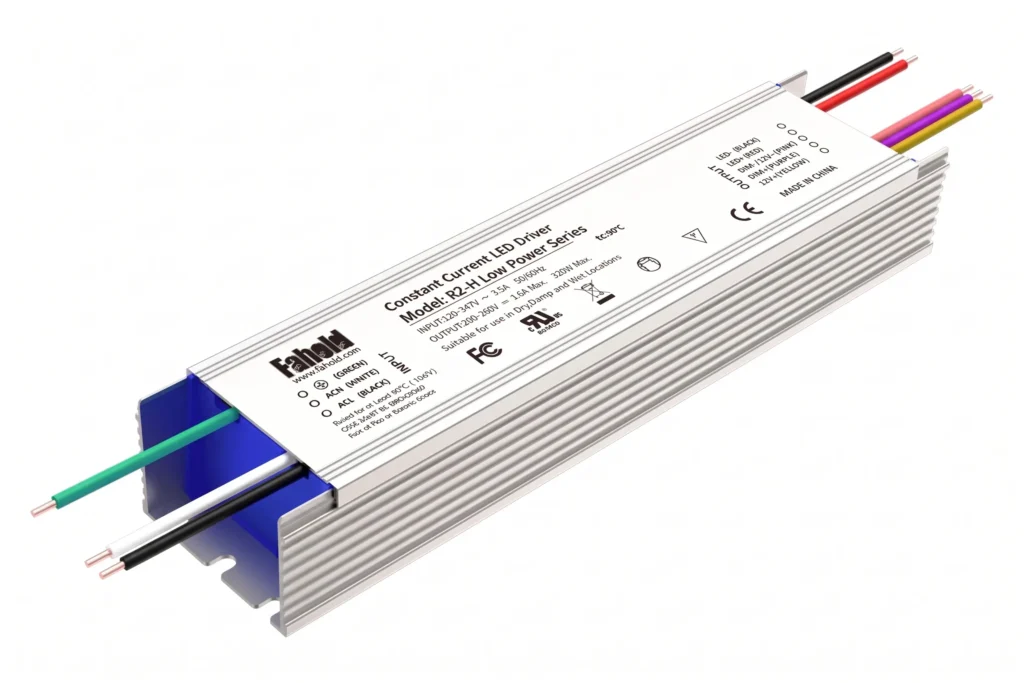
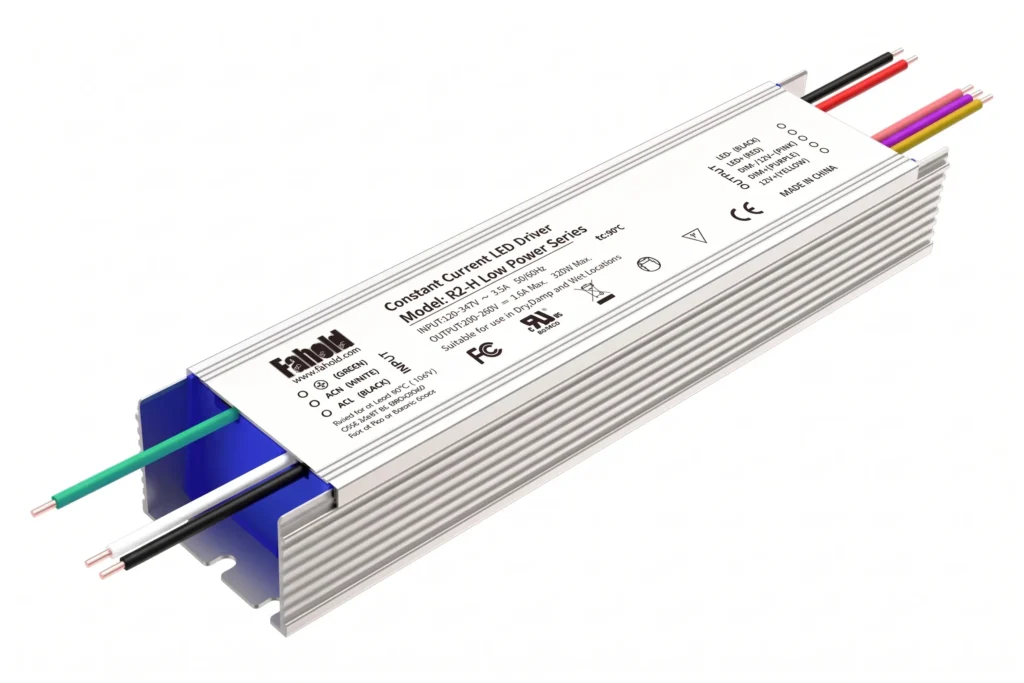
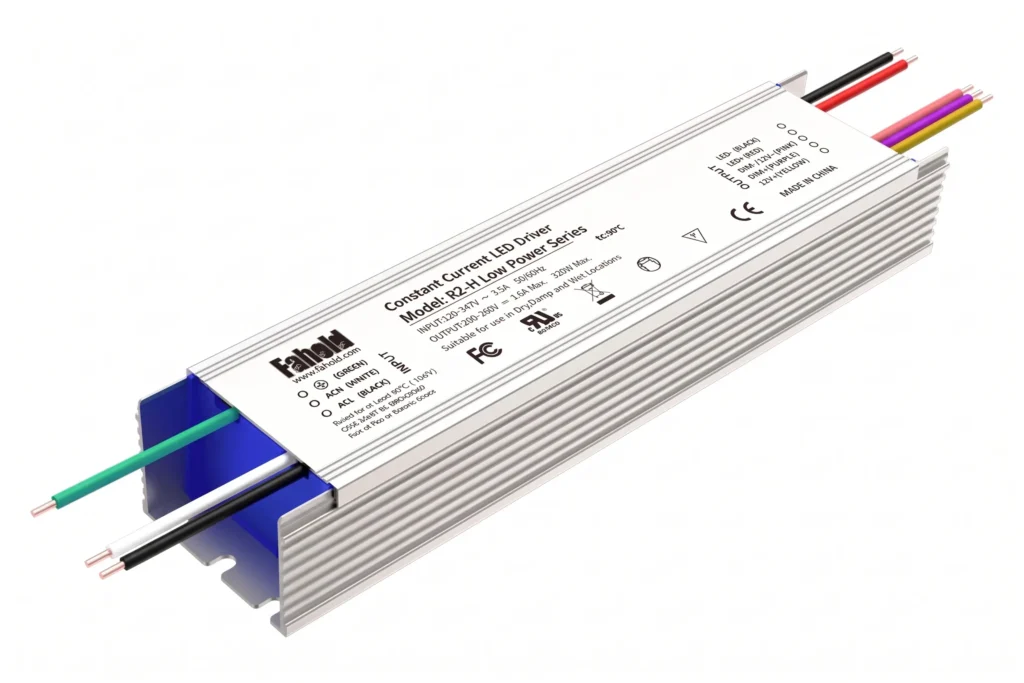
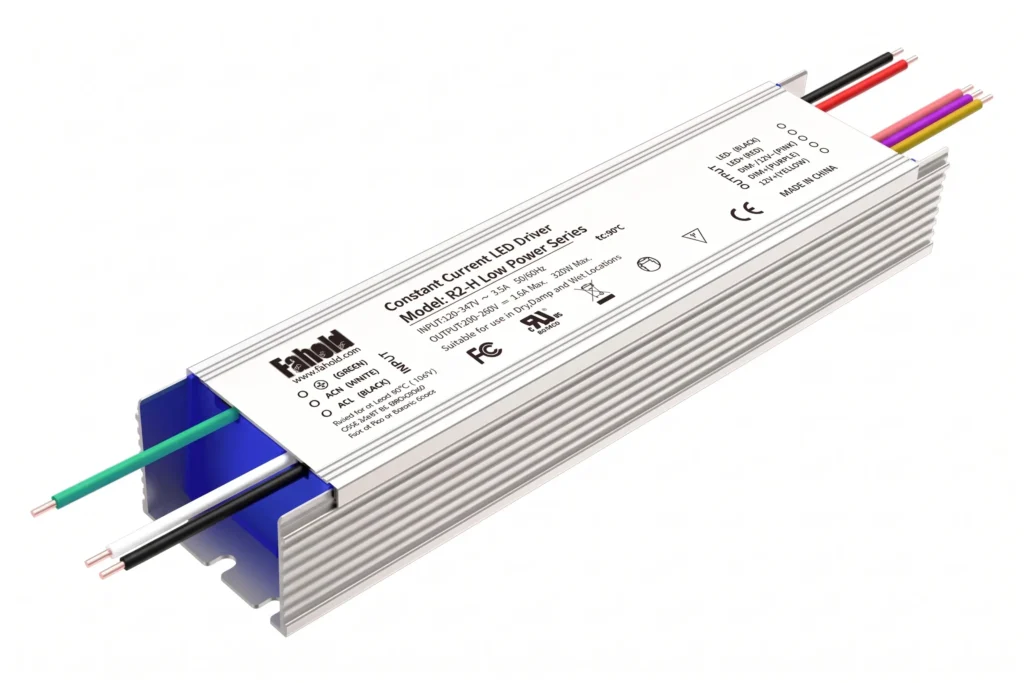
A non-isolated single-channel horticulture LED driver provides one regulated constant-current output without galvanic isolation between the AC input and LED output. This architecture can support compact mechanical integration, high power density and high conversion efficiency when the complete grow-light fixture is specifically engineered around a non-isolated power system.
FAHOLD non-isolated single-channel products cover two significantly different horticulture applications. R2-H addresses lower-power inter-canopy and linear grow-light fixtures, while R4 / R4E / R4-V address high-power commercial grow lights, LED bar fixtures and greenhouse luminaires.
Because these platforms use different LED voltage, wattage and control architectures, driver selection should begin with the actual fixture application and LED-board electrical requirements rather than wattage alone.
R2-H and R4 both belong to the non-isolated single-channel category, but they are designed for different fixture classes.
| Platform | Power Direction | Output Voltage | Primary Application |
|---|---|---|---|
| R2-H | 60W–320W | 180–260Vdc | Inter-canopy, linear and lower-power horticulture lighting |
| R4 / R4E / R4-V | 400W–1200W | 210–360Vdc | High-power LED bar lights, indoor grow lights and commercial horticulture fixtures |
Choose R2-H when the fixture requires a compact lower-power single-output driver for a high-voltage LED string. Choose R4 when higher fixture wattage, programmable output and broader professional control functions are required.
A single-channel driver is appropriate when the horticulture luminaire operates as one primary regulated LED load. The driver controls one electrical output rather than separately managing multiple LED sections.
| Architecture | Typical Fixture Design | Selection Direction |
|---|---|---|
| Single-Channel | One primary LED string or electrically combined LED load | Inter-canopy fixtures, LED bars and high-power grow lights using one regulated output |
| Multi-Channel | Two or more LED loads requiring separate power or control | Dual-channel supplemental, spectral or top-grow lighting systems |
Total fixture wattage does not determine channel count. A 1000W fixture may still use a single-channel driver if its LED architecture operates as one regulated electrical load.
For fixtures requiring separate LED outputs, compare
Non-Isolated Multi-Channel Grow Light Drivers
.
Inter-canopy lighting places LED fixtures inside or between the crop canopy rather than only above the plants. These fixtures typically require a narrow mechanical format and lower individual fixture power than large overhead top lights.
FAHOLD R2-H uses a non-isolated single-channel constant-current architecture with a 180–260Vdc LED output window. The high LED-string voltage allows a compact driver platform to supply compatible linear horticulture loads efficiently.
Current R2-H products are divided into two AC input groups: 120–277Vac for common commercial lighting infrastructure and 200–480Vac for facilities using higher-voltage electrical distribution.
The current 120–277Vac R2-H range includes six power classes: 60W, 100W, 150W, 200W, 240W and 320W. All current products use a 180–260Vdc output-voltage platform.
| Power Options | Rated Input | Output Platform | Typical Application |
|---|---|---|---|
| 60W–100W | 120–277Vac | 180–260Vdc | Compact inter-canopy and supplemental linear fixtures |
| 150W–200W | 120–277Vac | 180–260Vdc | Medium-power inter-lighting and under-canopy fixtures |
| 240W–320W | 120–277Vac | 180–260Vdc | Higher-output linear horticulture fixtures |
For model-level selection, compare
R2-H 120–277Vac Inter-Canopy LED Drivers
.
For commercial horticulture facilities using higher-voltage AC distribution, the R2-H high-voltage branch provides 200–480Vac input while retaining the same 180–260Vdc horticulture LED output architecture.
Current models include 60W, 120W, 150W and 200W power classes. This allows compact inter-canopy or linear grow-light fixtures to operate within compatible 277V, 347V and 480V-class facility infrastructure without requiring a high-power top-light driver.
Compare
R2-H 200–480Vac Inter-Canopy LED Drivers
for the high-voltage product group.
R4 is the high-power branch of the FAHOLD non-isolated single-channel horticulture portfolio. It is designed for commercial grow lights, LED bar fixtures and other high-output luminaires that use one high-voltage regulated LED load.
The family covers 400W to 1200W across three AC input platforms: R4 for 120–277Vac, R4E for 200–277Vac and R4-V for 200–480Vac. All current R4 platforms use a 210–360Vdc LED output-voltage window.
Unlike the simpler R2-H application direction, R4 also provides offline programmable output and flexible external control on compatible configurations, making it suitable for OEM grow-light product families with multiple current or wattage targets.
The standard R4 branch provides 120–277Vac input for commercial grow-light fixtures that require broad compatibility with common building and lighting supply voltages.
Current power classes include 400W, 600W, 800W and 1000W. All use the 210–360Vdc output platform, with full-power current increasing according to model wattage.
Browse
R4 120–277Vac Grow Light Drivers
for detailed model selection.
R4E is designed for commercial grow-light projects based specifically around 200–277Vac electrical infrastructure. Current products include 500W, 700W, 800W, 1000W and 1200W power classes.
The same 210–360Vdc output architecture allows fixture manufacturers to maintain a consistent high-voltage LED-string design while selecting the driver according to the required power and AC input platform.
Compare
R4E 200–277Vac High-Power Grow Light Drivers
.
R4-V extends the high-power R4 architecture to 200–480Vac input for compatible commercial and industrial horticulture facilities.
Current R4-V models include 400W, 600W, 800W, 1000W and 1200W power classes. This platform can support facilities using high-voltage distribution such as 347V and 480V-class systems while maintaining the R4 210–360Vdc output architecture.
Compare
R4-V 200–480Vac Grow Light Drivers
.
The LED output-voltage window is one of the clearest distinctions between R2-H and R4.
| Output Window | Platform | Typical Fixture Direction |
|---|---|---|
| 180–260Vdc | R2-H | Lower-power inter-canopy and linear horticulture LED strings |
| 210–360Vdc | R4 / R4E / R4-V | High-power commercial grow-light and LED bar architectures |
The correct driver cannot be selected from wattage alone. The minimum, nominal and maximum LED forward voltage must remain within the driver's supported output range at the intended operating current.
R4 supports offline programmable output. Supported electrical parameters can be configured within the permitted operating range of the selected driver to match different LED-board currents, fixture wattages or product variants.
This can help grow-light manufacturers reduce the number of unique driver platforms used across an OEM product family. Several luminaire SKUs can potentially share the same driver direction while using different programmed output settings within the approved electrical limits.
Programming requirements should be defined during fixture development so production settings, electrical specifications and finished-product labels remain consistent.
Compatible R4 Type B configurations support 3-in-1 dimming using 0–10V, PWM and resistor-based control. These interfaces allow commercial grow-light output to respond to cultivation stage, daylight strategy, facility scheduling and centralized control systems.
| Control Method | Typical Application | What to Confirm |
|---|---|---|
| 0–10V | Commercial greenhouse and grow-light controllers | Signal range, wiring and controller compatibility |
| PWM | Fixture controllers and horticulture automation | Signal level, frequency and driver compatibility |
| Resistor / Rx | External resistance-based output adjustment | Supported resistance range and control-interface requirements |
Control functions vary by driver family and configuration. Do not assume every non-isolated single-channel product on this page uses the same dimming interface.
Compatible R4 dimmable configurations support Dim-to-Off and soft-start functions. Dim-to-Off allows the LED output to shut down fully at the lower control threshold, while soft-start supports controlled turn-on behavior.
A true off state can be particularly relevant to controlled-environment agriculture when lighting schedules require complete darkness rather than residual LED glow.
Selected R4 configurations support additional fixture-integration options such as an RJ12 interface with knob dimming or a 12V auxiliary-power output.
These functions are configuration-dependent and should be specified during product selection. They should not be assumed to be standard on every R4, R4E or R4-V model.
High conversion efficiency is particularly important in horticulture lighting because fixtures can operate for long daily cycles. Electrical losses increase energy consumption and become heat that must be managed by the fixture and facility.
Selected R4 1000W and 1200W models reach approximately 97% typical efficiency, while other current R4 products are typically listed around 96% to 96.5% depending on model.
Actual efficiency depends on input voltage, LED operating point, current and thermal conditions. Efficiency should therefore be evaluated together with output compatibility, power factor, control functions and fixture heat management.
Current R4, R4E and R4-V products use an IP65 enclosure platform for professional horticulture and high-power lighting applications.
The driver IP rating applies to the driver enclosure itself. Connectors, cables, seals, fixture housing, mounting orientation and the complete luminaire must also be designed for the environmental conditions of the grow facility.
One of the key characteristics of R4 is its slim linear enclosure. This allows several hundred watts to more than one kilowatt of driver power to be integrated into grow-light or LED bar fixtures where internal mechanical space is limited.
This high-power-density architecture is particularly relevant to commercial horticulture luminaire manufacturers developing long, narrow or modular fixture structures.
| Fixture Requirement | Recommended Direction |
|---|---|
| 60W–320W Inter-Canopy / Linear Grow Light | R2-H |
| 400W–1000W Grow Light Using 120–277Vac | R4 |
| 500W–1200W Grow Light Using 200–277Vac | R4E |
| 400W–1200W High-Voltage Grow Light Using 200–480Vac | R4-V |
For the complete non-isolated horticulture portfolio, return to
Non-Isolated Horticulture LED Drivers
.
For fixture architectures requiring separate outputs, compare
Non-Isolated Multi-Channel Grow Light Drivers
.
For complete R4 dimensions, configuration codes, efficiency data and control options, review the
R4 High-Power Non-Isolated Grow Light LED Driver Series
.
Horticulture fixture manufacturers often require more than a standard wattage. LED forward-voltage range, output current, AC input, programmable settings, dimming protocol, connector requirements, cable lengths, enclosure integration and target certification can all affect the final driver configuration.
FAHOLD supports R2-H and R4-family project matching, technical datasheets, samples, programming evaluation and OEM/ODM grow-light development. Providing the facility input voltage, LED voltage window, required current, maximum fixture wattage, control method, environmental requirements and certification target allows the appropriate platform to be identified more efficiently.
A non-isolated single-channel grow light driver provides one regulated constant-current LED output without galvanic isolation between the AC input and LED output. It is suitable for horticulture fixtures specifically engineered around a single high-voltage LED load and a complete non-isolated safety architecture.
A single-channel driver powers one primary regulated LED load. A multi-channel driver provides separate outputs for two or more LED loads or fixture sections. Channel architecture should be selected from the actual electrical design of the grow-light fixture rather than total wattage alone.
The current FAHOLD range covers approximately 60W to 1200W. R2-H serves 60W–320W inter-canopy and linear horticulture fixtures, while R4 / R4E / R4-V cover high-power grow-light applications from 400W to 1200W.
R2-H is designed for inter-canopy and linear horticulture lighting. Current products use a 180–260Vdc single-output platform, with 120–277Vac models from 60W to 320W and 200–480Vac models from 60W to 200W.
The R4 family is designed for high-power non-isolated single-channel grow-light fixtures. Current R4 platforms cover 400W to 1200W with 120–277Vac, 200–277Vac and 200–480Vac input options and a 210–360Vdc output-voltage range.
Yes. Compatible R4 configurations support offline programmable output. Supported parameters can be configured within the electrical operating limits of the selected driver to match different LED-board currents, fixture wattages and OEM product variants.
Yes. Compatible R4 Type B configurations support 0–10V, PWM and resistor-based 3-in-1 dimming together with Dim-to-Off. Non-dimming configurations are also available, so the required control type should be specified during model selection.
Current FAHOLD platforms include 120–277Vac, 200–277Vac and 200–480Vac rated-input options depending on series. Select the driver according to the actual electrical distribution used by the grow-light fixture or cultivation facility.
The 180–260Vdc platform is used by R2-H for lower-power inter-canopy and linear horticulture fixtures. The 210–360Vdc platform is used by R4 / R4E / R4-V for higher-power commercial grow lights. The correct output range must match the complete forward-voltage window of the LED load.
Provide the facility AC input, minimum and maximum LED forward voltage, required output current, maximum fixture wattage, dimming method, programming requirement, environmental conditions and target certification. These parameters help determine whether an R2-H, R4, R4E or R4-V platform is appropriate.