Table of Contents
LED power supply voltage drop is the reduction in voltage between the power supply output and the LED load because current flows through resistance in wire, connectors, terminals, PCB traces and other parts of the distribution path.
In a constant-voltage system, this creates an important distinction:
A power supply can be correctly selected and operating normally while a remote LED load still receives less voltage than expected.
That is why voltage drop should be treated as a system-distribution problem, not automatically as a power-supply wattage problem.
The basic relationship is:
Vdrop = I × R
where:
- Vdrop = voltage lost in the current path;
- I = current through the path;
- R = total electrical resistance of that path.
For the complete constant-voltage architecture, start with the Constant Voltage LED Power Supply Guide. If several loads share the same source, also read Can Multiple LED Loads Share One Power Supply?.
Quick Answer: What Causes LED Power Supply Voltage Drop?
Three variables explain most practical voltage-drop problems:
- Current — more current produces more voltage drop through the same resistance.
- Distance — longer conductors have more resistance.
- Conductor resistance — smaller conductors, high-resistance connections and long LED-strip copper traces increase the total path resistance.
Southwire’s professional voltage-drop calculator uses circuit current, conductor size, cable-run length, voltage and installation conditions to calculate voltage drop or minimum conductor size: Southwire Re³ Voltage Drop Calculator.
The same engineering logic applies to low-voltage LED distribution.
Why Voltage Can Be Lower at the LED Load
Real conductors are not ideal.
A 24V power supply may measure close to its rated output directly at the output terminals, while a distant LED branch measures a lower voltage.
For example:
- power-supply terminals: 24.0V;
- remote branch under load: 22.9V.
That difference does not prove the supply itself is defective.
Possible causes include:
- long DC wire runs;
- undersized conductors;
- high branch current;
- loose or high-resistance terminals;
- connector losses;
- LED-strip copper-trace resistance.
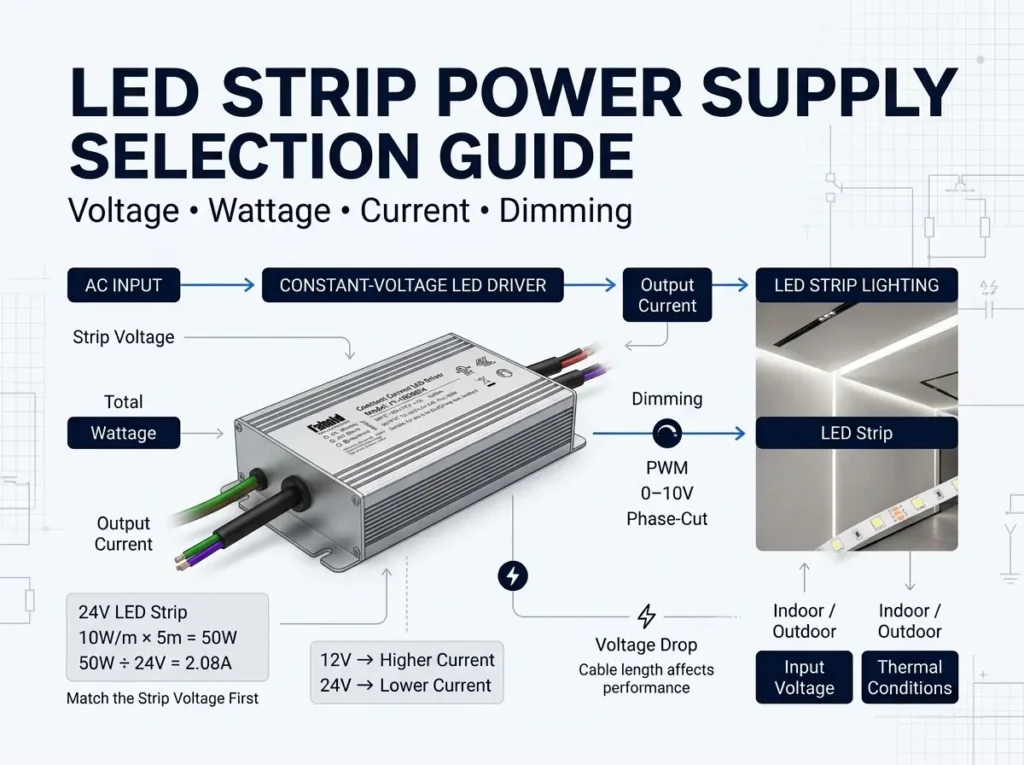
FAHOLD’s existing LED Strip Power Supply Selection Guide already introduces these strip-specific factors. This article goes deeper into the engineering relationship among current, resistance, distance and distribution topology rather than repeating the general strip-selection workflow.
The Three Core Variables: Current, Length and Conductor Size
1. Current
From Ohm’s law:
Vdrop = I × R
If resistance remains constant and current doubles, voltage drop doubles.
2. Wire length
Longer conductors have more resistance.
A practical calculation must account for the complete relevant current path rather than looking only at the visible one-way distance.
3. Conductor size
For the same conductor material and length, a larger cross-sectional area generally produces lower resistance.
In North American projects, wire size is commonly specified in AWG.
Do not choose AWG from a generic LED-strip chart alone. Final conductor selection should consider current, length, allowable voltage drop, conductor ampacity, installation method, ambient temperature and applicable electrical requirements.
Southwire’s calculator explicitly evaluates both voltage-drop and NEC ampacity constraints for AWG/KCMIL conductors: Southwire Voltage Drop and Wire Sizing Tool.
Worked Example 1: 24V, 120W Constant-Voltage Load
Assumptions
- power-supply output: 24VDC;
- connected load: 120W;
- total relevant circuit resistance: 0.20Ω;
- load is operating at the stated 120W design condition.
Step 1 — Calculate current
I = P ÷ V
120W ÷ 24V = 5A
Step 2 — Calculate voltage drop
Vdrop = I × R
5A × 0.20Ω = 1.0V
Step 3 — Estimate voltage at the load
24V − 1V = 23V
Step 4 — Convert to percentage
1V ÷ 24V × 100 ≈ 4.17%
This is an illustrative calculation, not FAHOLD test data. A real installation requires actual conductor resistance, route length, connection losses and LED-load behavior.
Worked Example 2: Why Higher System Voltage Reduces Current
Consider a 240W load designed in three hypothetical system voltages.
| System voltage | Load current |
|---|---|
| 12V | 20A |
| 24V | 10A |
| 48V | 5A |
Now assume the same hypothetical 0.10Ω total circuit resistance in all three examples.
| System | Current | Vdrop | Drop as % of nominal voltage |
|---|---|---|---|
| 12V | 20A | 2.0V | 16.67% |
| 24V | 10A | 1.0V | 4.17% |
| 48V | 5A | 0.5V | 1.04% |
This does not mean a 24V LED load can be connected to a 48V power supply. It shows why a complete system designed for higher voltage can distribute the same power at lower current.
Voltage Drop Also Creates Conductor Power Loss
Ploss = I² × R
Using the 24V and 48V cases above with 0.10Ω resistance:
- 24V system: 10² × 0.10 = 10W
- 48V system: 5² × 0.10 = 2.5W
Under the stated assumptions, halving the current reduces resistive conductor loss to one quarter.
This describes conductor loss only, not total system efficiency.
What Does Excessive Voltage Drop Look Like?
Depending on the LED product, excessive voltage drop may contribute to:
- reduced brightness at remote loads;
- brightness differences between branches;
- color variation;
- unstable or inconsistent operation.
For strip-specific applications, see LED Strip Lighting.
For signage, see Sign Lighting.
Why a Higher-Wattage Power Supply Usually Does Not Fix Voltage Drop
If a 24V supply already maintains 24V at its output terminals, replacing it with a higher-wattage 24V unit does not automatically change cable length, conductor resistance, terminal resistance or LED-strip trace resistance.
This separates two different problems:
| Problem | Primary issue |
|---|---|
| Supply cannot support total load | Power-supply capacity |
| Supply output is correct but remote voltage is low | Distribution voltage drop |
| One branch is dimmer than another | Branch wiring / load / connection differences |
| All branches collapse under load | Source capacity, input, protection or shared distribution |
For capacity questions, see How Much Power-Supply Capacity Should You Leave for LED Loads?.
How to Reduce Voltage Drop
Use a lower-resistance conductor
An appropriately larger conductor reduces resistance and therefore reduces voltage drop for the same current and length.
Shorten the low-voltage cable run
Moving the power supply closer to the LED load can reduce conductor length.
Split a large load into parallel branches
Parallel branch design can distribute current more effectively when each branch is sized correctly.
See Can Multiple LED Loads Share One Power Supply?.
Use manufacturer-approved power injection
Long LED-strip installations may use additional feed points, center feeding or dual-end feeding when the strip manufacturer permits those methods.
Do not publish a universal injection interval.
Select system voltage early in the design
When the complete project is still being designed, a higher system voltage may reduce current for the same load power.
This is a system-architecture decision, not a field workaround for an already-specified lower-voltage load.
Power Injection vs Adding Another Power Supply
Power injection uses additional feed points to shorten the effective high-current path.
Another power supply creates another source/zone.
Do not electrically tie separate supply outputs together unless the exact products explicitly support parallel operation and the manufacturer provides the method.
Voltage Drop in LED Strip Lighting
For LED strip projects, evaluate:
- external wiring from supply/controller to strip;
- internal copper path along the strip itself.
A large feeder conductor cannot remove resistance inside an excessively long strip run.
For practical strip selection, use How to Choose the Right Power Supply for LED Strip Lights.
Voltage Drop in Sign Lighting
A useful field diagnostic is to measure voltage under load:
- at the power-supply output;
- at the beginning of each major branch;
- at the remote end of the affected branch.
This helps separate source regulation from distribution loss.
UL Solutions discusses UL 2108 as the Standard for Low Voltage Lighting Systems in relevant North American applications: UL Solutions — UL 2108 Low-Voltage Lighting Systems.
Do Not Turn a Design Target Into a Universal Code Rule
A preferred maximum voltage-drop percentage is often used as a design target, but one percentage should not be presented as universally required for every LED circuit.
The applicable design depends on circuit type, installation, project specification, applicable code, listed equipment instructions and LED manufacturer requirements.
Once these are defined, send the project requirements to FAHOLD for specification-based matching.
Field Troubleshooting Workflow
- Measure supply output under load.
- Measure the remote load voltage.
- Check current.
- Inspect terminals, splices and connectors.
- Compare affected and unaffected branches.
- Recalculate conductor size and run length.
- Check product-specific run/feed instructions.
Engineering Checklist
| Question | Why it matters |
|---|---|
| What voltage does the load require? | Confirms CV compatibility |
| What is maximum current? | Current directly affects Vdrop |
| What is the full current-path length? | Length affects resistance |
| What conductor size/material is used? | Determines resistance |
| Are connectors/splices present? | Adds possible resistance |
| Does one trunk carry several branches? | Changes upstream current |
| What are manufacturer feed limits? | Accounts for load-internal resistance |
| What voltage reaches the remote load? | Verifies real performance |
FAQ
What causes LED power supply voltage drop?
Current flowing through resistance in wire, connectors and LED-load conductors causes voltage loss.
Does a larger LED power supply reduce voltage drop?
Not automatically. Extra wattage does not remove downstream resistance.
Does thicker wire reduce voltage drop?
Generally yes, because a larger conductor normally has lower resistance for the same material and length.
Why is 24V better than 12V for long runs?
At equal power, 24V uses half the current of 12V, reducing resistive voltage drop in the same path.
Can I increase the output voltage to compensate for drop?
Do not exceed the LED load’s permitted input range. Correct the distribution design instead.
Does power injection reduce voltage drop?
It can when the product and wiring architecture permit it. Follow the LED manufacturer’s feed instructions.
Need Help With Your LED Power Supply Project?
Tell us what you are working on. We will review your application and recommend the most relevant FAHOLD solution.