Table of Contents
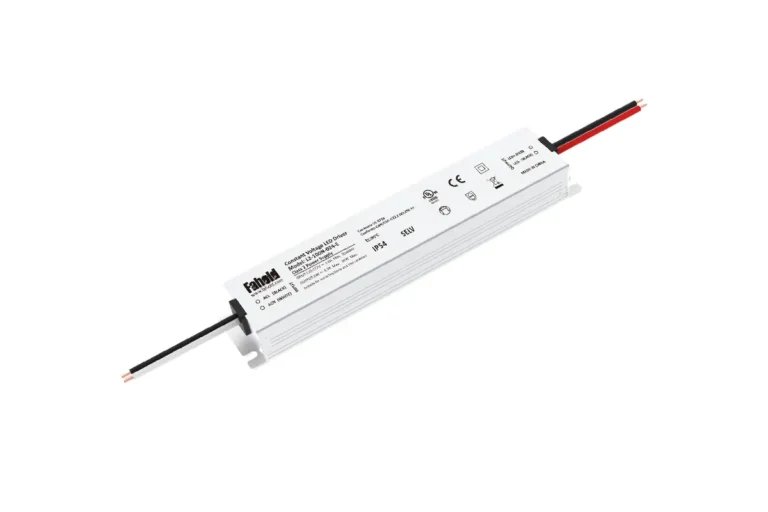
A constant voltage LED power supply maintains a specified DC output voltage while the connected compatible load draws the current it requires within the supply’s rated operating capacity.
This architecture is widely used for low-voltage LED systems such as conventional LED strips, signage modules designed for fixed-voltage input, linear lighting and other loads explicitly designed for regulated 12V, 24V or 48V DC.
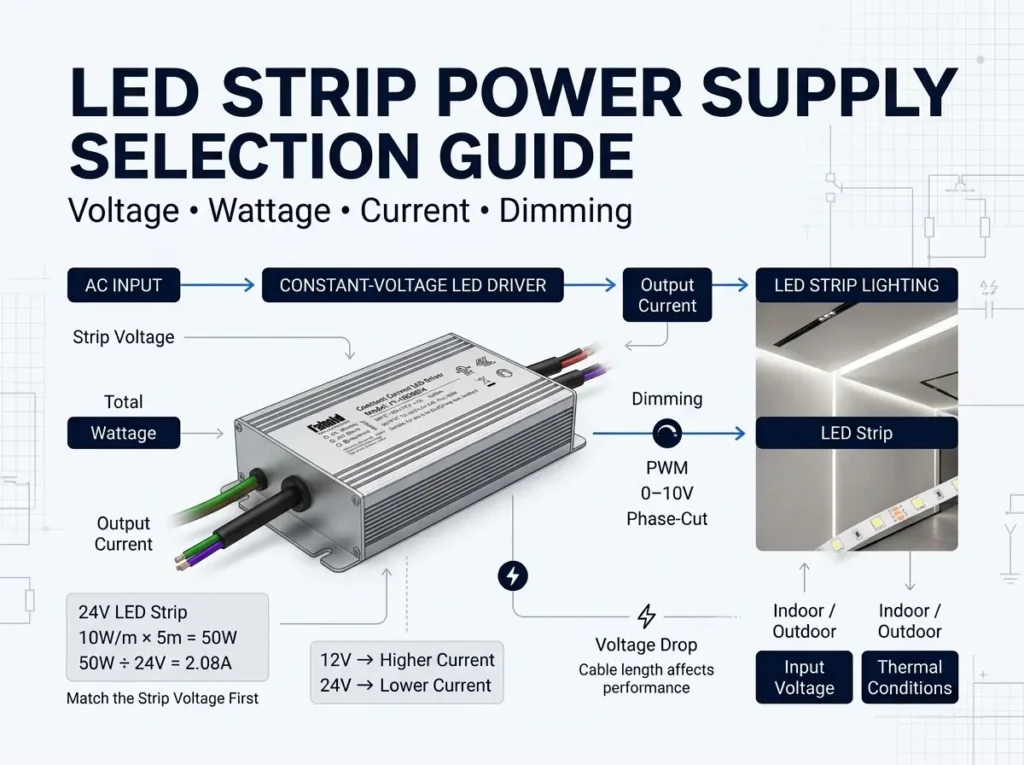
The core selection sequence is:
- Confirm that the load requires constant voltage.
- Match the DC output voltage.
- Calculate maximum connected wattage.
- Calculate load current.
- Verify usable capacity and derating.
- Confirm AC input.
- Check dimming/control.
- Check environment, certification and dimensions.
For the broader terminology framework, start with the LED Power Supply Guide.
What Is a Constant Voltage LED Power Supply?
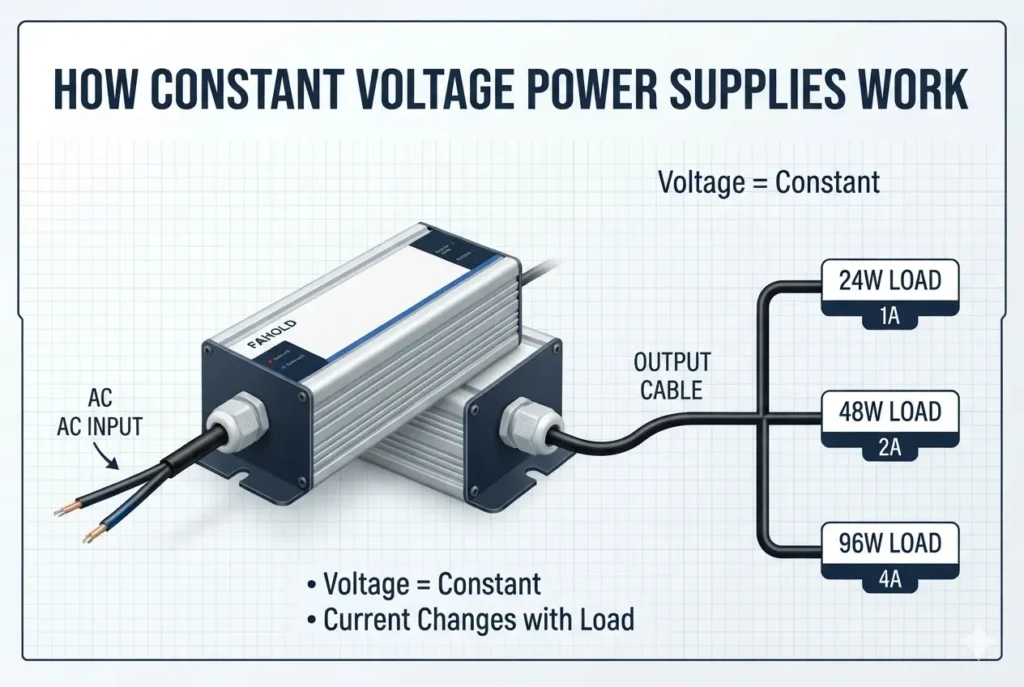
A CV supply regulates its output around a specified voltage.
For example, a 24V supply maintains its specified 24V output while load current varies within its operating range.
MEAN WELL describes the same principle: constant output voltage with current varying according to load condition. See MEAN WELL — Constant Voltage and Constant Current LED Power Supply.
A definition-focused child article is planned at What Is a Constant Voltage LED Power Supply?.
Constant Voltage vs Constant Current
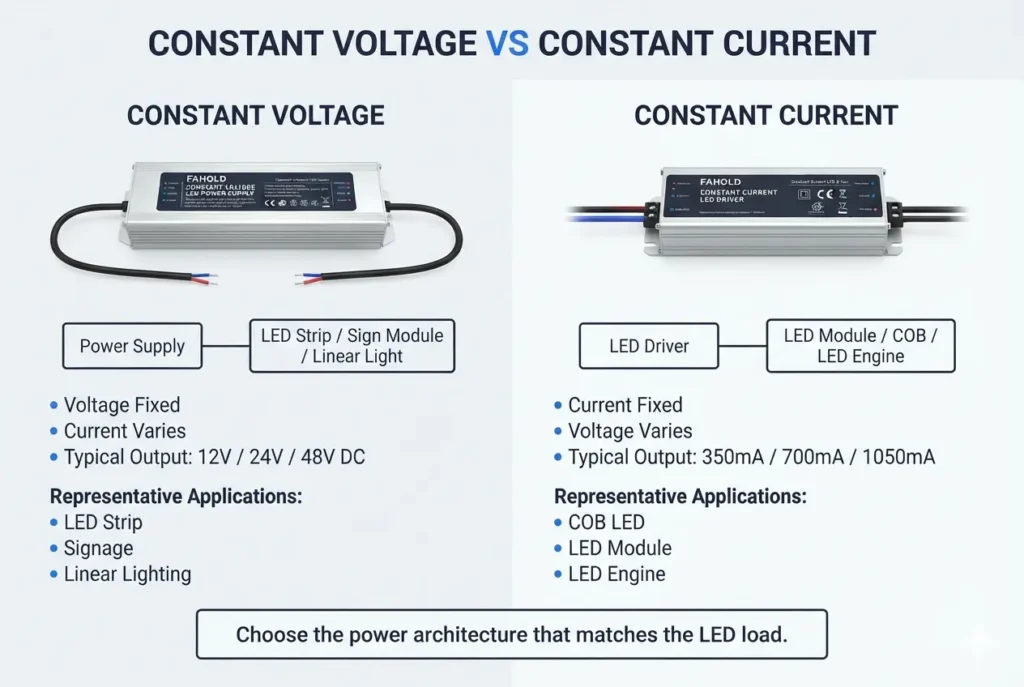
| Factor | Constant Voltage | Constant Current |
|---|---|---|
| Regulated quantity | Voltage | Current |
| Typical specification | 12V / 24V / 48V | Specified mA/A + voltage window |
| Load current | Varies with compatible load | Regulated by driver |
| Common use | Fixed-voltage strips/signage | LED engines/modules designed for CC |
| Main matching requirement | Voltage + capacity | Current + voltage range |
Do not choose CV or CC from wattage alone. The LED load determines the required drive architecture.
IEC 61347-2-13:2024 is the current IEC safety standard for electronic controlgear for LED light sources: IEC 61347-2-13:2024.
Why LED Strips Commonly Use Constant Voltage
Many conventional low-voltage strips are designed for fixed DC input.
A typical architecture is:
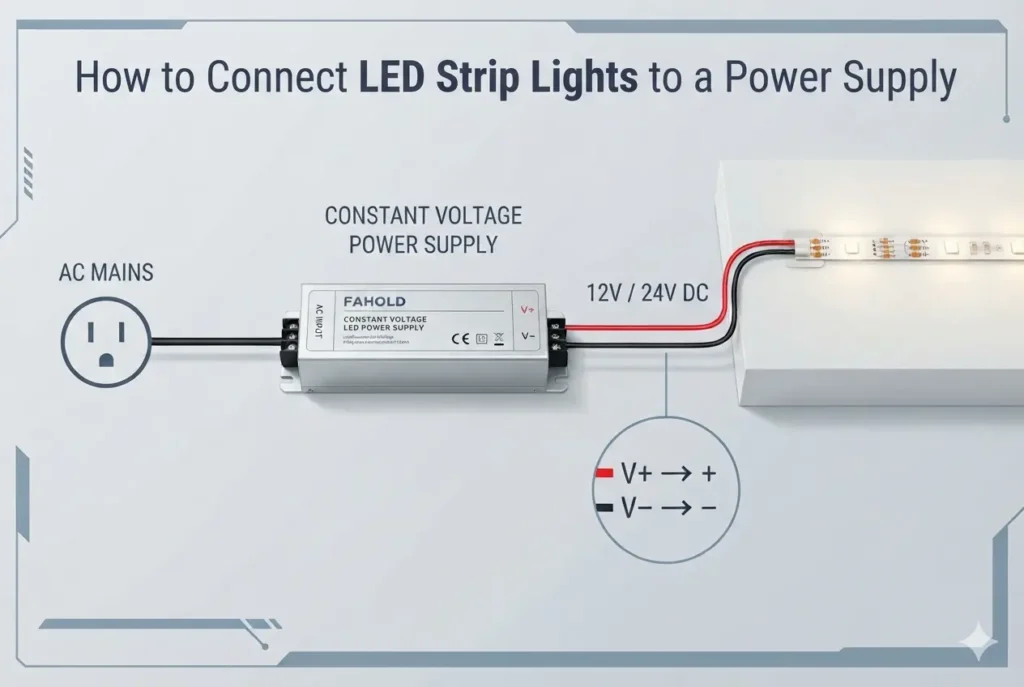
AC mains → CV LED power supply → controller if required → LED strip
If a strip is rated 24VDC, begin with a compatible 24V supply. Wattage cannot compensate for wrong voltage.
FAHOLD’s existing strip-selection guide follows the same rule: How to Choose the Right Power Supply for LED Strip Lights.
12V, 24V and 48V: What Changes?
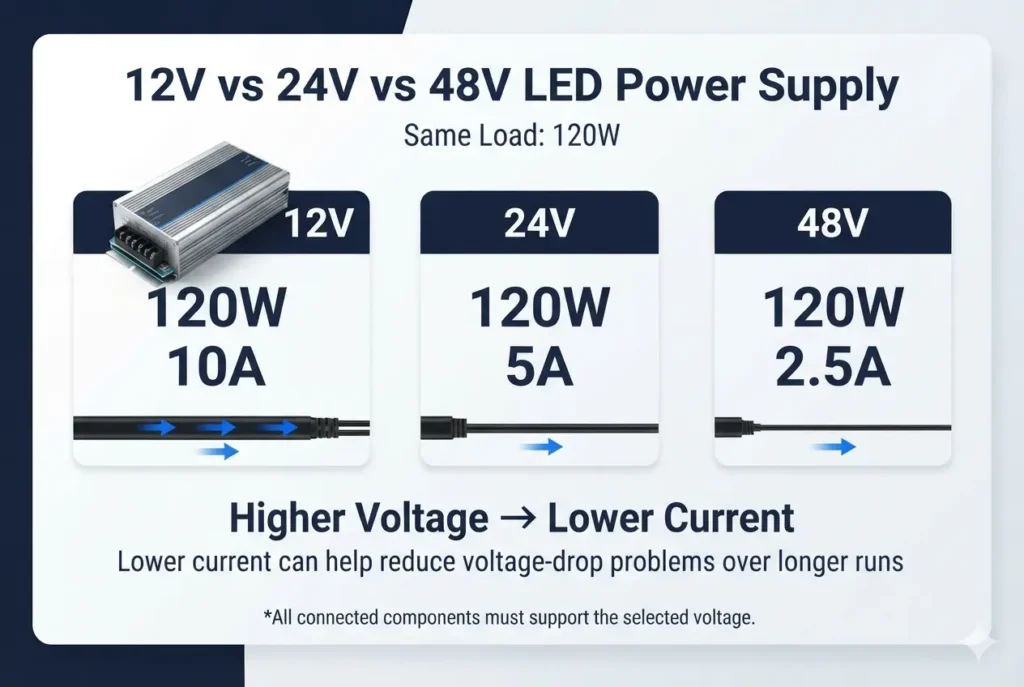
At the same power, higher voltage means lower current:
I = P ÷ V
For 120W:
- 12V → 10A
- 24V → 5A
- 48V → 2.5A
This affects conductor current, voltage drop and distribution design.
It does not mean the highest voltage is automatically best. The load and every connected component must support it.
See 12V vs 24V LED Power Supply and 24V vs 48V LED Power Supply for the detailed architecture decisions.
12V Constant-Voltage Systems
12V makes sense when the load is designed for 12V, existing equipment uses 12V, runs are short enough for manageable current, or controls/accessories require 12V.
For 60W:
60W ÷ 12V = 5A
24V Constant-Voltage Systems
24V reduces current relative to 12V and is widely used for professional strip and architectural lighting.
For the same 60W:
60W ÷ 24V = 2.5A
The lower current can make voltage-drop management easier, but the load must be designed for 24V.
48V Constant-Voltage Systems
48V further reduces current:
60W ÷ 48V = 1.25A
Professional 48V CV products exist. MEAN WELL currently lists LED power-supply families with 48V constant-voltage options: MEAN WELL LED Power Supply Product Families.
The practical constraint is ecosystem compatibility: load, controller, dimmer, connectors and supply must support 48V.
How to Calculate Load Current
Once voltage and wattage are known:
Current (A) = Power (W) ÷ Voltage (V)
Example:
- 24V;
- 96W total load.
96W ÷ 24V = 4A
The candidate therefore needs compatible 24V output and sufficient usable current/power capacity.
For the full calculation, see How to Size an LED Power Supply.
How to Calculate Total LED Load
For strip:
Total load = W/ft × feet
or:
Total load = W/m × meters
For multiple branches:
| Branch | Load |
|---|---|
| A | 30W |
| B | 25W |
| C | 20W |
| Total | 75W |
Evaluate the supply against the combined 75W load.
Why Nameplate Wattage Is Not Enough
A 100W nameplate does not prove that 100W is usable under every operating condition.
Check the exact datasheet for:
- temperature derating;
- input-voltage derating;
- mounting/cooling;
- continuous-loading restrictions.
MEAN WELL’s technical guidance discusses load, temperature and derating in LED power-supply selection: MEAN WELL LED Power Supply Selection Guidance.
The defensible rule is:
Usable output under actual operating conditions must support maximum connected load.
Can You Oversize a CV Power Supply?
Often yes, if voltage and every other specification remain compatible.
A compatible 24V, 40W load does not automatically consume 100W from a 24V, 100W supply.
But excessive capacity can add cost/size and may introduce load-point or control considerations.
See Can You Use a Higher-Wattage LED Power Supply? for the complete decision tree.
Voltage Drop and Distribution
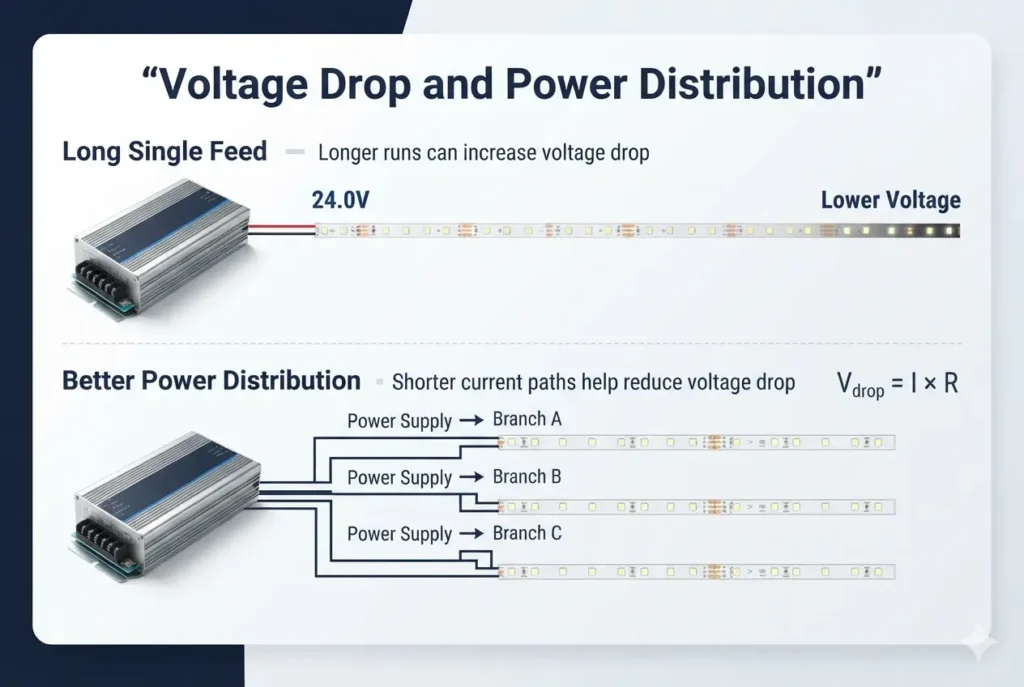
Real conductors have resistance.
Vdrop = I × R
At the same power, a higher system voltage reduces current and can reduce conductor voltage drop.
But voltage drop also depends on conductor size, length, connections and the LED load’s internal design. A larger-wattage supply does not automatically solve it.
For long strip systems, consider parallel branches and manufacturer-approved power-injection layouts.
See LED Strip Lighting for application design.
Constant Voltage for Sign Lighting
Signage can involve many distributed modules and long branch wiring.
Evaluate:
- module voltage;
- total wattage;
- branch current;
- cabinet temperature;
- supply location;
- wire length;
- service access;
- exposure.
For Sign Lighting, one large supply is not automatically better than several smaller supplies.
Dimming a Constant-Voltage System
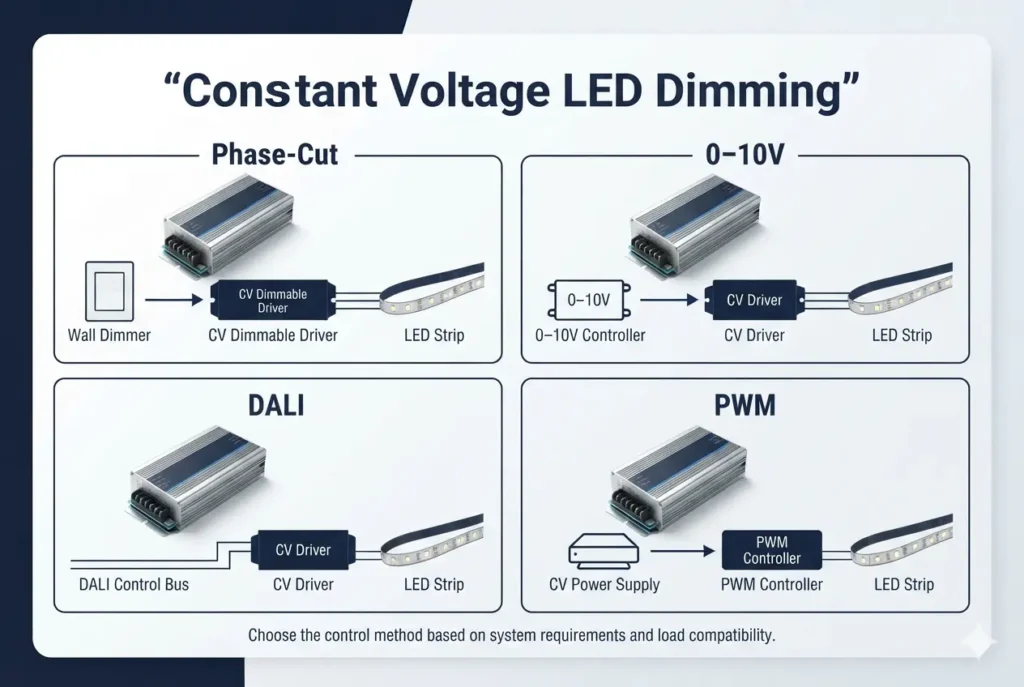
“Dimmable” is not one universal interface.
Projects may require:
- phase-cut;
- 0–10V;
- DALI;
- PWM-style output/control;
- another specified interface.
The supply, controller and load must be compatible as a system.
The DALI Alliance defines LED drivers/control gear as specific devices in a DALI architecture: DALI Alliance — DALI Systems.
North American Class 2
Low voltage alone does not establish Class 2 status.
UL 2108 is relevant to low-voltage lighting systems in North America. UL’s technical discussion shows that Class 2 configurations involve defined power-unit and system requirements: UL Solutions — UL 2108 Low-Voltage Lighting Systems.
Verify the exact power unit, output limits and complete installation configuration.
Constant-Voltage Selection Workflow
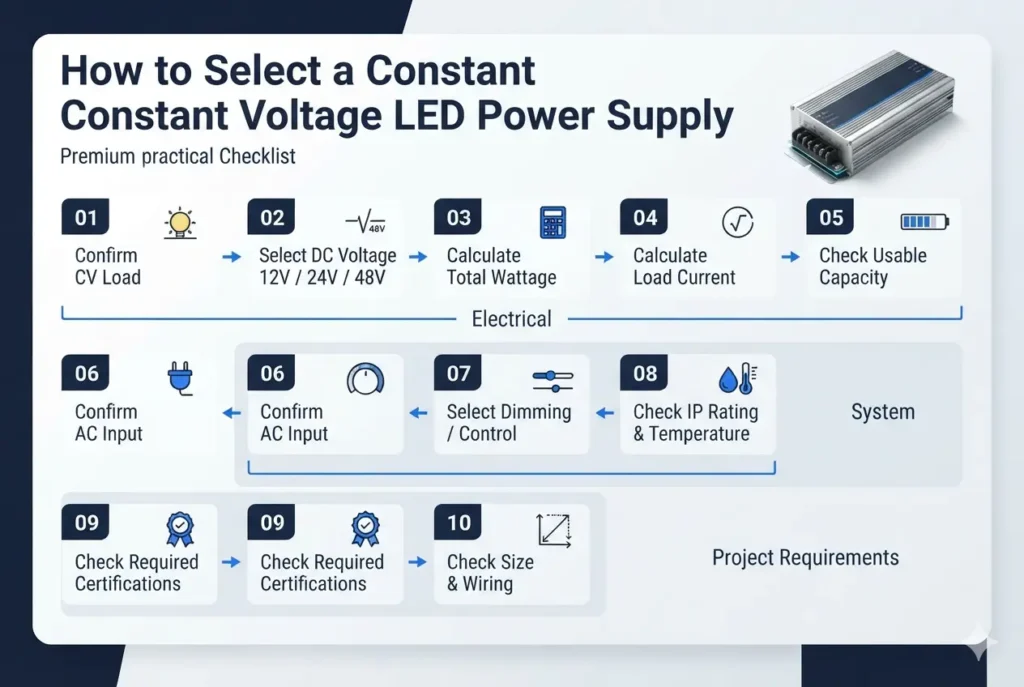
Step 1 — Confirm CV architecture
Verify fixed-voltage input is required.
Step 2 — Match DC voltage
12V to 12V; 24V to 24V; 48V to 48V.
Step 3 — Calculate total load
Add all compatible loads sharing the supply.
Step 4 — Calculate current
Use I = P ÷ V.
Step 5 — Check usable capacity
Review loading and derating.
Step 6 — Check AC input
Match project mains.
Step 7 — Check control
Verify exact dimming interface.
Step 8 — Check environment
Review thermal/IP requirements.
Step 9 — Check certifications
Match market/project requirements.
Step 10 — Check dimensions and wiring
Confirm mechanical fit and connections.
For a broader workflow, use How to Choose an LED Power Supply.
What to Send for Product Matching
| Requirement | What to provide |
|---|---|
| Market | US / Canada / other |
| AC input | Project requirement |
| DC output | 12V / 24V / 48V |
| Maximum load | Watts |
| Output current | Required/calculated |
| Dimming | None / 0–10V / DALI / phase-cut / other |
| Environment | Indoor / damp / outdoor / enclosure |
| Certification | Project-specific |
| Dimensions | Maximum space |
| Application | Strip / signage / architectural |
With these details, send your project requirements to FAHOLD for specification-based matching.
Constant Voltage LED Power Supply FAQ
What is a constant voltage LED power supply?
A regulated supply that maintains a specified output voltage while a compatible load draws current within the supply’s operating capacity.
Are LED strips constant voltage?
Many conventional low-voltage strips are designed for fixed-voltage DC input. Always verify the exact strip specification.
What is CV vs CC?
CV regulates voltage while current varies with the compatible load. CC regulates current while voltage operates within a specified range.
How do I choose 12V, 24V or 48V?
Match an existing load’s rated voltage. For a new architecture, compare current, voltage drop, distribution and component availability.
How many watts do I need?
Calculate maximum connected load and verify sufficient usable capacity after loading and derating checks.
Can I use a higher-wattage CV supply?
Potentially yes, if voltage and every other specification remain compatible.
Is every 24V supply Class 2?
No. Verify the exact product and system certification/limits.
Need Help With Your LED Power Supply Project?
Tell us what you are working on. We will review your application and recommend the most relevant FAHOLD solution.