Table of Contents
Quick Answer: What Is an LED Power Supply?
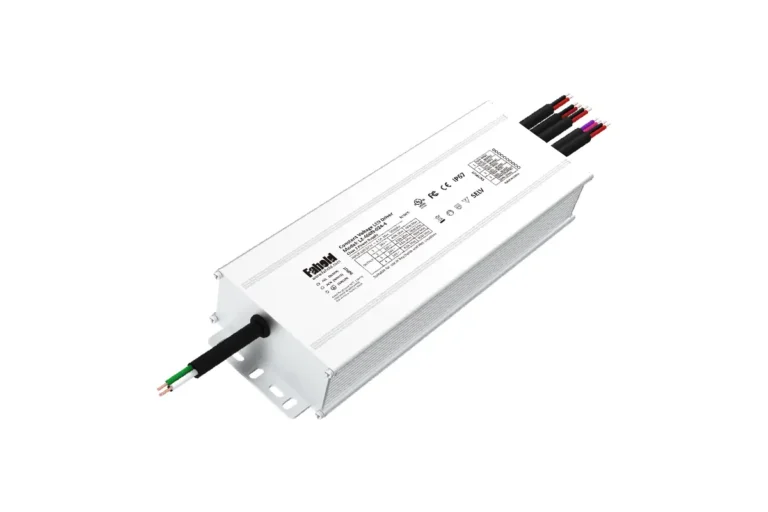
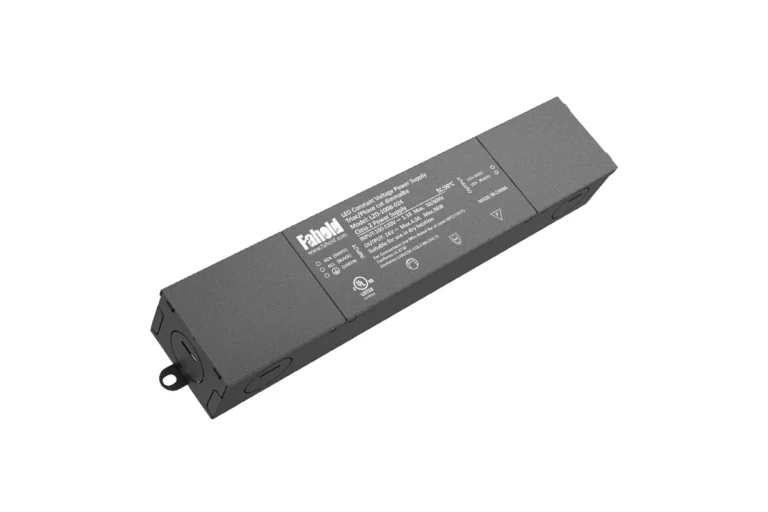
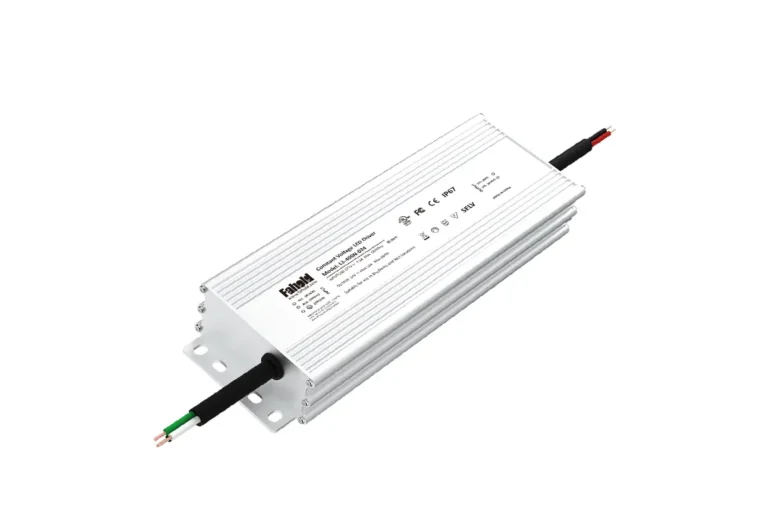
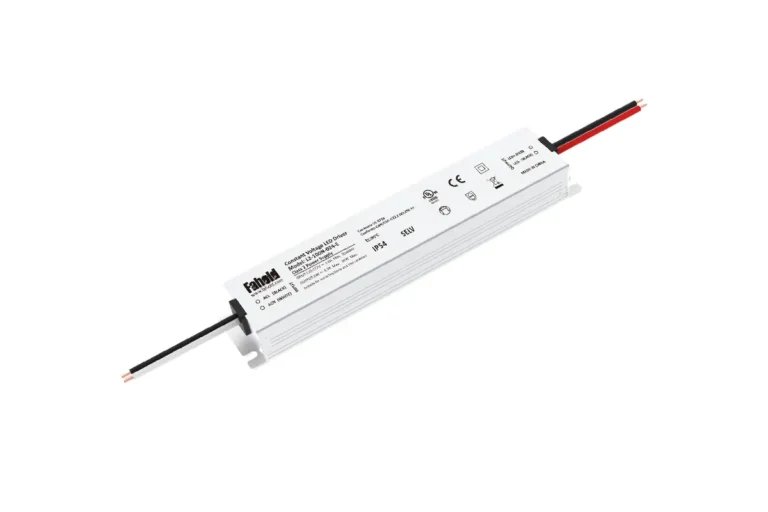
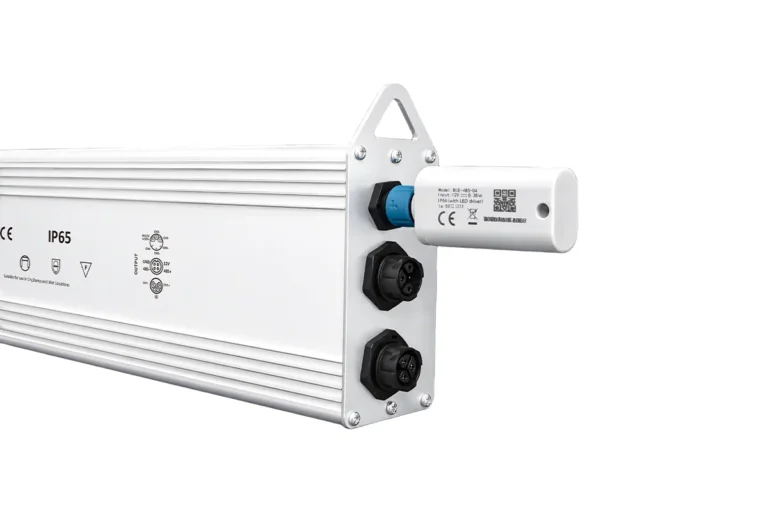
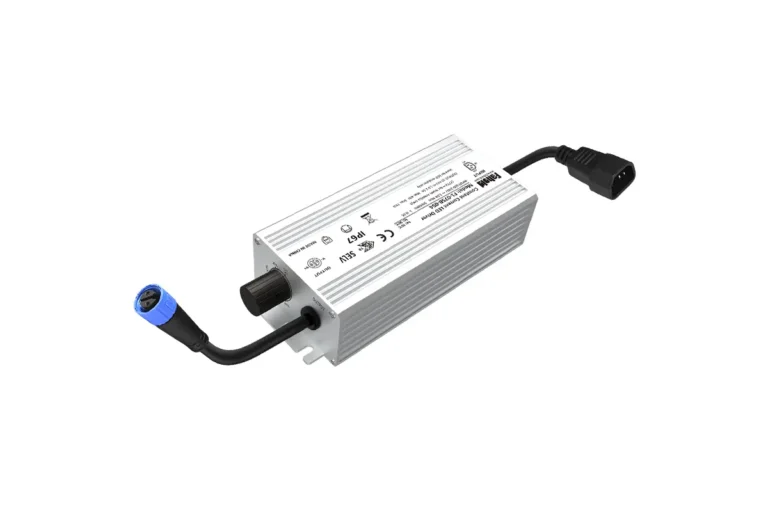
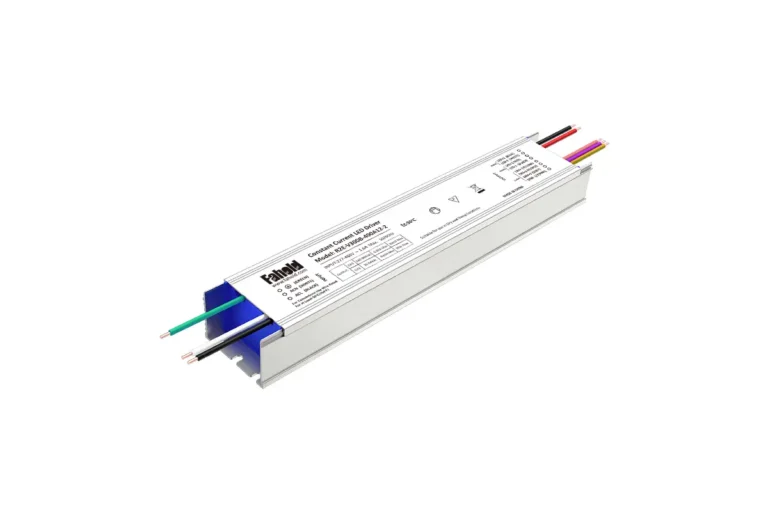
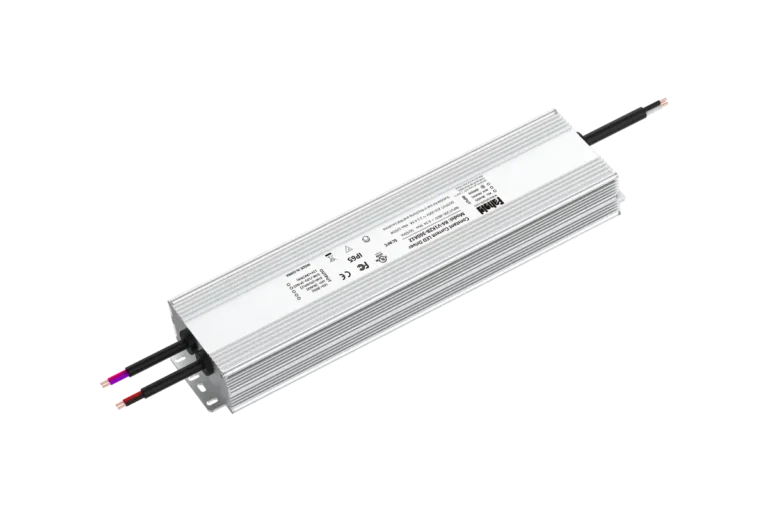
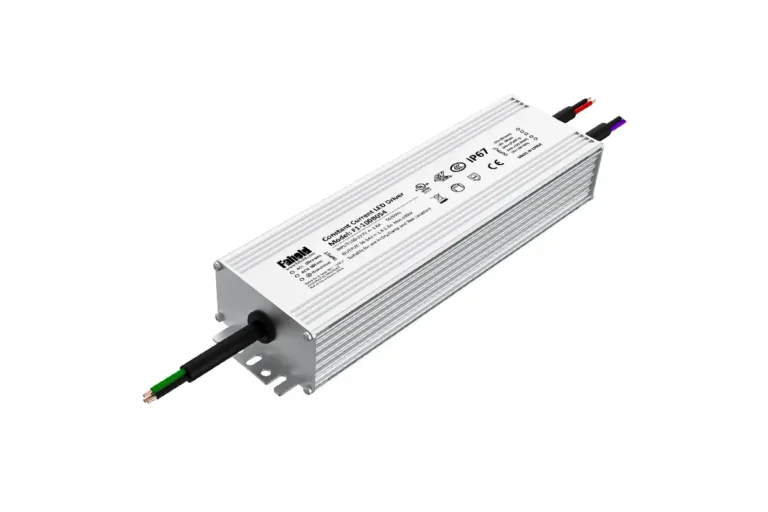
An LED power supply is a power-conversion device used to provide the electrical output required by an LED load. In professional lighting, the term may refer to a constant-voltage LED driver, a constant-current LED driver, or another LED control-gear architecture depending on how the LED module or strip is designed.
For many low-voltage LED strips, the required device is a constant-voltage LED driver with an output such as 12V, 24V, or 48V DC. For LED modules and luminaires designed around a regulated operating current, a constant-current LED driver may be required instead.
The correct choice depends on the LED load—not simply on whether a product is called a “power supply” or a “driver.”
A typical LED lighting system is:
AC Input → LED Power Supply / Driver → LED Load
What Does a Power Supply Do?
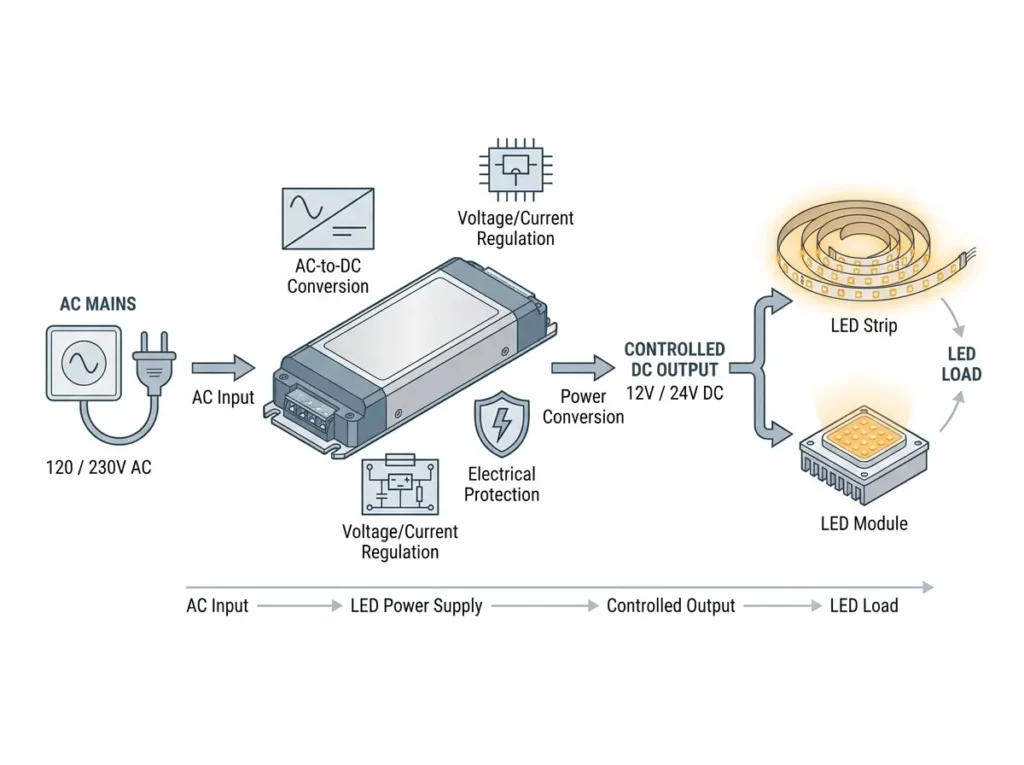
A power supply converts or conditions electrical power so that the connected load receives the voltage, current, and other electrical characteristics it requires.
In an LED lighting system, the incoming supply may be AC mains while the LED load requires controlled DC power.
For example:
120/230V AC → LED Driver → 24V DC → LED Strip
or:
AC Input → Constant-Current LED Driver → Regulated Current → LED Module
The exact architecture depends on the LED load.
Why Do LEDs Need a Driver or Power Supply?
LEDs are semiconductor devices and cannot be treated like a simple resistive load.
A lighting system must control the electrical conditions supplied to the LEDs. Depending on the LED module design, that may mean maintaining:
- a fixed output voltage;
- a regulated output current;
- a defined output-current range;
- a compatible dimming signal;
- electrical protection under abnormal conditions.
The term LED driver is therefore broader than a simple voltage converter in many professional lighting applications.
A driver may also include functions such as:
- dimming control;
- thermal protection;
- over-voltage protection;
- short-circuit protection;
- output-current programming;
- communication interfaces;
- surge protection.
The available functions depend on the actual driver design and verified product specification.
LED Power Supply vs LED Driver: Are They the Same?
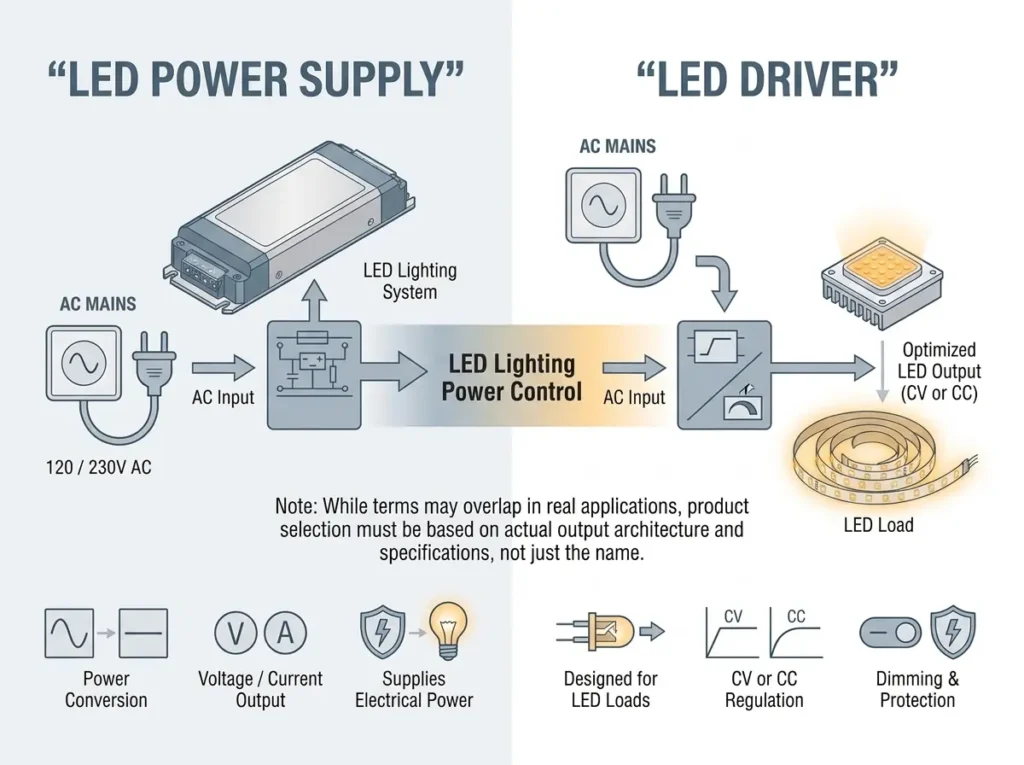
The two terms are often used interchangeably in lighting, but they are not always used with exactly the same technical meaning.
A useful way to think about them is:
Power supply describes the power-conversion function, while LED driver emphasizes that the device is designed to operate an LED load.
In practice, a constant-voltage LED driver may also be described as an LED power supply, especially in LED strip, signage, and linear-lighting applications.
The terminology alone is therefore not enough to select a product. Engineers and buyers should check the actual output architecture and electrical specifications.
Quick Comparison
| Term | Typical Meaning in LED Lighting | What to Verify |
|---|---|---|
| LED power supply | Power-conversion device for an LED system | Output voltage/current architecture |
| LED driver | Driver/control gear designed for an LED load | CV or CC output, power, current, dimming |
| Constant-voltage driver | Maintains a defined DC voltage | 12V / 24V / 48V etc. |
| Constant-current driver | Regulates LED current | mA/A setting and operating voltage range |
What Is a Constant-Voltage LED Power Supply?
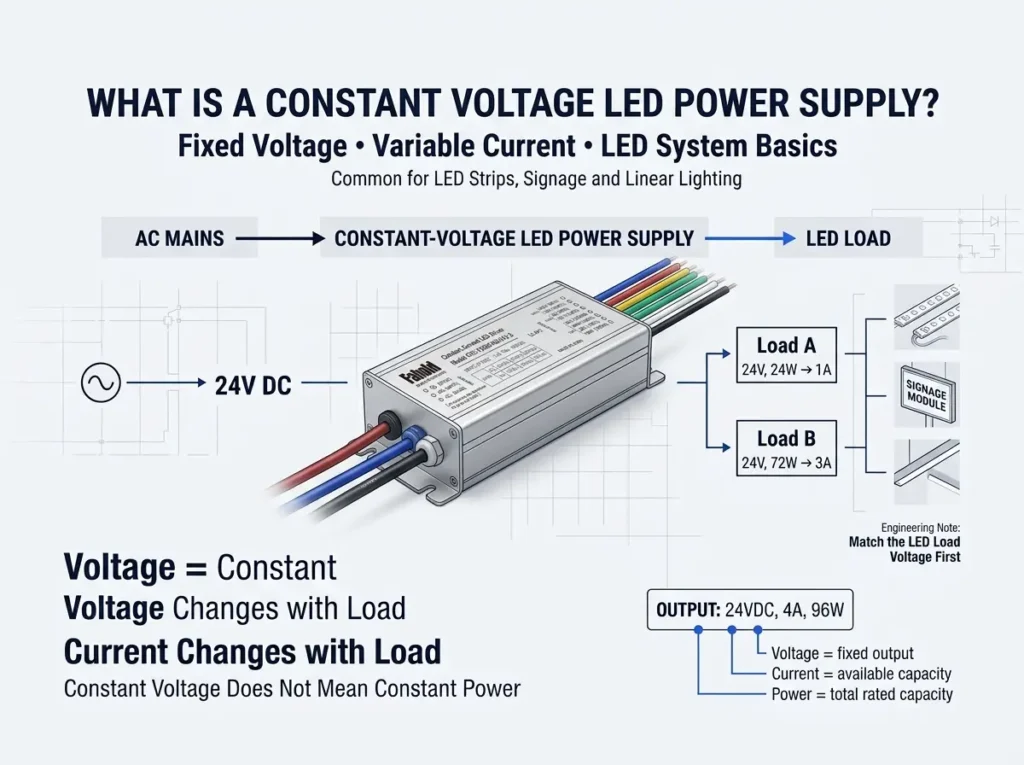
A constant-voltage LED driver maintains a specified DC output voltage.
Common outputs include:
- 12V DC;
- 24V DC;
- 48V DC.
This architecture is commonly used for LED strips and other LED systems designed to operate from a fixed-voltage source.
A typical architecture is:
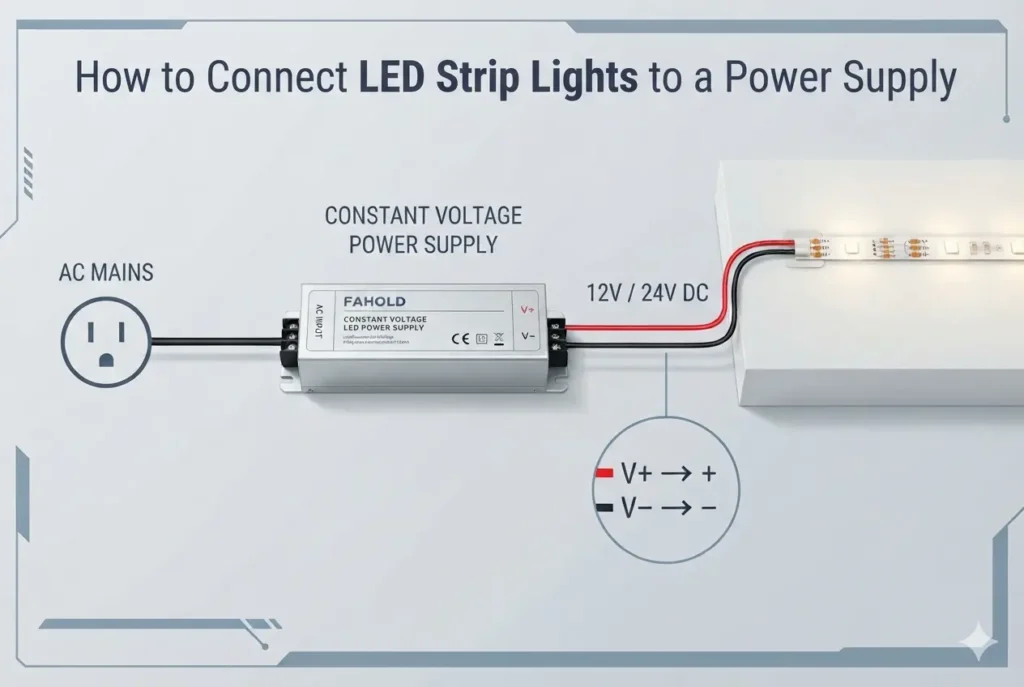
AC Mains → Constant-Voltage Driver → 24V DC → LED Strip
The LED strip itself contains circuitry that is designed for that nominal supply voltage.
For example, a conventional 24V LED strip should be matched with a 24V constant-voltage output—not a 12V output and not an arbitrary constant-current driver.
For a general description of common LED-strip electrical architectures, see the LED strip light overview.
Typical Constant-Voltage Applications
- LED strip lighting;
- linear lighting;
- signage;
- display lighting;
- cabinet lighting;
- architectural accent lighting.
For professional projects, constant voltage LED drivers should still be selected according to the complete electrical and environmental specification.
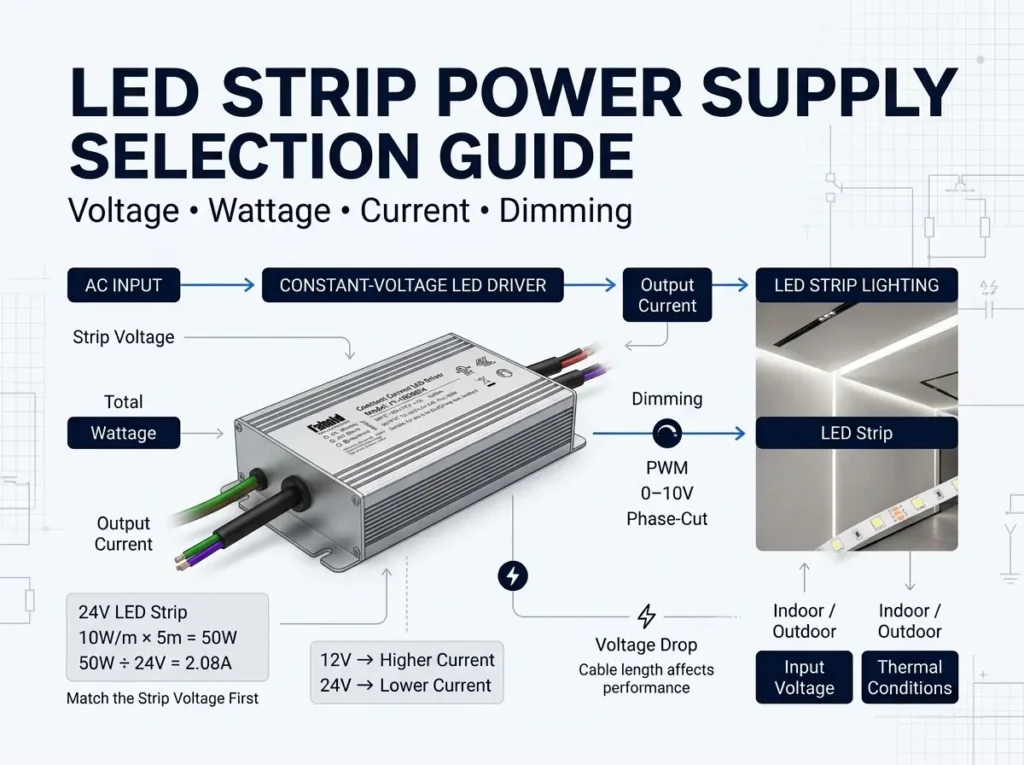
For a practical sizing workflow covering strip voltage, wattage, current, voltage drop, dimming, and installation conditions, see how to choose the right power supply for LED strip lights.
What Is a Constant-Current LED Driver?
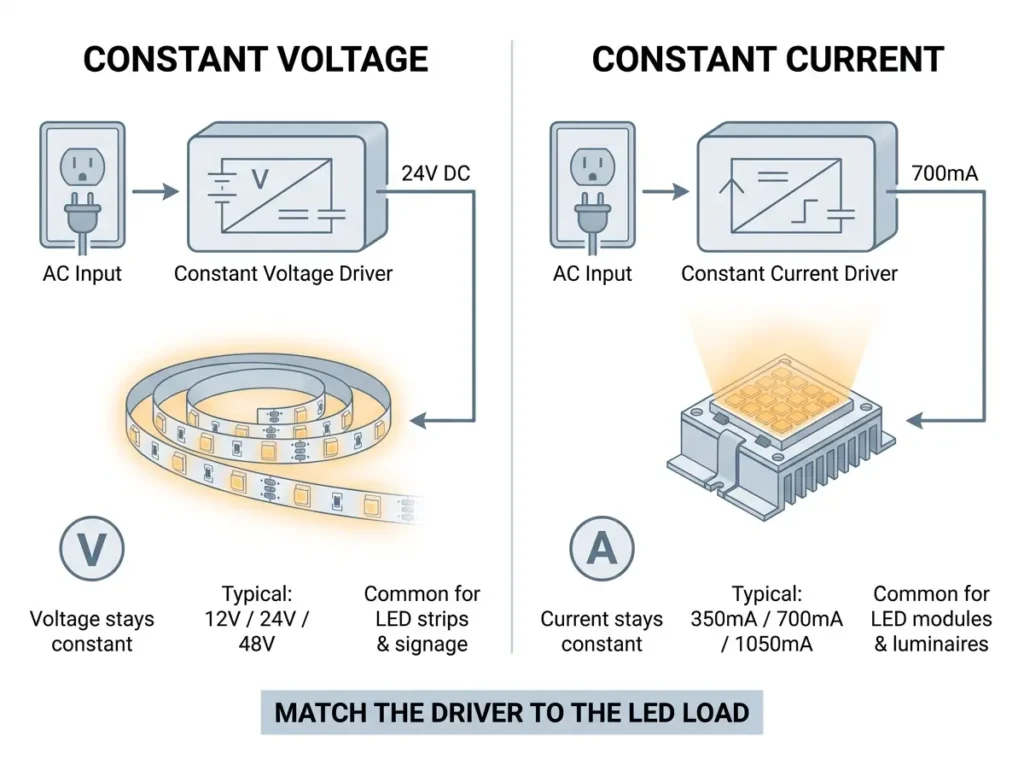
A constant-current LED driver regulates the output current supplied to the LED load.
Instead of being specified primarily by a fixed output voltage such as 24V, the driver may be selected using a regulated current such as:
- 350mA;
- 500mA;
- 700mA;
- 1050mA;
- another project-specific current.
The driver then operates within a defined output-voltage range required by the LED load.
A simplified architecture is:
AC Input → Constant-Current Driver → Regulated Current → LED Module
Constant-current systems are common when the LED module or luminaire is designed around a specific drive current.
Typical Constant-Current Applications
- LED modules;
- downlights;
- spotlights;
- high-power LED assemblies;
- luminaires designed around a specified drive current.
The correct current must be verified against the LED module specification. Supplying excessive current can overstress the LEDs.
Constant Voltage vs Constant Current LED Driver
| Selection Factor | Constant Voltage | Constant Current |
|---|---|---|
| Regulated parameter | Voltage | Current |
| Typical specification | 12V / 24V / 48V | 350mA / 700mA etc. |
| Common LED-strip use | Yes | Only where specifically designed |
| Common LED-module use | Sometimes | Very common |
| Main matching requirement | Rated load voltage | Drive current + operating voltage range |
| Common buyer mistake | Matching wattage but wrong voltage | Matching power but wrong current |
Selection Rule
Use the LED load datasheet first.
If the load specifies:
24V DC input
→ evaluate a 24V constant-voltage driver.
If the load specifies:
700mA constant current with a defined Vf range
→ evaluate a 700mA constant-current driver whose output-voltage range matches the load.
Can an LED Driver Be Used as a Power Supply?
Yes—when the driver’s output architecture matches the load.
An LED driver is itself a power-conversion device. However, that does not mean any LED driver can power any LED load.
For example:
- a 24V constant-voltage LED driver can supply a compatible 24V LED strip;
- a 700mA constant-current driver should not be substituted for a conventional 24V constant-voltage strip simply because both products have similar wattage ratings.
The correct question is therefore not:
Can I use an LED driver as a power supply?
It is:
Does this driver’s output specification match the electrical requirements of my LED load?
Does an LED Driver Need a Separate Power Supply?
Usually not if the LED driver is already designed to accept the available AC mains input and provide the required LED output.
A typical standalone driver performs the conversion directly:
AC Mains → LED Driver → LED Load
However, some lighting systems contain multiple power-conversion or control stages.
For example:
AC Mains → DC Power Supply → Controller → LED Strip
or:
AC Mains → Dimmable LED Driver → LED Load
The system architecture depends on the product design.
Do not add an additional power supply unless the driver or controller specification requires one.
After the correct driver architecture has been selected, use the LED strip power connection guide to review polarity, controller placement, multi-strip wiring, and installation checks.
How Do You Choose an LED Power Supply?
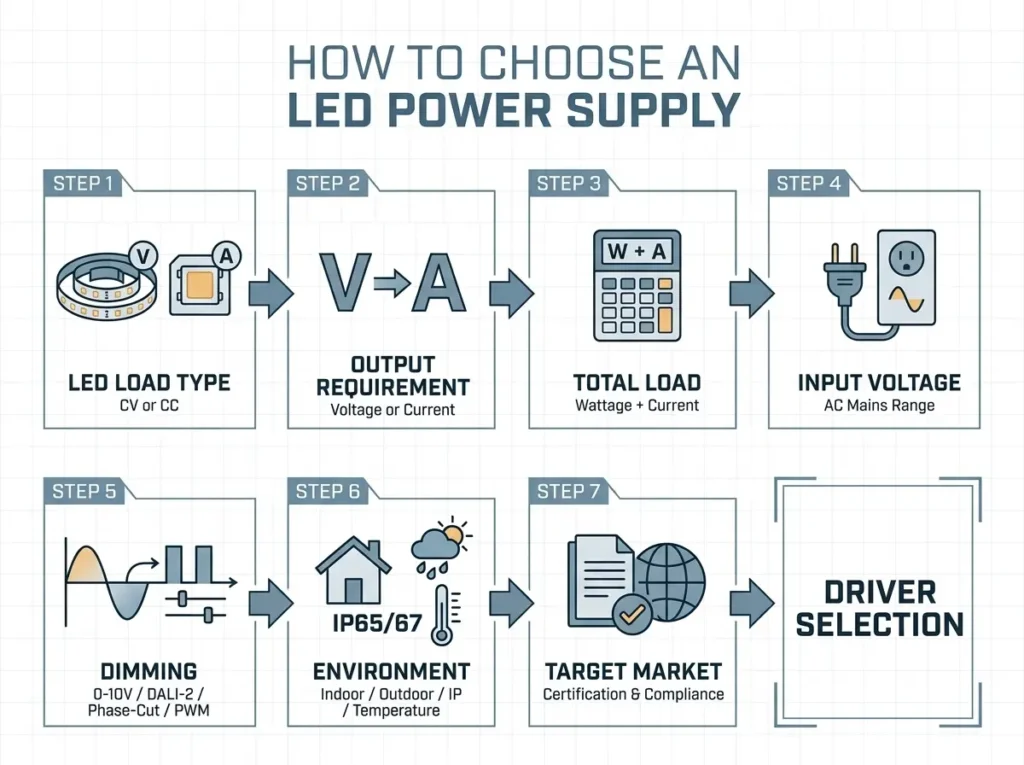
A professional selection should follow the load requirements in a defined sequence.
1. Determine the LED Load Type
Identify whether the load requires:
- constant voltage; or
- constant current.
2. Confirm the Output Voltage or Current
For constant-voltage loads:
- 12V;
- 24V;
- 48V;
- other specified voltage.
For constant-current loads:
- required current;
- LED forward-voltage range;
- total power.
3. Calculate the Total Load
For an LED strip:
Total Power = W/m × Total Length
For a constant-current LED module, use the module’s verified electrical specification.
4. Check Input Voltage
The driver must support the intended AC input range for the project.
5. Define Dimming Requirements
Possible control methods include:
- PWM;
- 0-10V;
- DALI-2;
- TRIAC;
- ELV;
- MLV;
- other control architectures.
For suitable outdoor projects, FAHOLD provides 0-10V LED drivers and DALI-2 LED drivers.
The official DALI Alliance / IEC 62386 framework is the appropriate primary reference for DALI-related protocol and control-gear requirements.
6. Define the Environment
Check:
- indoor or outdoor installation;
- moisture exposure;
- dust;
- operating temperature;
- enclosure conditions;
- required ingress protection.
The IP classification system is defined under IEC 60529.
7. Check Target-Market Requirements
Possible considerations include:
- safety certification;
- EMC requirements;
- market-specific standards;
- installation classification.
For North American LED equipment, requirements may involve UL 8750, depending on the final product and certification route.
What Specifications Matter When Comparing LED Power Supplies?
Do not compare LED power supplies only by wattage.
A professional comparison may include:
| Specification | Why It Matters |
|---|---|
| Input voltage | Must match the project mains supply |
| Output architecture | Constant voltage or constant current |
| Output voltage | Must match a CV LED load |
| Output current | Must support the LED load |
| Rated power | Must cover the connected load |
| Dimming | Must match the control system |
| Power factor | Relevant in many commercial projects |
| THD | Can matter for power-quality requirements |
| Efficiency | Affects losses and thermal behavior |
| Protection | OVP/OCP/SCP/OTP where applicable |
| IP rating | Relevant to installation environment |
| Operating temperature | Determines environmental suitability |
| Derating | Can reduce available output at temperature |
| Certifications | Must match target-market requirements |
| Mechanical size | Must fit the luminaire/enclosure |
Not every project requires the same priorities.
LED Power Supply Dimming Options
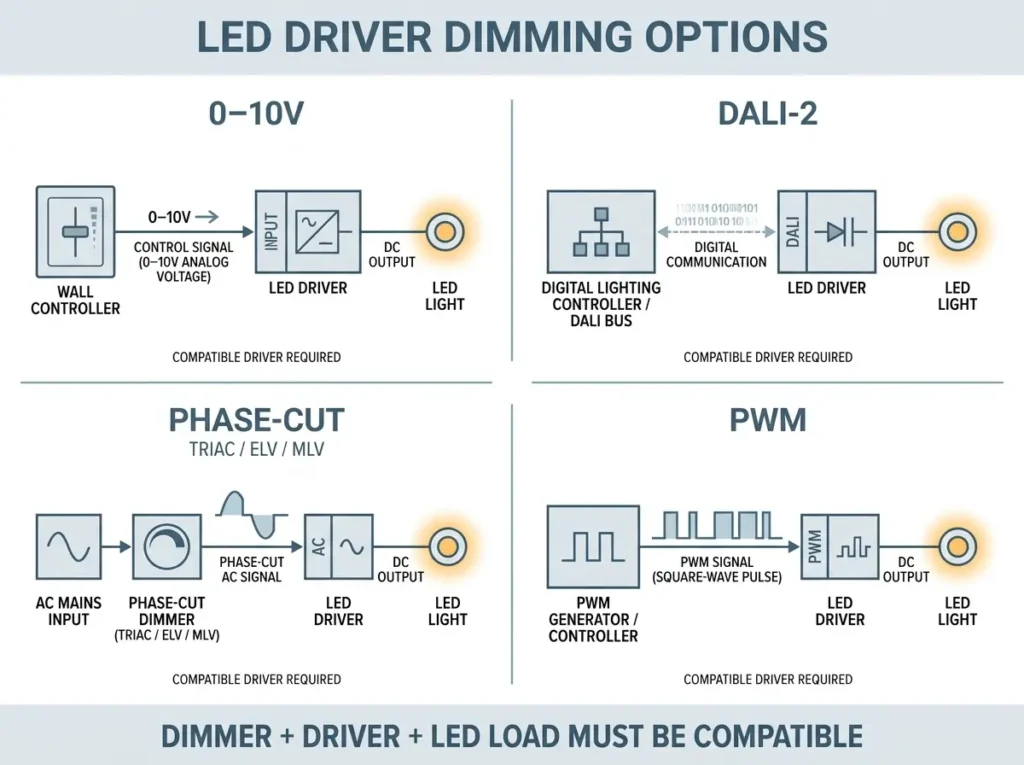
A power supply or driver must be explicitly designed for the intended dimming method.
0-10V
0-10V is an analog control method used in commercial lighting systems.
The 0-10V signal is a control interface; it is not the normal LED output voltage.
Projects requiring this architecture can review FAHOLD’s 0-10V LED drivers.
DALI-2
DALI-2 is part of a digital lighting-control ecosystem based on the IEC 62386 family.
The DALI Alliance maintains the relevant certification framework and device ecosystem.
Projects using DALI control can review FAHOLD’s DALI-2 LED drivers.
Phase-Cut Dimming
TRIAC, ELV, MLV, forward-phase, and reverse-phase systems require compatible drivers.
A driver described only as “dimmable” should not automatically be assumed compatible with every phase-cut dimmer.
PWM
PWM can be used in LED dimming architectures, particularly in low-voltage systems.
Compatibility should be verified across:
- driver;
- controller;
- LED load;
- switching frequency;
- wiring architecture.
Indoor vs Outdoor LED Power Supplies
Installation environment changes the selection criteria.
Indoor
Consider:
- mounting space;
- ventilation;
- enclosure temperature;
- wiring access;
- acoustic requirements;
- thermal management.
Outdoor or Exposed
Also evaluate:
- IP rating;
- moisture;
- dust;
- cable sealing;
- surge environment;
- operating temperature;
- thermal derating.
An IP number by itself does not guarantee that a product is appropriate for every outdoor installation.
The required enclosure protection should be determined from the actual environment and verified product specification.
LED Power Supply Safety and Certification
LED drivers are electrical equipment and should be selected and installed according to applicable product standards and local electrical rules.
For North American lighting products, UL identifies LED drivers and related LED equipment within the scope of UL 8750.
For ingress protection, refer to IEC 60529.
The applicable certification path depends on:
- product type;
- end use;
- installation;
- target market;
- final luminaire certification.
Do not assume that a driver is certified for a market without checking its verified documentation.
Common LED Power Supply Selection Mistakes
1. Choosing by Wattage Alone
A 100W driver is not suitable simply because the LED load is below 100W.
Voltage, current, output architecture, dimming, and environment also matter.
2. Confusing Constant Voltage and Constant Current
This can cause incorrect driver selection even when the rated power appears correct.
3. Ignoring Thermal Derating
A driver may not deliver its full rated output under every temperature condition.
4. Assuming All Dimmable Drivers Are Compatible
0-10V, DALI-2, PWM, and phase-cut are different control architectures.
5. Ignoring Target-Market Certification
A technically functional driver may still be unsuitable for the intended regulatory or certification environment.
6. Treating “LED Power Supply” as a Complete Specification
The phrase does not tell you:
- output voltage;
- output current;
- CV/CC architecture;
- dimming method;
- protection level;
- certification.
Always work from a complete specification.
LED Power Supply Selection Checklist for Engineers and Buyers
Before requesting a driver recommendation, prepare:
| Requirement | Information to Provide |
|---|---|
| Application | LED strip, luminaire, signage, module, etc. |
| Input voltage | Required AC input |
| Load type | Constant voltage or constant current |
| Output voltage | Required for CV load |
| Output current | Required for CC load / total CV current |
| Total wattage | Complete LED load |
| Dimming | None / 0-10V / DALI-2 / phase-cut / other |
| Environment | Indoor / outdoor / enclosed |
| IP requirement | Based on actual exposure |
| Operating temperature | Project conditions |
| Target market | Country or region |
| Certification | Project requirement |
| Quantity | Estimated volume |
| Project schedule | Sample / production timing |
LED Power Supply Selection Decision Tree
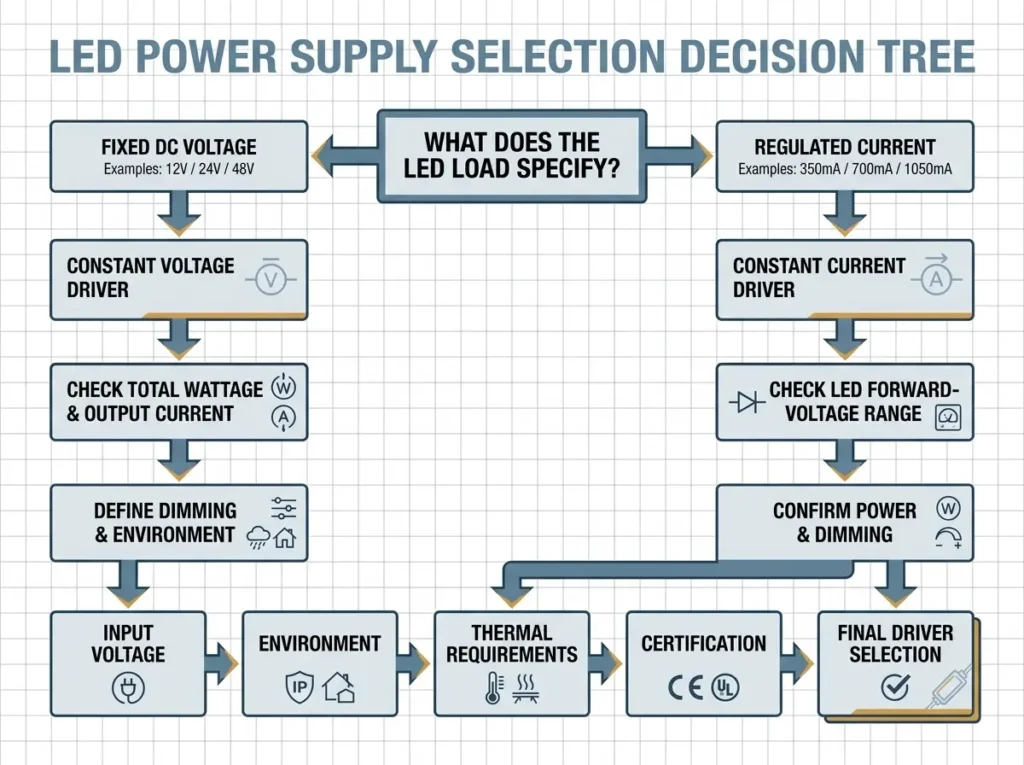
What does the LED load specify?
Fixed DC Voltage
Examples:
12V / 24V / 48V
↓
Evaluate constant voltage LED drivers
↓
Calculate total wattage and output current
↓
Define dimming and environment
Regulated Current
Examples:
350mA / 700mA / 1050mA
↓
Evaluate constant current LED drivers
↓
Check LED forward-voltage range
↓
Confirm total power and dimming requirements
Then for either architecture:
Input Voltage → Environment → Thermal Requirements → Certification → Driver Selection
Selecting an LED Power Supply for a FAHOLD Project
When evaluating an LED driver for a professional lighting application, provide the complete electrical and application specification.
The most useful information includes:
- input voltage;
- LED load type;
- output voltage or current;
- total wattage;
- dimming protocol;
- installation environment;
- target market;
- certification requirements;
- estimated quantity.
If your project uses 0-10V control, review FAHOLD’s 0-10V LED drivers.
If your project uses DALI digital control, review FAHOLD’s DALI-2 LED drivers.
For other requirements, constant voltage LED drivers, constant current LED drivers, and dimmable LED drivers should be matched to the actual project specification before selecting a model.
Need Help Defining Your LED Driver Specification?
If you are sourcing LED drivers for an OEM luminaire, LED strip, signage, architectural, commercial, or outdoor lighting project, prepare your electrical and application requirements first.
Request a Quote to discuss the appropriate LED driver specification with FAHOLD.
Frequently Asked Questions
What is an LED power supply?
An LED power supply converts incoming electrical power into the voltage and current conditions required by an LED lighting system. Depending on the load, it may use a constant-voltage or constant-current architecture.
Is an LED power supply the same as an LED driver?
The terms are often used interchangeably, but “LED driver” more specifically describes a device designed to operate an LED load. The important selection factor is the actual output architecture and specification, not the product label alone.
Can an LED driver be used as a power supply?
Yes, when the driver’s output voltage/current architecture matches the connected LED load. A constant-current driver cannot automatically replace a constant-voltage supply, and vice versa.
What is the difference between constant-voltage and constant-current LED drivers?
A constant-voltage driver regulates output voltage, such as 12V or 24V. A constant-current driver regulates current, such as 350mA or 700mA, while operating within a defined voltage range.
What power supply is normally used for LED strip lights?
Most conventional low-voltage LED strips are designed for constant-voltage operation. Common system voltages include 12V and 24V, although the strip specification must always be checked.
Does an LED driver need a separate power supply?
Not normally when the driver already accepts the available AC input and directly powers the LED load. Some control architectures use additional power supplies or controllers, so the system documentation should be checked.
How do I know which LED power supply to choose?
Identify the load type, required voltage/current, total wattage, input voltage, dimming method, installation environment, thermal requirements, and target-market certification before selecting a driver.
Find the Right LED Power Supply for Your Project
Share the core electrical and application requirements. We will narrow the available FAHOLD platforms to the options most relevant to your project.