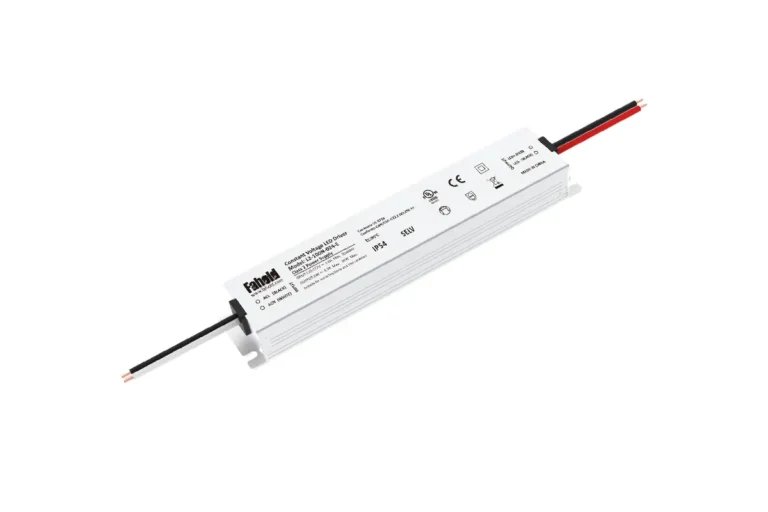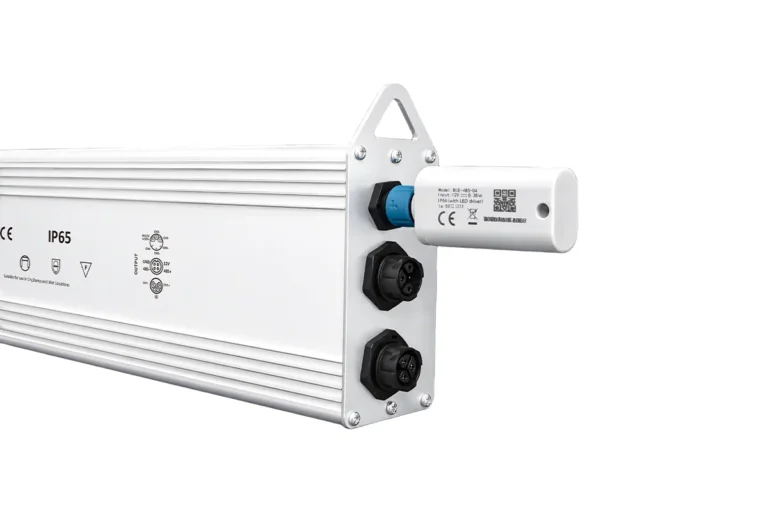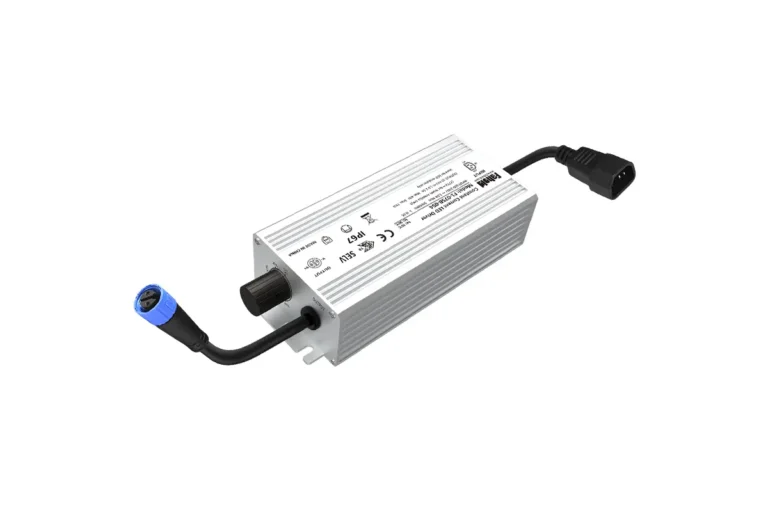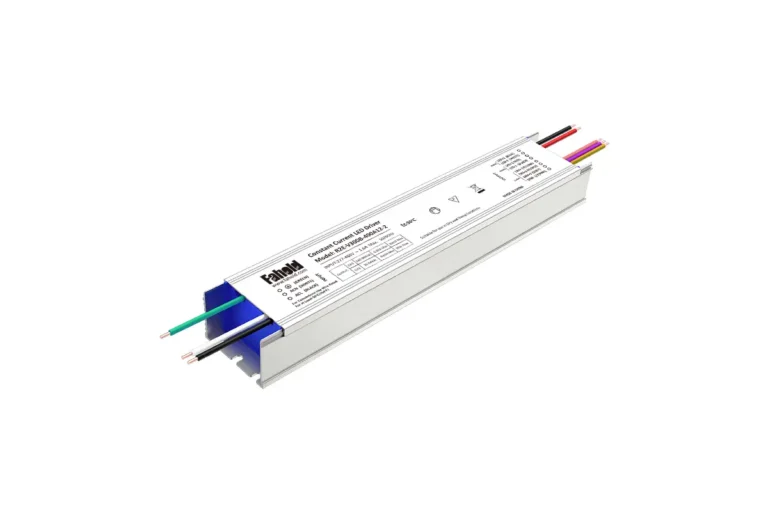
Table of Contents
Choosing an LED power supply is not simply a matter of finding a unit with enough watts.
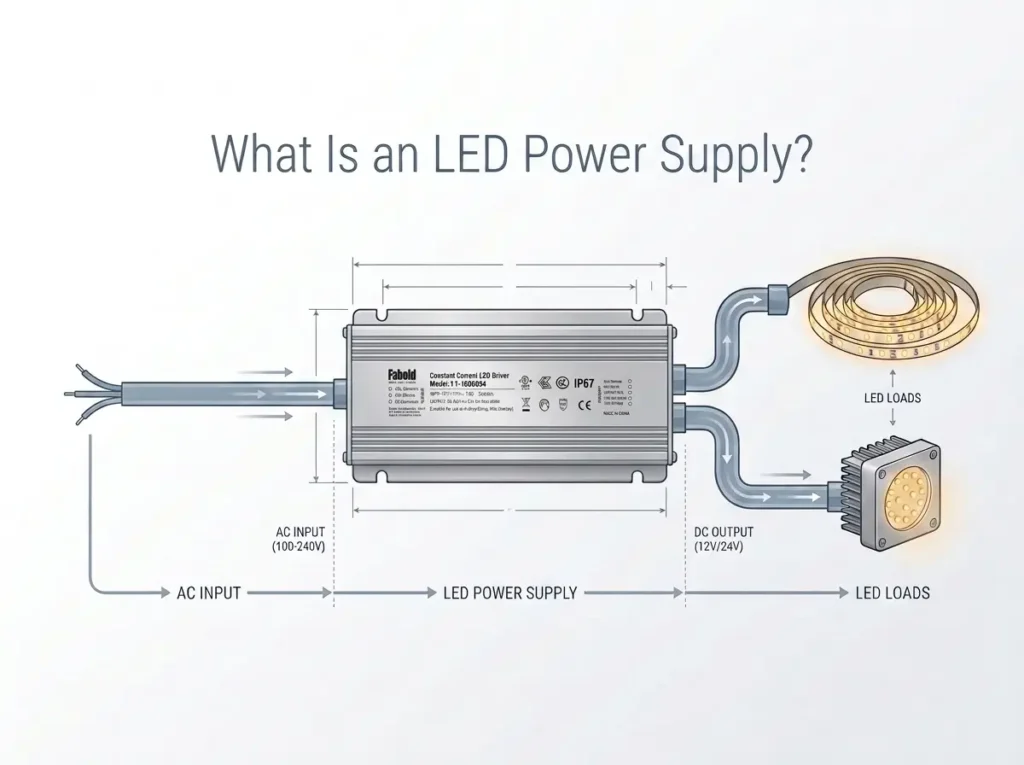
A suitable power supply has to match the electrical architecture of the LED load, the available AC input, the required DC output voltage, the maximum connected load, the installation environment, the control method, and any project-specific compliance or mechanical constraints.
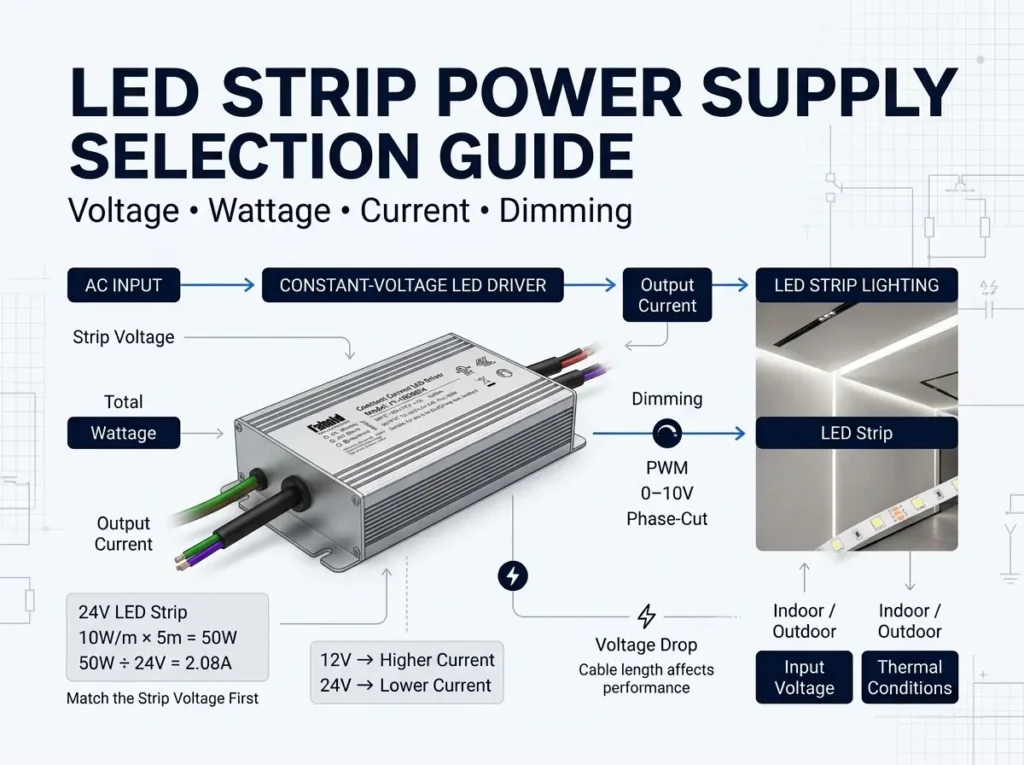
For constant-voltage LED lighting, a practical selection sequence is:
- Confirm whether the LED load requires constant voltage or constant current.
- Check the available AC input.
- Match the required DC output voltage.
- Calculate the maximum connected load.
- Select sufficient usable output capacity.
- Check temperature and environmental conditions.
- Confirm dimming or control compatibility.
- Verify certifications, dimensions, wiring and installation constraints.
This guide focuses mainly on constant-voltage LED power supplies for LED strips, signage and architectural lighting, with North American terminology and project practice as the primary reference.
If you need the broader terminology, voltage, wattage and application framework first, start with the LED Power Supply Guide. This page goes one level deeper and focuses on the actual selection workflow.
1. Start With the LED Load, Not the Power Supply
Before comparing power-supply wattage, identify what the LED load actually requires.
Check the LED strip, module, fixture or lighting-system datasheet for at least:
| Load specification | What to identify |
|---|---|
| Drive method | Constant voltage or constant current |
| Rated voltage | For example, 12 VDC, 24 VDC or another specified value |
| Power consumption | W, W/ft, W/m or W/module |
| Maximum connected load | Total expected load on one supply |
| Dimming requirement | None, phase-cut, 0–10 V, DALI or another method |
| Environment | Dry, damp, wet, outdoor or enclosed installation |
A constant-voltage supply maintains a specified output voltage while the connected load draws current within the supply’s permitted capacity. A constant-current driver regulates current and operates within a defined voltage range.
Those electrical architectures should not be treated as interchangeable merely because two products have similar wattage ratings.
The current international safety framework for electronic LED controlgear is covered by IEC 61347-2-13:2024, which applies to electronic controlgear for LED light sources. See the official IEC publication page for scope and current edition information: IEC 61347-2-13:2024 — Electronic controlgear for LED light sources.
For conventional constant-voltage LED strips and many signage modules, the load specification normally determines the required DC voltage first. Wattage comes after that.
2. Check the Input Voltage Available at the Installation
After confirming the load architecture, check the AC supply available at the project site.
Do not assume every AC/DC LED power supply accepts every mains voltage.
For procurement, record:
- project country or region;
- nominal site voltage;
- frequency where relevant;
- actual input-voltage range required;
- any project-specific electrical requirements.
Then compare those requirements against the exact candidate datasheet.
This prevents a common procurement error: selecting the correct DC output voltage but an incompatible AC-input version.
3. Match the Output Voltage to the Constant-Voltage Load
For a constant-voltage LED system, the supply voltage must be compatible with the load.
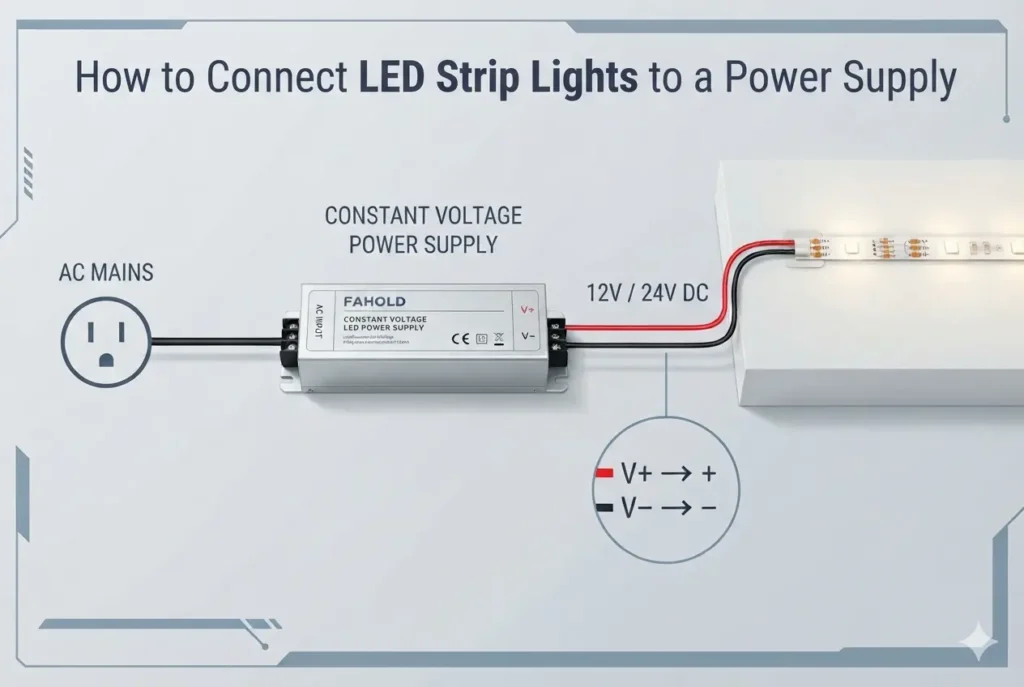
A conventional 24 VDC LED load requires a compatible 24 VDC supply. Likewise, a conventional 12 VDC load requires an appropriate 12 VDC supply.
Do not choose 12 V, 24 V or 48 V simply because one power supply is easier to source. The LED load determines the required operating voltage.
For example:
- LED load voltage: 24 VDC
- Maximum LED load: 72 W
The initial power-supply requirement becomes:
24 VDC output + sufficient usable capacity for the 72 W load under the actual operating conditions.
A 12 V supply is not a substitute just because its wattage is higher.
If you are deciding between system voltages at the design stage rather than matching an already-specified load, continue with 12V vs 24V LED Power Supply: How to Choose. For longer constant-voltage distribution where 48 V is being evaluated, see 24V vs 48V LED Power Supply: Key Differences.
4. Calculate the Maximum Connected LED Load
Once voltage is confirmed, calculate the maximum load connected to the supply.
For an LED strip specified in watts per unit length:
Total LED load (W) = Power per unit length × Total connected length
For modules:
Total LED load (W) = Number of modules × Watts per module
For several branches on one supply:
Total LED load = Load 1 + Load 2 + Load 3 + …
Use the manufacturer’s maximum specified load data where available instead of estimating from brightness, LED count or physical appearance.
This article intentionally does not go deep into sizing math because that is a separate search intent. For detailed calculations, current checks, headroom and derating examples, use How to Size an LED Power Supply for an LED Load.
5. Select Usable Capacity, Not Just a Nameplate Wattage
A calculated 72 W LED load does not automatically mean that any nominal 72 W power supply is a correct selection.
The candidate supply may have conditions affecting usable capacity, including:
- ambient-temperature derating;
- input-voltage derating;
- installation orientation;
- free-air or enclosure cooling;
- product-specific loading restrictions.
A common engineering practice is to avoid designing a continuous load directly at the absolute nameplate limit without checking the manufacturer’s loading and thermal guidance. However, a generic 20% rule should not be presented as a universal electrical-code requirement.
MEAN WELL’s LED power-supply technical guidance explicitly recommends considering margin, operating temperature and derating when matching a supply to an LED load: MEAN WELL LED power-supply selection and derating guidance.
The correct sequence is:
Calculated LED load → candidate datasheet → loading requirements → thermal/input derating → suitable standard rating
If you are specifically evaluating whether a substantially higher-wattage supply is acceptable, that question is covered separately in Can You Use a Higher-Wattage LED Power Supply?.
6. Check Current Capacity as a Second Verification
For a DC constant-voltage system:
I = P ÷ V
where:
- I = current in amperes;
- P = power in watts;
- V = voltage in volts.
For a 24 V, 72 W load:
72 W ÷ 24 V = 3 A
The nominal load therefore represents approximately 3 A at the stated rated condition.
Current is useful as a second verification because some product documentation lists output capability prominently in amps as well as watts.
The supply must satisfy both the required output voltage and the applicable output current/power capacity.
7. Account for Temperature and the Installation Environment
Power-supply selection changes when the same electrical load moves from an open indoor location to a sealed sign cabinet, exterior enclosure or tight architectural cavity.
Ask:
- What is the expected ambient temperature?
- Is the supply installed inside another enclosure?
- Is airflow restricted?
- Is direct solar heating possible?
- Is the location dry, damp or exposed to water?
- Does the candidate datasheet specify a temperature derating curve?
- Does mounting orientation affect available output?
The important distinction is:
Nameplate wattage and usable wattage under actual installation conditions are not always the same.
Manufacturer derating data should therefore be reviewed before final sizing, not after the product has already been purchased.
For application-specific context, review LED Strip Lighting for strip systems and Sign Lighting for distributed signage loads and enclosed sign environments.
8. Confirm Dimming and Control Compatibility
A supply that powers the LEDs correctly is not automatically compatible with the project’s control system.
If dimming is required, identify the control architecture before final product selection.
Possible requirements may include:
- phase-cut dimming;
- 0–10 V;
- DALI;
- PWM-related system architectures;
- other project-specific interfaces.
Do not assume that a product marketed simply as “dimmable” supports every control method.
For DALI systems, the DALI Alliance identifies control gear such as LED drivers as a core component in a DALI-2 system and distinguishes it from application controllers, input devices and bus power supplies. See the official system architecture: DALI Alliance — DALI-2 systems and components.
UL also addresses wired control circuits such as 0–10 V and DALI within the LED-equipment safety framework. For context, see: UL Solutions — UL 8750 updates for LED equipment with wired controls.
Before approval, verify:
- the supply’s supported dimming method;
- the controller/dimmer interface;
- control wiring;
- any minimum-load restrictions stated by the manufacturer;
- compatibility documentation for the exact product.
9. Verify Certifications Against the Exact Project
Do not treat certification marks as generic marketing badges.
The required certification depends on the market, project specification and installation.
For North American low-voltage lighting, UL 2108 is one relevant safety standard for low-voltage lighting systems. UL’s technical discussion also shows that requirements can vary by construction and Class 2 configuration: UL Solutions — UL 2108 Low-Voltage Lighting Systems.
Before specifying claims such as UL, Class 2, wet location or another compliance designation:
- identify the actual project requirement;
- verify the exact series/model documentation;
- confirm the certification applies to that configuration;
- avoid extending one model’s approval to an entire family unless documentation explicitly supports it.
A low DC voltage by itself does not prove that a product is Class 2.
10. Check Dimensions, Wiring and Installation Space
Electrical compatibility does not guarantee mechanical compatibility.
Before releasing a supply for purchasing, verify:
- overall dimensions;
- mounting method;
- required clearance;
- terminal or lead configuration;
- input and output wiring;
- grounding provisions;
- dimming/control leads;
- enclosure access;
- serviceability.
This is especially important for:
- narrow linear luminaires;
- coves;
- sign cabinets;
- retrofit spaces;
- compact architectural installations.
A supply that meets the electrical specification but does not physically fit is still the wrong supply.
LED Power Supply Selection Checklist
| Step | Question | Required result |
|---|---|---|
| 1 | CV or CC? | Match the LED load architecture |
| 2 | What AC input is available? | Within the candidate input specification |
| 3 | What DC voltage does the load require? | Compatible output voltage |
| 4 | What is the maximum connected load? | Calculated from manufacturer load data |
| 5 | Is usable capacity sufficient? | Loading and derating checked |
| 6 | What environment will it operate in? | Suitable thermal/environmental specification |
| 7 | Is dimming required? | Compatible control method |
| 8 | What compliance is required? | Exact model documentation verified |
| 9 | Will it physically fit? | Dimensions/mounting/wiring confirmed |
Application Changes the Final Selection
LED strip lighting
For LED strip lighting, voltage, total length, power per foot or meter, voltage drop, power injection and dimming architecture can all affect the final design.
Sign lighting
For sign lighting, consider distributed module loads, long wiring runs, enclosure temperature, service access and outdoor exposure.
Architectural and commercial lighting
For commercial lighting, control compatibility, enclosure dimensions, installation space and project compliance may carry as much weight as output wattage.
This is why selecting only by “24 V + watts” is incomplete.
If the project specifications are ready, send your requirements to FAHOLD for product matching.
Common LED Power Supply Selection Mistakes
Choosing wattage before voltage
A higher wattage does not correct an incompatible output voltage.
Treating constant voltage and constant current as interchangeable
The load architecture determines which control method is appropriate.
Ignoring derating
Nameplate wattage alone does not describe available output under every temperature and input condition.
Assuming every dimmable supply works with every controller
The control interface must be verified.
Using “outdoor” as the only environmental check
Ingress protection, thermal conditions and enclosure design are separate questions.
Assuming certification across a whole family
Verify the exact product documentation required for the project.
FAQ
How do I know what LED power supply I need?
Start with the LED load datasheet. Confirm constant voltage versus constant current, output voltage, maximum load, AC input, environment, dimming method, certification requirements and installation constraints.
Should the power-supply wattage be higher than the LED load?
The supply needs enough usable output capacity for the maximum load under actual operating conditions. Engineering margin can be useful, but final sizing should follow the candidate manufacturer’s loading and derating data rather than a universal fixed percentage.
Can I use a 24 V power supply for 12 V LEDs?
Not for a conventional 12 V constant-voltage load unless the LED system manufacturer explicitly specifies that input. Match the power-supply voltage to the load requirement.
How do I calculate power for LED strips?
Multiply the strip’s specified watts per foot or meter by the total powered length, then evaluate the resulting load against the power supply’s usable capacity. See How to Size an LED Power Supply for an LED Load for the full calculation workflow.
Does a dimmable LED power supply work with any dimmer?
No. Verify the supply, controller/dimmer and LED system as one control architecture.
What specifications should I send an LED power-supply manufacturer?
Provide input voltage, output voltage, load wattage/current, dimming requirements, installation environment, compliance requirements, dimensional constraints and application type.
Find the Right LED Power Supply for Your Project
Share the core electrical and application requirements. We will narrow the available FAHOLD platforms to the options most relevant to your project.