Table of Contents
Choosing the right power supply for LED strip lights starts with three parameters: strip voltage, total load wattage, and control requirements.
For most conventional 12V and 24V LED strip systems, the appropriate solution is a constant voltage LED driver that matches the strip’s rated voltage and provides sufficient output capacity for the complete connected load.
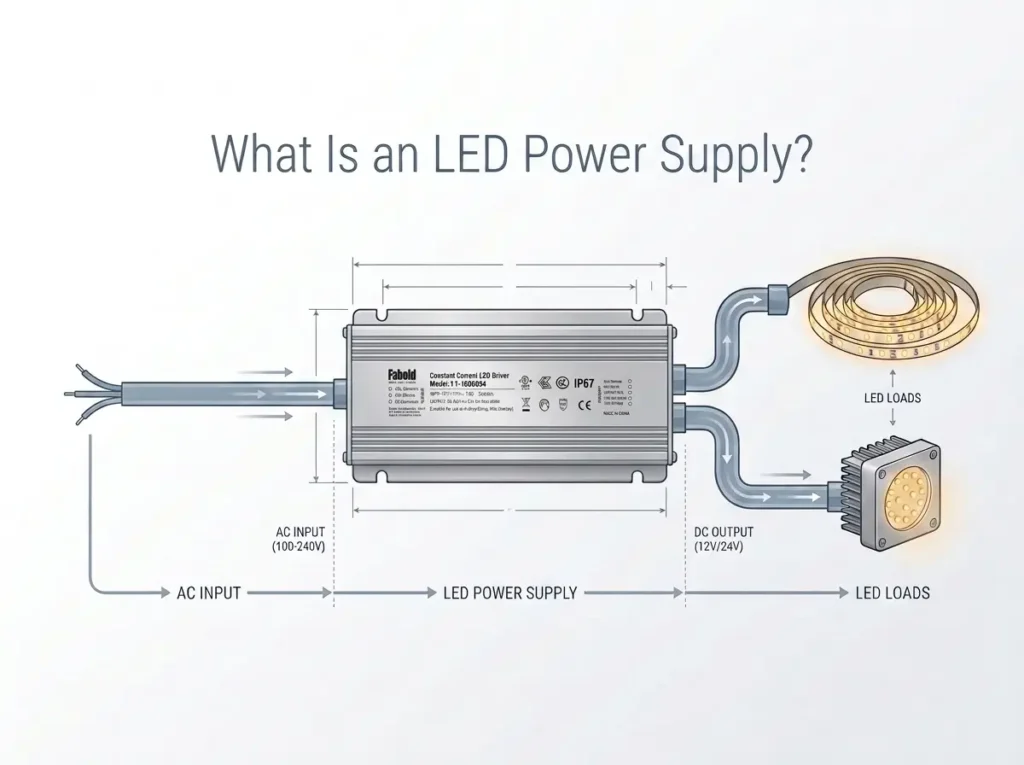
If you first need to clarify the terminology, read what an LED power supply is and how it differs from an LED driver.
For professional lighting projects, however, wattage alone is not enough. Cable length, voltage drop, dimming compatibility, installation environment, thermal conditions, input voltage, and certification requirements can all affect the final driver selection.
Quick Answer: What Power Supply Do LED Strip Lights Need?
For a typical low-voltage LED strip:
- Match the LED strip voltage.
- Calculate total strip wattage.
- Calculate the required output current.
- Select a driver with adequate output capacity.
- Check voltage drop and wiring conditions.
- Confirm dimming requirements.
- Check indoor or outdoor installation conditions.
- Verify applicable certifications and thermal limits.
The basic sizing formula is:
Total LED Load (W) = Strip Power (W/m) × Total Strip Length (m)
The driver should then be selected according to the calculated load and its verified operating specifications rather than by wattage alone.
What Type of Power Supply Does an LED Strip Need?
Most conventional low-voltage LED strips operate from a fixed DC voltage.
Common strip voltages include:
- 12V DC
- 24V DC
- 48V DC
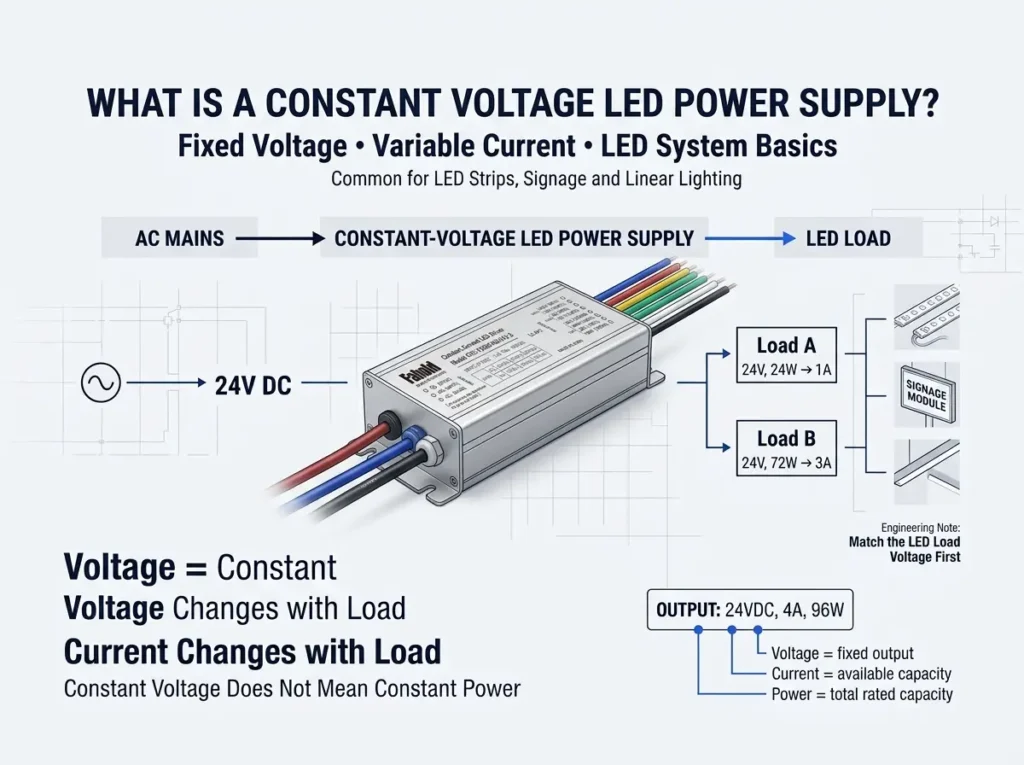
For these systems, a constant voltage LED driver maintains the required output voltage while the LED strip circuitry determines the current consumed by the connected load.
A typical system architecture is:
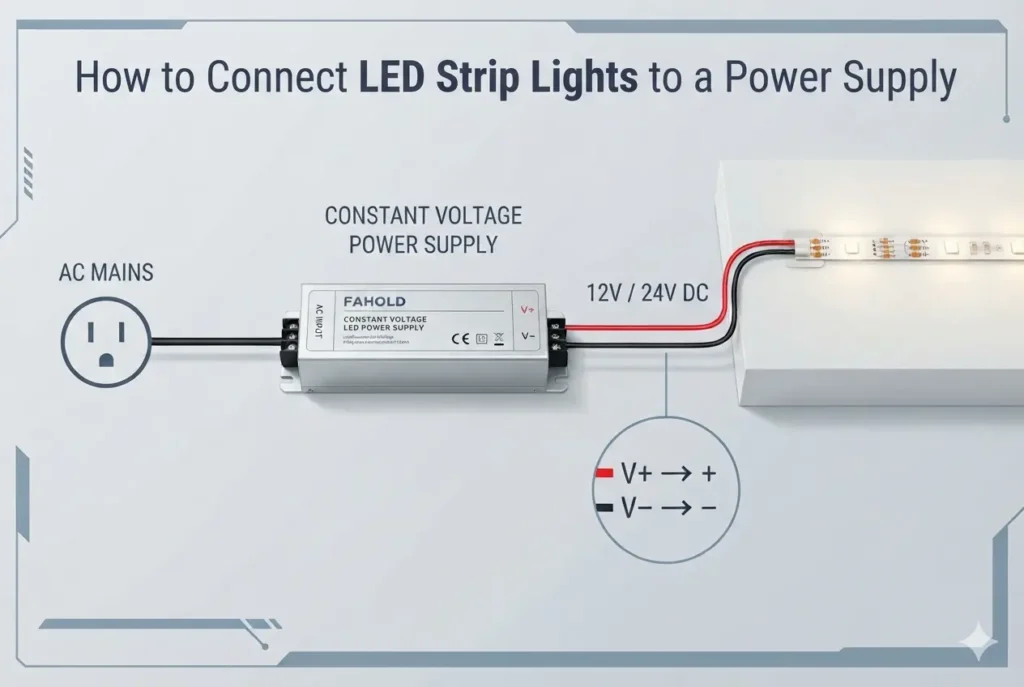
AC Input → Constant Voltage LED Driver → LED Strip
The driver’s output voltage must match the LED strip rating.
| LED Strip Rating | Typical Driver Requirement |
|---|---|
| 12V DC | 12V constant voltage output |
| 24V DC | 24V constant voltage output |
| 48V DC | 48V constant voltage output, where specified |
Voltage compatibility is the first requirement.
A driver with enough wattage but the wrong output voltage is still the wrong driver.
Step 1: Check the LED Strip Voltage
The strip voltage is normally shown on:
- the LED strip PCB;
- product label;
- packaging;
- datasheet;
- supplier specification.
12V LED Strip Power Supply
A 12V LED strip normally requires a 12V constant-voltage output.
12V systems are commonly found in:
- cabinet lighting;
- display lighting;
- furniture lighting;
- short linear-lighting runs;
- smaller signage systems.
At the same power level, a 12V system draws more current than a 24V system.
Using:Current (A) = Power (W) ÷ Voltage (V)
For a 120W load:120W ÷ 12V = 10A
24V LED Strip Power Supply
A 24V LED strip requires a 24V constant-voltage driver.
For the same 120W load:120W ÷ 24V = 5A
This lower current can make conductor sizing and power distribution easier in longer professional installations.
However, 24V should not automatically replace 12V. The selected driver voltage must follow the actual LED strip specification.
12V vs 24V LED Strip Power Supply
| Factor | 12V System | 24V System |
|---|---|---|
| Current at same wattage | Higher | Lower |
| Long cable runs | More sensitive to voltage drop | Generally easier to manage |
| Typical use | Smaller and shorter installations | Commercial and longer linear runs |
| Driver requirement | 12V CV driver | 24V CV driver |
| Wiring consideration | Higher current | Lower current |
The correct choice is determined by the LED strip design, not simply by which voltage appears technically preferable.
Step 2: Calculate the Total LED Strip Wattage
Once the strip voltage is confirmed, calculate the total power requirement.
Use:Total Load = LED Strip Power per Meter × Total Length
Example 1: 5-Meter LED Strip
Suppose the LED strip is rated:
- Voltage: 24V
- Power consumption: 10W/m
- Length: 5m
Calculation:10W/m × 5m = 50W
The connected LED load is therefore approximately:50W
The driver must be capable of supporting that load under the intended operating conditions.
Example 2: 10-Meter Commercial Installation
Suppose the strip specification is:
- Voltage: 24V
- Power: 14.4W/m
- Length: 10m
Calculation:14.4W/m × 10m = 144W
Required load:144W
This does not mean wattage is now the only selection criterion.
The designer should also evaluate:
- driver output-current capacity;
- allowable loading;
- temperature derating;
- cable losses;
- installation environment;
- dimming requirements.
Step 3: Calculate the Required Output Current
For a constant-voltage LED strip system:Current (A) = Total Power (W) ÷ Output Voltage (V)
Example:A 24V system consumes 96W.
96W ÷ 24V = 4A
The selected driver therefore needs sufficient 24V output-current capacity for the complete connected load.
For a 12V system consuming the same 96W:
96W ÷ 12V = 8A
This illustrates why voltage, current, wattage, connector capacity, and conductor size should be evaluated together.
How Much Extra Power Capacity Should a Power Supply Have?
A common online recommendation is to automatically add a fixed percentage—often 20%—to every LED strip calculation.
That is too simplistic for professional driver selection.
A better process is:
- Calculate the actual LED load.
- Select a driver whose rated output appropriately covers the load.
- Check the manufacturer’s permitted operating range.
- Review temperature derating.
- Consider enclosure and installation conditions.
- Apply additional project margin where appropriate.
For example, a 50W LED load clearly cannot be powered correctly by a 40W driver.
A higher-rated driver may be appropriate, but the exact rating should be selected using verified driver specifications rather than an arbitrary universal percentage.
Step 4: Consider Voltage Drop
Even when the driver has sufficient output wattage, poor low-voltage wiring design can result in inconsistent LED strip performance.
Voltage drop occurs because conductors have electrical resistance, causing the voltage available at the load to decrease as current flows through the wiring.
Important factors include:
- cable length;
- current;
- conductor cross-section;
- conductor material;
- terminal resistance;
- connection quality.
Excessive voltage drop may result in:
- reduced brightness at the end of a strip;
- inconsistent brightness between branches;
- color variation;
- unstable operation.
Possible design solutions include:
- using larger conductors;
- shortening low-voltage cable runs;
- injecting power at multiple locations;
- splitting large systems across multiple drivers;
- using 24V instead of 12V where the LED strip system supports it.
The driver wattage alone cannot solve a poorly designed power-distribution system.
How Many LED Strips Can One Power Supply Run?
Multiple LED strips can share one constant-voltage driver when:
- all strips require the same rated voltage;
- their combined wattage remains within the driver’s allowable output;
- branch wiring is correctly sized;
- voltage drop remains acceptable.
For example:
| LED Strip Branch | Load |
|---|---|
| Strip A | 30W |
| Strip B | 25W |
| Strip C | 20W |
| Total | 75W |
The driver must support the combined 75W load, not just the wattage of one strip.
For larger systems, engineers should also consider:
- branch current;
- cable size;
- connector ratings;
- voltage drop;
- power-injection locations;
- serviceability.
One large power supply is not always preferable to several smaller drivers.
The optimal architecture depends on the physical layout and project requirements.
Constant Voltage vs Constant Current LED Drivers
Understanding the difference between constant-voltage and constant-current drivers is critical when selecting an LED power supply.
Constant Voltage LED Driver
A constant-voltage driver maintains a defined output voltage.
Typical outputs include:
- 12V
- 24V
- 48V
This architecture is widely used for conventional low-voltage LED strips.
Constant Current LED Driver
A constant-current driver regulates the current supplied to the LED load.
Typical ratings may include:
- 350mA
- 500mA
- 700mA
- 1050mA
These drivers are commonly used with LED modules and luminaires specifically designed around a regulated operating current.
Quick Comparison
| Factor | Constant Voltage | Constant Current |
|---|---|---|
| Controlled parameter | Voltage | Current |
| Typical specification | 12V / 24V / 48V | 350mA / 700mA etc. |
| Common conventional LED strip use | Yes | Only for strips/modules designed for CC operation |
| Main matching requirement | Rated voltage | Current and voltage operating window |
For most standard 12V and 24V strips, begin by evaluating constant voltage LED drivers.
Step 5: Determine Whether Dimming Is Required
If the project requires brightness control, the lighting-control architecture should be defined before selecting the driver.
Possible control methods include:
- PWM;
- 0-10V;
- DALI-2;
- TRIAC;
- ELV;
- MLV;
- other phase-cut systems.
A driver should not be assumed compatible simply because both the driver and controller are described as “dimmable.”
PWM Dimming
PWM stands for pulse-width modulation.
It controls perceived LED brightness by rapidly switching output power between on and off states while varying the duty cycle.
PWM is commonly associated with low-voltage LED strip control, but compatibility depends on the:
- LED driver;
- controller;
- LED strip;
- control frequency;
- system architecture.
0-10V Dimming
0-10V is an analog lighting-control method widely used in commercial lighting systems.
A compatible 0-10V driver receives the control signal and regulates the LED output accordingly.
For suitable outdoor lighting projects, review FAHOLD 0-10V LED drivers.
A critical distinction is that 0-10V describes the control signal.
It does not mean a 24V LED strip receives 0-10V as its normal power input.
DALI-2 Dimming
DALI is a digital lighting-control protocol used for communication between compatible lighting-control equipment.
The official DALI Alliance / IEC 62386 documentation provides the standards framework behind DALI communication and control gear.
DALI-2 extends the certification framework and interoperability requirements for compatible devices.
For suitable applications, review FAHOLD DALI-2 LED drivers.
Phase-Cut Dimming
TRIAC, ELV, MLV, forward-phase, and reverse-phase systems require drivers specifically designed for the intended phase-cut control architecture.
A standard non-dimmable power supply should not be assumed compatible with a mains wall dimmer.
When sourcing dimmable LED drivers, specify:
- control method;
- LED strip voltage;
- output power;
- intended dimmer/controller;
- application environment.
Step 6: Check Indoor or Outdoor Installation Conditions
Electrical output specifications are only part of driver selection.
Indoor Installations
Consider:
- available mounting space;
- ventilation;
- enclosure temperature;
- access for wiring;
- installation method;
- thermal management.
Outdoor or Exposed Installations
Additional considerations include:
- ingress protection;
- moisture;
- dust;
- operating temperature;
- cable sealing;
- enclosure design;
- surge environment.
The IP classification system is defined by IEC 60529.
However, an IP rating should never be selected from the number alone. The actual installation location and exposure conditions determine the required level of protection.
For professional LED strip lighting applications, define environmental conditions before selecting the driver.
Step 7: Confirm Input Voltage and Target Market
The LED strip output voltage and the driver’s AC input voltage are different specifications.
For example:
AC Mains → LED Driver → 24V DC → LED Strip
Before selecting a product, verify:
- AC input-voltage range;
- mains frequency;
- target country or region;
- safety standards;
- EMC requirements;
- project certification requirements.
For North American lighting applications, applicable safety requirements may include standards such as UL 8750, depending on the final lighting product and certification route.
Do not assume that a driver suitable for one market is automatically approved for another.
Certification must be verified against the actual product specification.
Step 8: Check Thermal Conditions and Derating
Driver performance can change with temperature.
Relevant datasheet parameters may include:
- ambient temperature (Ta);
- case temperature (Tc);
- maximum operating temperature;
- load-versus-temperature derating.
A driver installed inside:
- a sealed luminaire;
- signage enclosure;
- architectural profile;
- outdoor housing
may operate at a significantly higher local temperature than the surrounding ambient environment.
Therefore, a driver that appears correctly sized by wattage can still become unsuitable if thermal conditions cause significant derating.
Thermal evaluation should be part of the initial selection process.
LED Strip Power Supply Selection Examples
Example A: 5m 24V LED Strip
LED strip:
- 24V
- 9.6W/m
- 5m
Total load:
9.6W × 5 = 48W
Required current:
48W ÷ 24V = 2A
Selection should therefore begin with:
- 24V constant-voltage output;
- sufficient output-current capacity;
- adequate rated power;
- suitable thermal performance;
- appropriate input voltage;
- correct dimming interface, if required.
Example B: 10m 24V Commercial LED Strip
LED strip:
- 24V
- 14.4W/m
- 10m
Total load:
14.4W × 10 = 144W
Current:
144W ÷ 24V = 6A
At this scale, additional checks become important:
- conductor size;
- voltage drop;
- power-feed locations;
- number of drivers;
- enclosure temperature;
- dimming architecture.
Choosing a product solely because its label says “150W” is not a complete engineering selection process.
Example C: Multiple LED Strip Branches
Three 24V branches consume:
- Branch A: 36W
- Branch B: 48W
- Branch C: 24W
Combined load:
36W + 48W + 24W = 108W
Required current:
108W ÷ 24V = 4.5A
Both the driver and the distribution wiring must support the complete system.
Common LED Strip Power Supply Selection Mistakes
1. Matching Wattage but Not Voltage
A 100W 12V driver is still incorrect for a 24V LED strip.
Voltage matching comes first.
2. Assuming Every LED Driver Has the Same Output Architecture
Always confirm whether the LED load requires:
- constant voltage; or
- constant current.
3. Ignoring Voltage Drop
A correctly sized driver does not guarantee uniform voltage across long cable runs.
4. Ignoring Dimming Compatibility
A dimmable system requires compatibility between:
- controller;
- driver;
- LED load;
- wiring architecture.
5. Applying a Universal Power-Margin Percentage
A fixed percentage should not replace the driver’s actual loading and thermal specifications.
6. Selecting an IP Rating Without Evaluating the Installation
Indoor, damp, enclosed, and directly exposed installations can have very different protection requirements.
7. Selecting the Driver Before Defining the LED Load
The LED strip requirements should determine the power-supply specification.
LED Strip Power Supply Specification Checklist for Buyers
For lighting manufacturers, distributors, project contractors, sourcing managers, and OEM customers, prepare the following information before requesting a driver recommendation:
| Parameter | Information Required |
|---|---|
| Application | LED strip, signage, linear lighting, etc. |
| Input voltage | Required AC range |
| LED strip voltage | 12V / 24V / 48V / other |
| Strip power | W/m or W/ft |
| Total strip length | Installed length |
| Total wattage | Calculated load |
| Output current | Calculated requirement |
| Dimming | Non-dimming / 0-10V / DALI-2 / phase-cut / other |
| Installation | Indoor / outdoor / enclosed |
| Protection | Required environmental protection |
| Target market | Country or region |
| Certification | Project requirement |
| Quantity | Estimated order volume |
| Project schedule | Sample / production timing |
Providing these parameters allows the driver supplier to evaluate the complete electrical system instead of recommending a product based on wattage alone.
LED Strip Power Supply Selection Workflow
Use this process:
1. Identify LED strip voltage
↓
2. Confirm power consumption per meter
↓
3. Determine total installed length
↓
4. Calculate total load wattage
↓
5. Calculate output current
↓
6. Evaluate voltage drop
↓
7. Define dimming or control requirements
↓
8. Define environmental conditions
↓
9. Check thermal and derating requirements
↓
10. Confirm input voltage and certifications
↓
11. Select the appropriate LED driver
This provides a more reliable selection method than using wattage alone.
Selecting a FAHOLD LED Driver for an LED Strip Project
For professional LED strip and linear-lighting projects, driver selection should begin with the complete system specification.
When evaluating constant voltage LED drivers, provide:
- LED strip output voltage;
- total wattage;
- required output current;
- input voltage;
- dimming method;
- installation environment;
- target market;
- certification requirements.
Projects requiring analog lighting control can review FAHOLD 0-10V LED drivers.
Projects using digital DALI control can review FAHOLD DALI-2 LED drivers.
Where an existing product category or series does not clearly satisfy the application, provide the complete lighting-system specification before selecting a model.
Need Help Selecting the Right LED Driver?
If you are sourcing an LED driver for an LED strip, linear-lighting, signage, commercial-lighting, or OEM luminaire project, prepare:
- input voltage;
- LED strip voltage;
- total load wattage;
- dimming requirements;
- application environment;
- target market;
- estimated quantity.
Request a Quote to discuss the appropriate LED driver specification for your project.
Frequently Asked Questions
What power supply do I need for LED strip lights?
Match the power supply output voltage to the LED strip first. A 12V LED strip requires a 12V constant-voltage driver, while a 24V LED strip requires a 24V constant-voltage driver. Then calculate total wattage and required output current before checking thermal, wiring, and environmental requirements.
How do I calculate power supply size for an LED strip?
Use:Total Power = LED Strip Wattage per Meter × Total Strip Length
Then calculate:Required Current = Total Power ÷ Strip Voltage
Use these values together with the driver’s rated output and operating specifications.
Can multiple LED strips use one power supply?
Yes. Multiple strips can share a constant-voltage driver when they require the same voltage and their combined power and current remain within the driver’s operating limits. Branch wiring and voltage drop must also be evaluated.
Is a 24V power supply better than a 12V power supply?
Not universally. The power supply voltage must match the LED strip. At the same wattage, a 24V system operates at lower current than a 12V system, which can be advantageous in longer power-distribution runs.
Can I use a higher-wattage power supply with an LED strip?
A constant-voltage driver can have a rated power higher than the actual LED load if the output voltage is correct and the connected load remains within the driver’s permitted operating range. Always verify the manufacturer’s specifications.
Do LED strip lights need constant-voltage or constant-current drivers?
Most conventional 12V and 24V LED strips are designed for constant-voltage operation. Constant-current drivers should only be used when the LED load is specifically designed for regulated-current operation.
Can LED strip lights use a dimmable driver?
Yes, when the LED strip, driver, controller, and control architecture are compatible. Depending on the system, dimming may use PWM, 0-10V, DALI-2, phase-cut, or another control method.
Find the Right LED Power Supply for Your Project
Share the core electrical and application requirements. We will narrow the available FAHOLD platforms to the options most relevant to your project.