Table of Contents
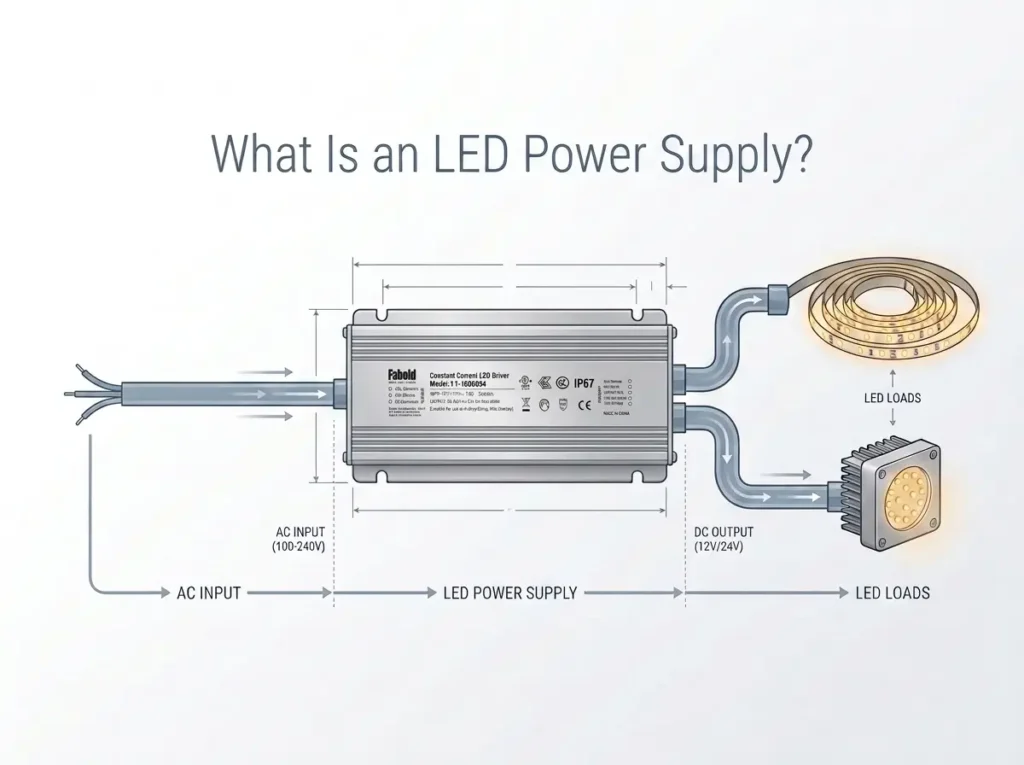
A constant voltage LED power supply is a regulated power source designed to maintain a specified DC output voltage—such as 12V, 24V or another rated value—while the connected compatible LED load draws the current it requires within the supply’s rated output capacity.
In practical terms:
- Voltage is regulated by the power supply.
- Current varies with the connected load.
- The LED load must be designed for that fixed voltage.
- The supply must have enough current and wattage capacity for the total load.
This architecture is commonly used with LED products that already include their own current-limiting or current-regulating circuitry, such as many LED strips, signage modules and linear-lighting products.
If you need the complete constant-voltage selection framework rather than only the definition, start with the Constant Voltage LED Power Supply Guide.
Quick Answer: What Does “Constant Voltage” Mean?
“Constant voltage” means the power supply regulates its output around a specified voltage as the connected load changes within its permitted operating range.
For example, a 24V constant-voltage supply is designed to maintain approximately its specified 24V output while the current drawn by the connected load varies.
MEAN WELL describes a traditional constant-voltage supply in the same way: output voltage remains at its rated value while output current changes according to the load condition. See MEAN WELL — LED Power Supply Technical Q&A.
TDK-Lambda also distinguishes regulated constant-voltage power supplies from constant-current LED drivers and notes that the critical selection issue is the actual output architecture, not merely whether a product is marketed as a “driver” or “power supply.” See TDK-Lambda — What Type of LED Driver or Power Supply Do I Need?.
How a Constant Voltage LED Power Supply Works
A typical AC-powered constant-voltage lighting system can be represented as:
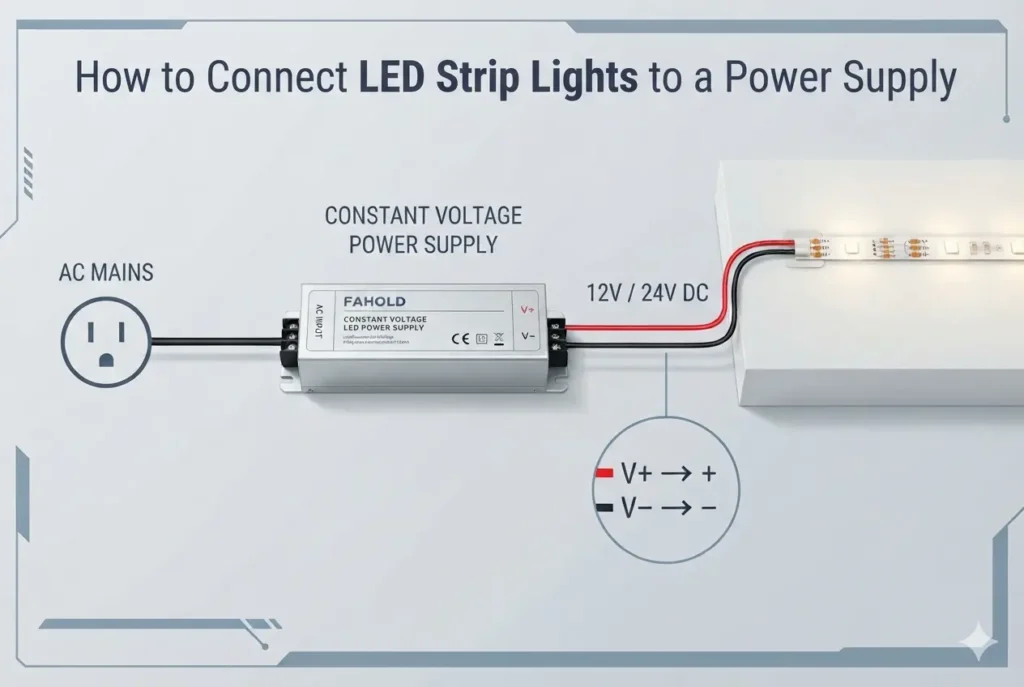
AC mains → constant-voltage LED power supply → controller if required → fixed-voltage LED load
The power supply converts the available input power to the DC voltage required by the lighting system.
For example:
- AC input: project-dependent;
- DC output: 24V;
- connected LED load: 72W.
The load current is:
I = P ÷ V
72W ÷ 24V = 3A
The power supply therefore needs to provide the correct 24V output and sufficient usable output-current/power capacity under the actual operating conditions.
The important point is that the 3A is determined by the load requirement in this example. The supply’s current rating represents how much current it is designed to make available within its specification.
Constant Voltage Does Not Mean Constant Power
A constant-voltage supply does not force every connected load to consume the same wattage.
Suppose the same 24V supply powers two different compatible loads at different times:
- Load A: 24V, 24W → approximately 1A
- Load B: 24V, 72W → approximately 3A
The regulated output voltage remains the same, while the current demand changes.
This is one reason the label should be read in terms of voltage + maximum output current + power capacity, not wattage alone.
If your main question is how much capacity should remain above the calculated load, continue with How Much Power-Supply Capacity Should You Leave for LED Loads?.
What Does a Constant Voltage Power-Supply Label Look Like?
A constant-voltage product is usually easy to identify when the output specification states a fixed DC voltage.
For example:
OUTPUT: 24VDC, 4A, 96W
The interpretation is:
- regulated output voltage: 24VDC;
- rated output-current capacity: 4A;
- rated power: 96W.
The basic relationship is:
24V × 4A = 96W
The connected compatible load does not need to consume the full 4A or 96W simply because that is the supply’s rated capacity.
However, actual usable output can still depend on the exact product’s thermal, input-voltage and installation requirements.
How Is Constant Voltage Different From Constant Current?
A constant-voltage supply regulates voltage.
A constant-current driver regulates current.
| Characteristic | Constant Voltage | Constant Current |
|---|---|---|
| Regulated output | Voltage | Current |
| Typical label cue | 12VDC / 24VDC / 48VDC | 350mA / 700mA / 1050mA, etc. |
| Other output variable | Current changes with load | Voltage varies within a specified range |
| Common system architecture | Load includes its own current control | Driver controls LED current directly |
| Common applications | Many strips, signage modules, linear systems | LED engines/modules designed for CC |
This distinction is more important than the marketing term printed on the product.
The current IEC safety framework for electronic LED controlgear is IEC 61347-2-13:2024. Its scope covers electronic controlgear for LED light sources and rated output characteristics: IEC 61347-2-13:2024.
For a full decision framework—including how to identify the correct type from a load label and what happens when the wrong type is used—see Constant Voltage vs Constant Current for LED Lighting.
Why Many LED Strips Use Constant Voltage
Many conventional LED strips are designed for a fixed DC input voltage.
Their segments contain circuitry that limits or regulates current locally, so the external power source is selected primarily around:
- required DC voltage;
- total connected wattage/current;
- dimming/control architecture;
- wiring and voltage drop;
- installation environment.
A typical strip may be labeled 12VDC or 24VDC.
If the strip says 24VDC, the first selection requirement is a compatible 24V constant-voltage supply.
The supply wattage comes next.
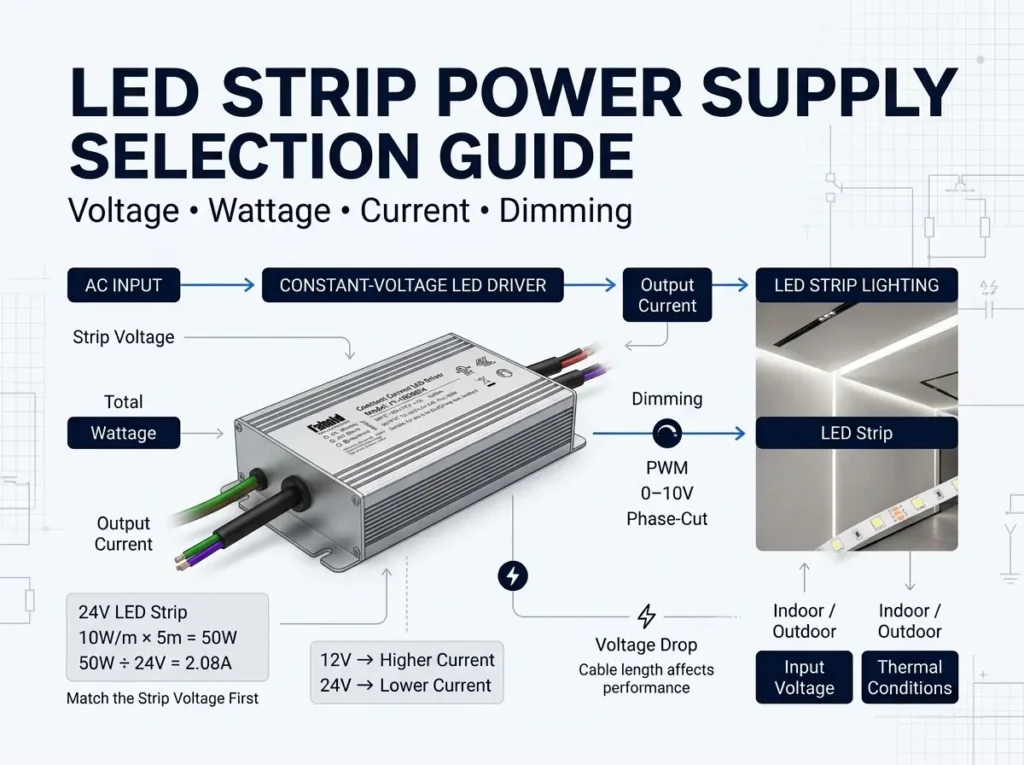
FAHOLD’s existing guide How to Choose the Right Power Supply for LED Strip Lights goes deeper into strip-specific voltage, load calculations, current, dimming and installation conditions.
For the broader application, see LED Strip Lighting.
Why Signage Often Uses Constant Voltage
Many channel-letter modules, light-box modules and other signage loads are also designed around a specified DC voltage.
A sign system can contain many modules connected across several branches. In that case, the power-supply designer needs to verify:
- module voltage;
- total module wattage;
- combined current;
- branch layout;
- wire length;
- enclosure temperature;
- environmental exposure.
The fact that multiple modules can share a supply does not remove the need to calculate the combined load.
That topic is covered separately in Can Multiple LED Loads Share One Power Supply?.
For application-level requirements, see Sign Lighting.
How Do You Match a Constant Voltage Supply to the Load?
Use this sequence.
Step 1 — Confirm the LED load is constant voltage
Check the load datasheet or label.
Look for a defined fixed-voltage input such as:
- 12VDC;
- 24VDC;
- another specified DC voltage.
Do not assume the architecture from product appearance alone.
Step 2 — Match the output voltage
A conventional 24V load requires a compatible 24V supply.
A higher-wattage 12V supply does not substitute for a 24V supply.
Step 3 — Calculate total connected power
For LED strip:
Total load = watts per foot/meter × total length
For modules:
Total load = watts per module × quantity
For several branches:
Total load = Branch A + Branch B + Branch C + …
Step 4 — Calculate current
Use:
I = P ÷ V
For a 24V, 120W system:
120W ÷ 24V = 5A
Step 5 — Check usable capacity and derating
Do not stop at the nameplate wattage.
Check the exact supply datasheet for:
- continuous loading;
- ambient-temperature derating;
- input-voltage derating;
- mounting/cooling conditions.
For the complete general selection workflow, use How to Choose an LED Power Supply.
What Happens If the Power Supply Voltage Does Not Match?
A constant-voltage system should not be designed on the assumption that a “close” voltage is automatically acceptable.
Examples:
- 24V load + 12V supply → incorrect operating condition;
- 12V load + 24V supply → incorrect and potentially damaging operating condition;
- 24V load + compatible 24V supply → correct voltage basis, with remaining checks still required.
The load manufacturer’s specification determines acceptable voltage.
If you are still deciding the system architecture rather than matching an existing load, see 12V vs 24V LED Power Supply and 24V vs 48V LED Power Supply.
What Happens If the Load Exceeds the Supply Capacity?
If the connected load exceeds the rated or usable output capacity, the supply can enter overload behavior defined by its design.
MEAN WELL notes that overload protection can include shutdown, hiccup or current-limiting behavior depending on the product and that operation in the overload-protection region is not intended as normal continuous operation: MEAN WELL — Overload Protection and CV/CC Operation.
The practical rule is:
Size the supply so the maximum connected load remains within the product’s normal operating region under the real environmental and input conditions.
Why Voltage Drop Matters in Constant-Voltage Systems
A power supply can be correctly rated at 24V while the voltage measured at a distant LED load is lower because wiring and connections have resistance.
In a simplified circuit:
Vdrop = I × R
Higher current and higher circuit resistance increase voltage drop.
That means constant-voltage system design must consider not only the power-supply output but also the wiring between the supply and the load.
A larger-wattage supply does not automatically fix conductor voltage drop.
For the dedicated engineering guide, see Voltage Drop in Constant-Voltage LED Systems.
Can a Constant Voltage Power Supply Be Dimmable?
Yes, but “constant voltage” describes output regulation—not the dimming interface.
A constant-voltage power supply may be:
- non-dimmable;
- phase-cut dimmable;
- controlled by 0–10V;
- controlled through DALI or another system;
- used with a downstream PWM controller;
- designed around another manufacturer-defined architecture.
Do not assume every CV supply supports every dimming method.
If the project uses wired control, verify the exact product documentation. UL 8750 includes requirements relevant to LED equipment and wired controls such as 0–10V and DALI in applicable product configurations: UL Solutions — UL 8750 and Wired LED Controls.
Does Low Voltage Automatically Mean Class 2?
No.
A 12V or 24V output label does not by itself prove that the power unit or lighting system is Class 2.
UL’s discussion of UL 2108 shows that low-voltage lighting systems and Class 2 configurations have defined power-unit and system requirements: UL Solutions — UL 2108 Low-Voltage Lighting Systems.
For a North American project, verify the exact product certification and output limits rather than inferring Class 2 from voltage alone.
Constant Voltage Selection Checklist
Before approving a CV supply, confirm:
| Requirement | What to verify |
|---|---|
| Load architecture | Constant voltage |
| Output voltage | Exact load-compatible DC voltage |
| Total load | Maximum connected wattage |
| Output current | Sufficient for total load |
| Capacity | Normal operation after applicable derating |
| AC input | Compatible with project mains |
| Dimming/control | Exact interface compatibility |
| Wiring | Voltage drop and branch distribution |
| Environment | Thermal/IP/exposure requirements |
| Certification | Exact product/project requirements |
| Dimensions | Mechanical fit and connection method |
When Should FAHOLD Product Matching Begin?
Not at the definition stage.
A useful product recommendation requires at least:
- project market;
- AC input;
- required DC output voltage;
- maximum load wattage/current;
- dimming/control;
- installation environment;
- certification requirements;
- dimensional constraints.
Once those conditions are known, send the project requirements to FAHOLD for specification-based matching.
FAQ
What is a constant voltage LED power supply?
It is a regulated power source that maintains a specified DC output voltage while a compatible connected load draws current within the supply’s operating capacity.
What is an example of constant voltage?
A 24VDC LED power supply designed to maintain its 24V output while compatible loads draw different current levels is a constant-voltage source.
Are LED strip lights constant voltage?
Many conventional low-voltage LED strips are designed for fixed-voltage input such as 12V or 24V. Always verify the exact strip label or datasheet.
Does constant voltage mean the current stays the same?
No. In a CV architecture, voltage is regulated while current changes according to the compatible load.
How do I know if my LED is constant voltage or constant current?
Read the LED load specification. A fixed-voltage input such as 24VDC usually indicates a CV system; a specified drive current such as 700mA together with an operating voltage range points toward a CC architecture. Confirm with the manufacturer documentation.
Can I use a higher-wattage constant-voltage supply?
Potentially yes, provided the output voltage and all other specifications are compatible. Extra wattage represents additional capacity, not permission to change the output voltage.
Need Help With Your LED Power Supply Project?
Tell us what you are working on. We will review your application and recommend the most relevant FAHOLD solution.