Table of Contents
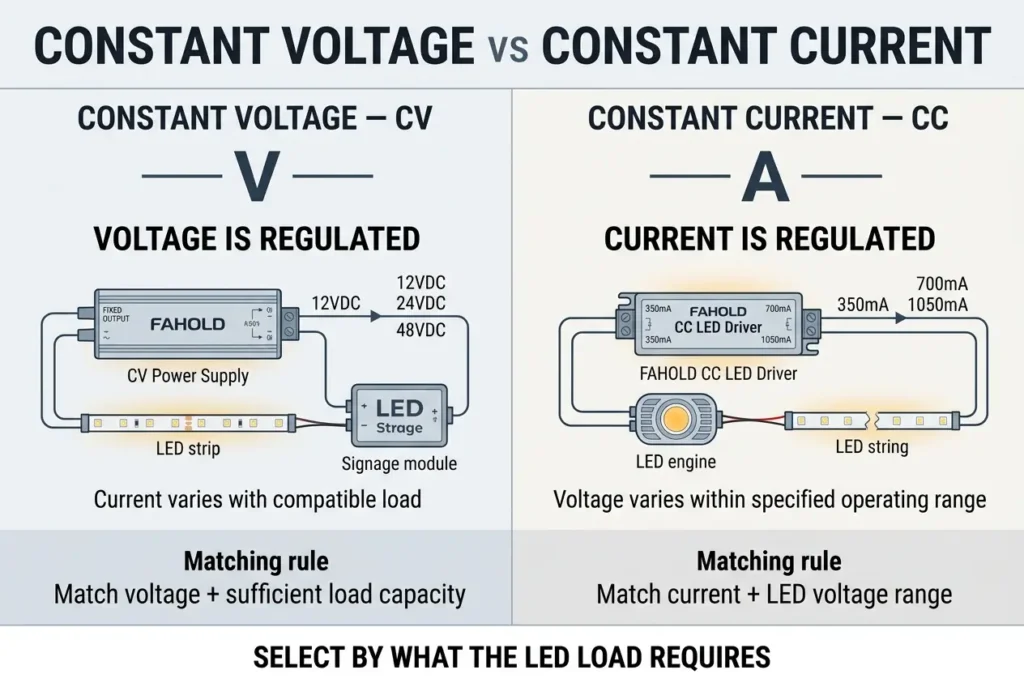
The difference between constant voltage (CV) and constant current (CC) is not a naming preference. It describes what the LED power source regulates and therefore how it must be matched to the LED load.
- A constant-voltage power supply regulates output voltage while the compatible load draws current within the supply’s rated capacity.
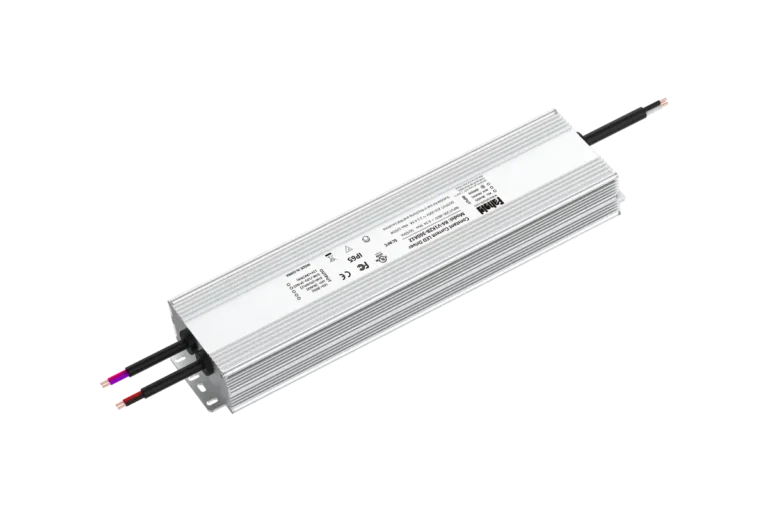
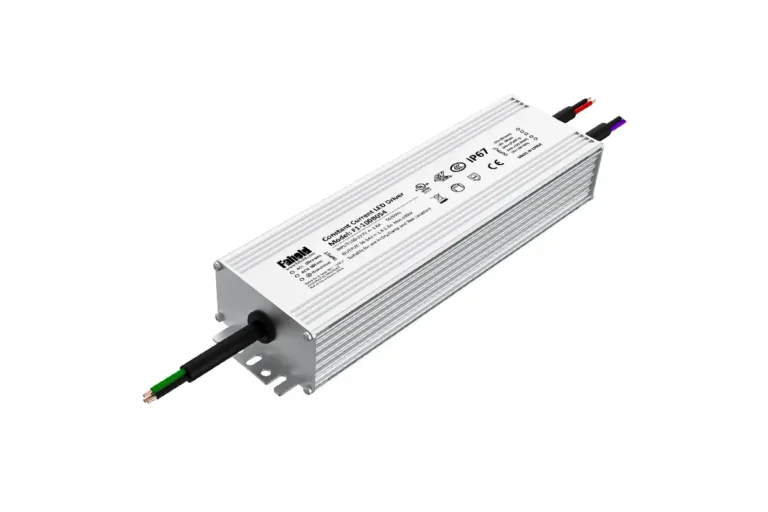
- A constant-current LED driver regulates output current while its output voltage varies within a defined operating range to suit the LED load.
The quickest practical rule is:
If the LED load is specified by a fixed input voltage such as 12VDC or 24VDC, it is generally a constant-voltage system. If it is specified by a drive current such as 350mA, 700mA or 1050mA together with an operating voltage range, it is generally a constant-current system.
The exact load datasheet remains the final authority.
If you need the CV architecture explained first, read What Is a Constant Voltage LED Power Supply?. For the complete CV topic cluster, use the Constant Voltage LED Power Supply Guide.
Constant Voltage vs Constant Current: Quick Comparison
| Feature | Constant Voltage (CV) | Constant Current (CC) |
|---|---|---|
| Regulated quantity | Voltage | Current |
| Typical output marking | 12VDC, 24VDC, 48VDC | 350mA, 700mA, 1050mA, etc. |
| Other output variable | Current varies with compatible load | Voltage varies within specified range |
| Common load architecture | Load includes current-limiting/regulating circuitry | Driver regulates LED current directly |
| Typical applications | Many LED strips, signage modules, linear systems | LED engines/modules designed for CC, many integrated luminaires |
| Primary matching rule | Voltage must match + capacity must be sufficient | Current must match + LED voltage must fit driver range |
| Common error | Choosing correct watts but wrong voltage | Choosing correct watts but wrong current/range |
MEAN WELL’s technical documentation distinguishes CV and CC operation on exactly this basis: CV supplies maintain output voltage as current varies with load, while CC LED power supplies regulate current within their defined operating region. See MEAN WELL — CV and CC LED Power Supply Operation.
TDK-Lambda makes the same practical distinction and notes that “LED driver” and “LED power supply” are sometimes used inconsistently in the market, making the actual output specification more important than the name. See TDK-Lambda — Constant Current vs Constant Voltage LED Power Sources.
What Does a Constant Voltage Driver Regulate?
A CV supply holds its output voltage around a rated value.
Example label:
OUTPUT: 24VDC, 4A, 96W
The relevant selection logic is:
- the LED load must be compatible with 24VDC;
- the total load current must remain within the usable output capacity;
- the total wattage must remain within the candidate’s normal operating region after applicable derating.
At a 48W load:
48W ÷ 24V = 2A
At a 72W load:
72W ÷ 24V = 3A
The voltage remains the regulated quantity while current demand changes.
What Does a Constant Current Driver Regulate?
A CC driver regulates current.
A simplified label might look like:
OUTPUT: 700mA, 25–42VDC
The key selection questions become:
- Does the LED load require 700mA?
- Does the LED string’s operating/forward-voltage range fit within the driver’s specified voltage window?
- Is the resulting load power within the driver’s rating?
- Are dimming and environmental requirements compatible?
For CC systems, selecting only from wattage is particularly risky because two 30W drivers can have different current ratings and different output-voltage windows.
How to Identify CV or CC From the LED Load Label
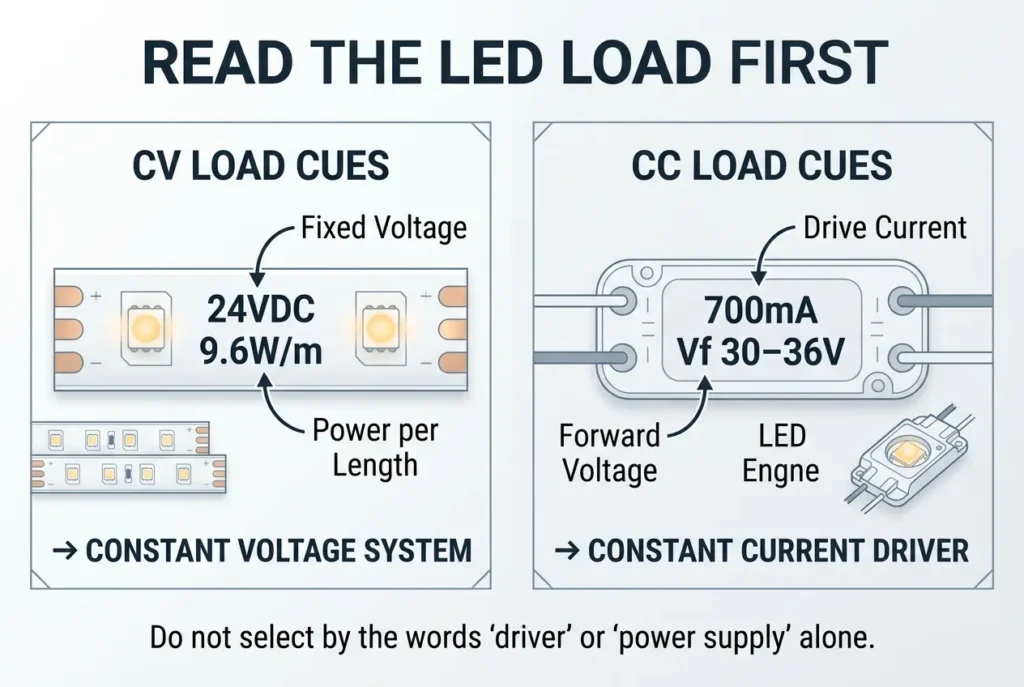
The load label is often more useful than the driver label.
Typical CV load cues
A fixed-voltage load may show:
- 12VDC;
- 24VDC;
- 48VDC;
- watts per meter/foot;
- total wattage;
- maximum current.
Example:
24VDC · 9.6W/m
This points toward a 24V constant-voltage system.
Typical CC load cues
A CC LED module may show:
- 350mA;
- 700mA;
- 1050mA;
- forward voltage or operating voltage range;
- maximum power.
Example:
700mA · Vf 30–36V
This points toward a 700mA constant-current driver whose operating voltage range includes the LED load.
Do not rely on product category names such as “LED driver,” “LED transformer” or “LED power supply” to make this decision.
Why Wattage Alone Cannot Tell You CV or CC
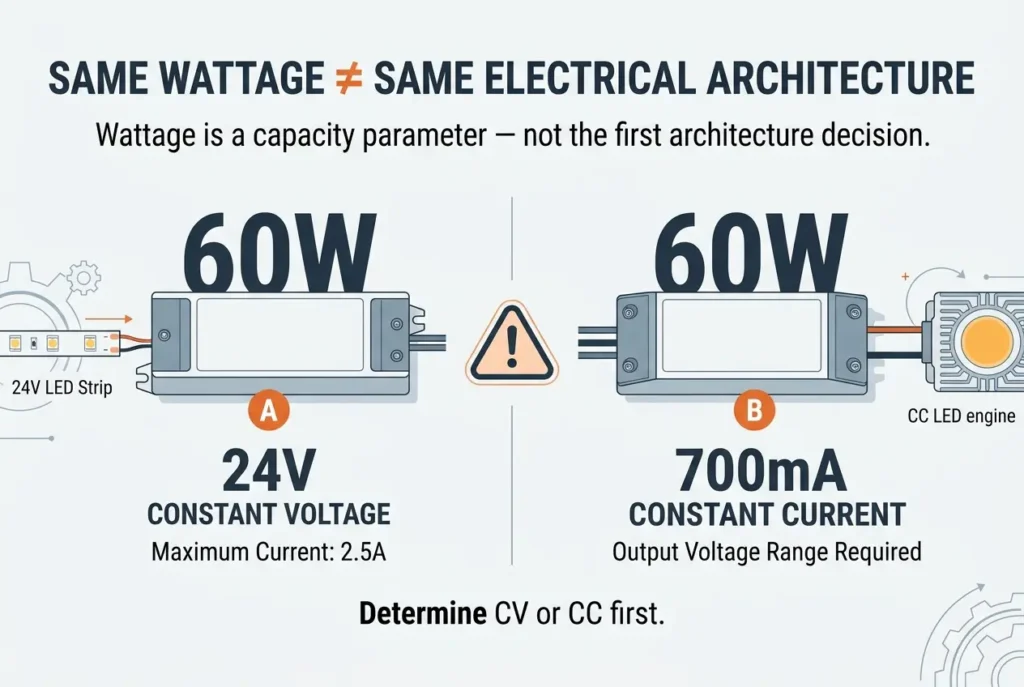
Suppose two products are both rated 60W.
Product A
- 24V constant voltage;
- maximum current 2.5A.
Product B
- 700mA constant current;
- voltage range appropriate to its design.
Both can be approximately 60W-class products, but they are designed for different loads.
This is why the table task specifically requires “cannot only look at wattage.”
Wattage is a capacity/result parameter.
The architecture is defined first by what is regulated:
- fixed voltage;
- or fixed current.
For complete power-supply selection after architecture is known, use How to Choose an LED Power Supply.
Why Many LED Strips Are Constant Voltage
Many conventional low-voltage LED strips are built as repeated segments that include current-limiting or current-regulating components.
The external supply provides a fixed voltage, commonly according to the strip’s rated system voltage.
That makes the decision sequence:
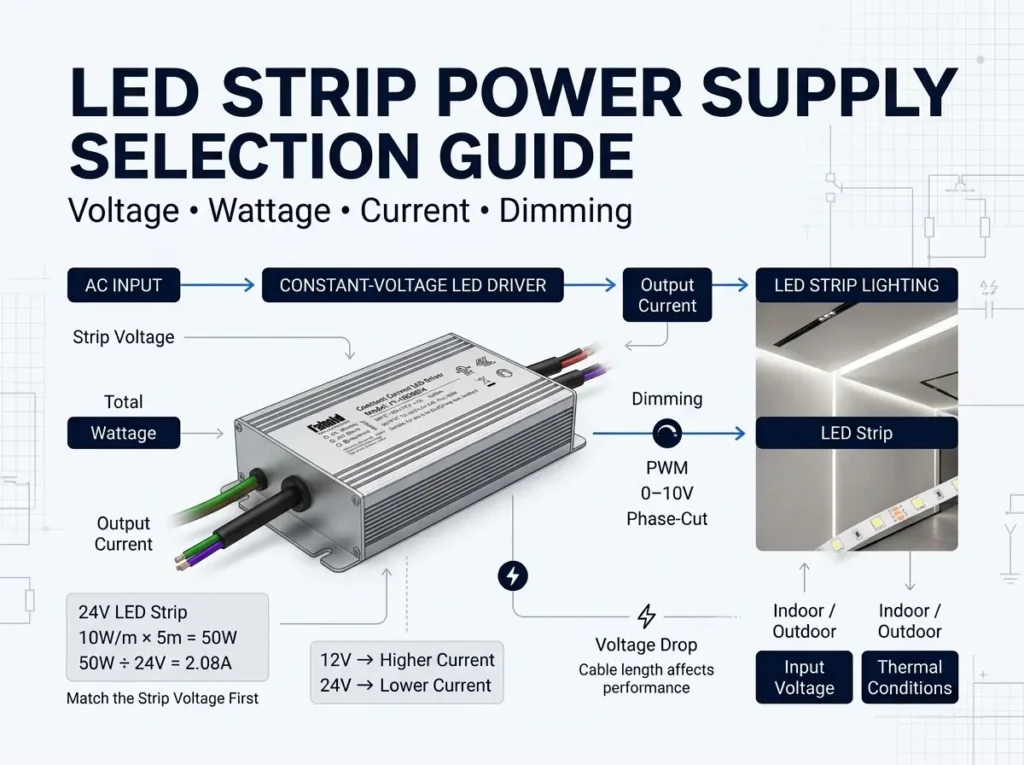
Strip voltage → total strip wattage → current → supply capacity → wiring → dimming/environment
FAHOLD’s existing LED Strip Power Supply Selection Guide covers this strip-specific workflow in detail.
For the application page, see LED Strip Lighting.
Why Many High-Power LED Engines Use Constant Current
Bare or integrated LED engines designed for direct current regulation are commonly paired with a constant-current driver.
LED forward voltage changes with device characteristics and operating conditions, which is one reason direct LED drive commonly focuses on current regulation.
MEAN WELL’s LED technical Q&A explains that LED forward voltage has nonlinear characteristics and temperature sensitivity and describes constant-current driving as a common approach for direct high-power LED operation: MEAN WELL — LED Drive Methods and Constant Current Operation.
The IEC controlgear framework also treats rated output characteristics as core product parameters. See IEC 61347-2-13:2024.
Where Is Current Regulation Located?
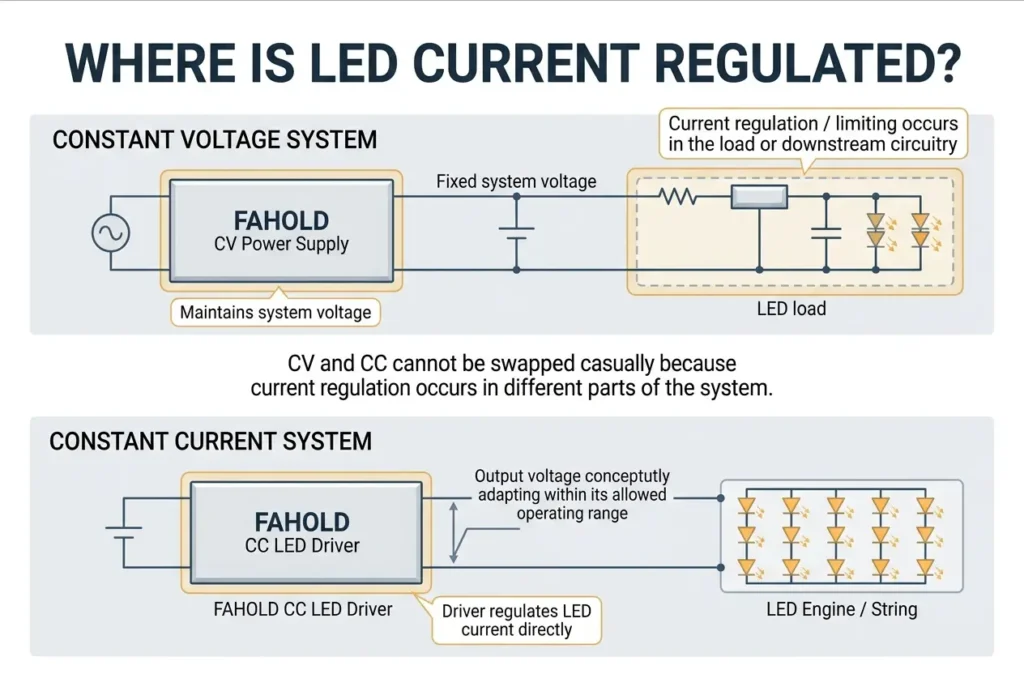
A useful way to understand CV vs CC is to ask:
Where is the LED current being regulated?
Constant-voltage system
Current control is typically part of the LED load or a downstream controller/driver circuit.
The external supply maintains the system voltage.
Constant-current system
The LED driver itself regulates current delivered to the LED load.
This distinction helps explain why the two architectures cannot be swapped casually.
What Happens If You Use the Wrong Type?
CC driver on a CV load
A constant-current driver is not automatically a substitute for a fixed-voltage supply.
The load may not operate within the intended electrical conditions because the CC driver is trying to regulate current rather than provide the fixed system voltage the load expects.
CV supply on a CC load
A fixed-voltage supply should not be connected directly to an LED load that expects regulated drive current unless the system includes appropriate current-regulating circuitry and is designed that way.
The practical risk is incorrect current through the LED load.
Correct wattage does not make the mismatch acceptable
A 50W CV supply and a 50W CC driver can still be electrically incompatible with the same LED load.
The required architecture comes first.
CV vs CC Connection Architecture
Typical constant-voltage system
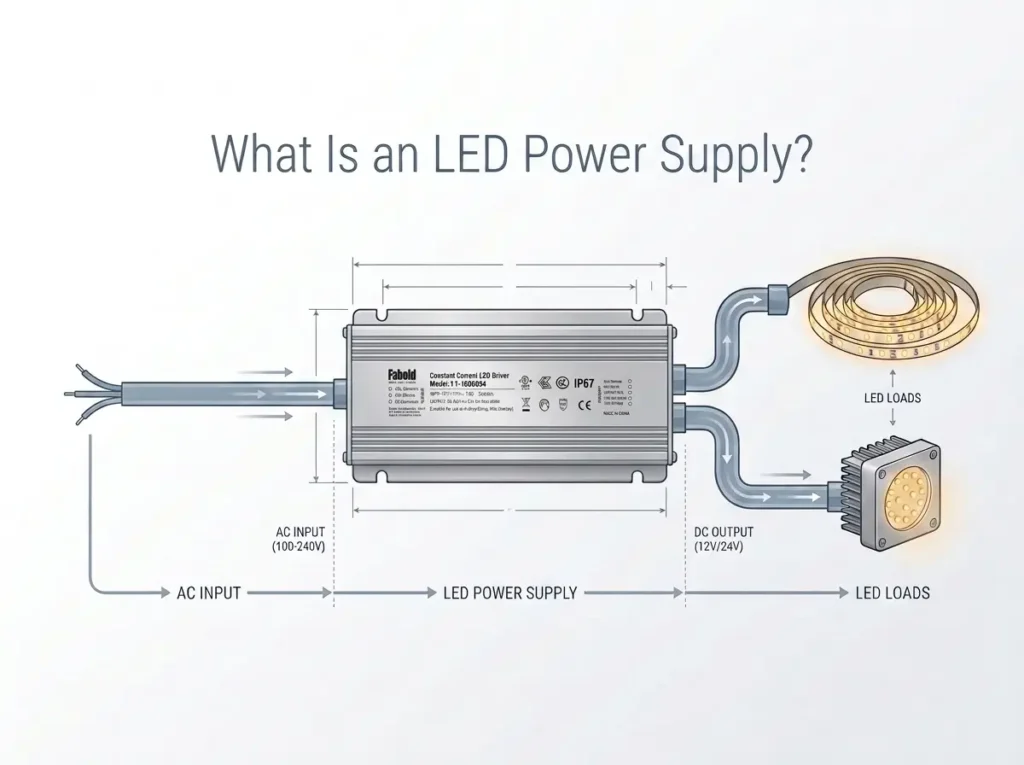
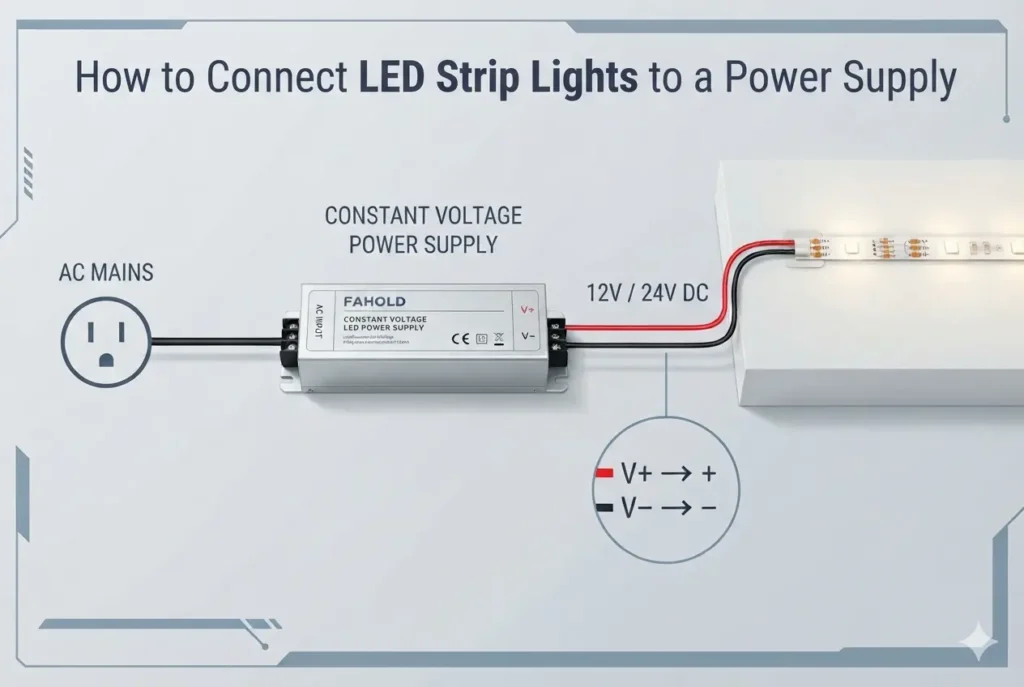
AC mains → CV power supply → optional controller → LED strip/module
The LED load expects a fixed DC voltage.
Typical constant-current system
AC mains → CC LED driver → LED engine/string
The LED load expects a regulated current.
Real products can include more complex CV+CC operating characteristics, control electronics or internal driver stages, so the exact datasheet remains essential.
Constant Voltage and Parallel Loads
CV systems are often used where several compatible loads operate in parallel across the same system voltage.
Example:
- three 24V branches;
- each branch has known wattage;
- combined wattage determines supply capacity.
The supply still needs correct branch wiring, current capacity and voltage-drop control.
For the dedicated guide, see Can Multiple LED Loads Share One Power Supply?.
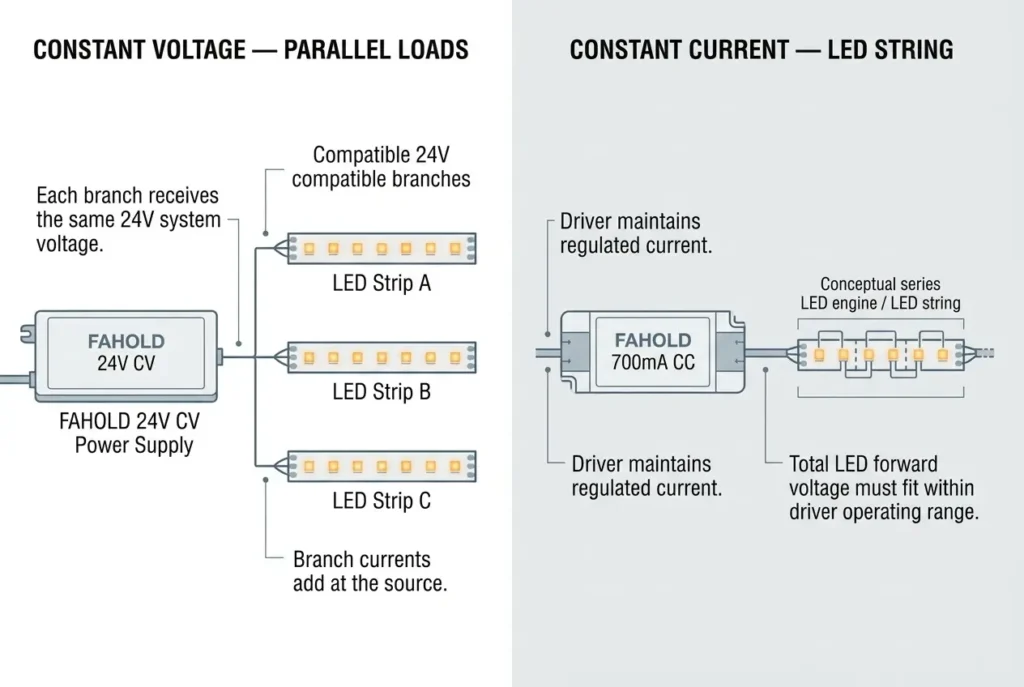
Constant Current and Series LED Strings
CC systems are frequently designed around LED strings where the driver maintains current and the total LED forward voltage must fit within the driver’s operating range.
This is why a CC driver label often contains both:
- rated current;
- output-voltage range.
If the LED string voltage falls outside the driver’s intended operating region, correct current regulation may not be possible.
Voltage Drop Matters Differently in a CV System
In a constant-voltage system, conductor voltage drop can reduce the actual voltage reaching remote loads.
That can create visible brightness variation or improper operation even when the supply itself is correctly rated.
The basic relationship:
Vdrop = I × R
means current, conductor resistance and distance all matter.
For the full guide, see Voltage Drop in Constant-Voltage LED Systems.
Do CV and CC Use the Same Dimming Methods?
Not necessarily.
The terms CV and CC describe output regulation, not a universal dimming protocol.
Either architecture may use different control methods depending on product design, including:
- 0–10V;
- DALI;
- phase-cut;
- PWM-related control;
- manufacturer-specific interfaces.
Do not assume a dimming method from CV/CC alone.
UL 8750 addresses LED equipment used in lighting products and includes considerations for wired controls such as 0–10V and DALI in applicable configurations: UL Solutions — UL 8750 and Wired LED Controls.
North American Class 2 Does Not Decide CV vs CC by Itself
Class 2 is a safety/power-source classification question, not simply a CV-versus-CC naming rule.
A product may need to be evaluated against applicable output and system requirements regardless of whether its lighting architecture is described as CV or CC.
UL’s discussion of UL 2108 shows that low-voltage lighting systems and Class 2 configurations require specific power-unit and system considerations: UL Solutions — UL 2108 Low-Voltage Lighting Systems.
Do not infer Class 2 from “24V” alone.
CV vs CC Selection Workflow
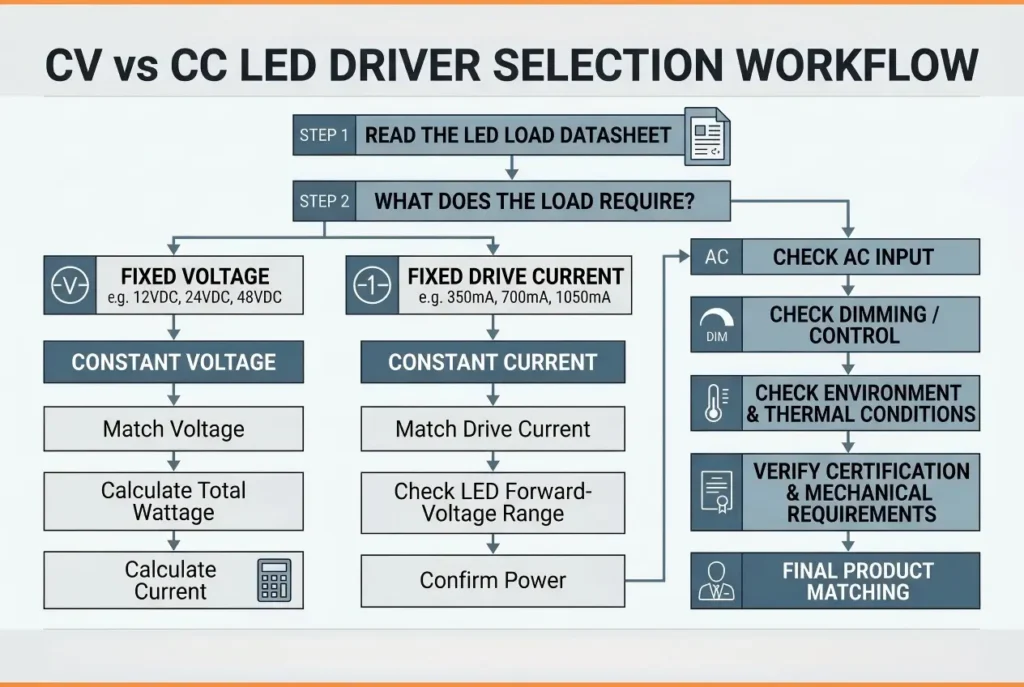
Use the following decision path before comparing individual products.
Step 1 — Read the LED load datasheet
Do not start with the power-supply catalog.
Step 2 — Identify the primary electrical requirement
Does the load specify:
- fixed voltage?
- or fixed drive current?
Step 3 — If CV, match voltage
Then calculate total load wattage and current.
Step 4 — If CC, match current
Then confirm the LED operating-voltage range fits the driver.
Step 5 — Check AC input
Match the project mains requirements.
Step 6 — Check dimming
Verify the exact control interface.
Step 7 — Check environment and thermal conditions
Review enclosure, ambient temperature and derating.
Step 8 — Verify certification and mechanical requirements
Only then should a final series/model be selected.
Procurement Comparison Table
| Procurement question | CV system | CC system |
|---|---|---|
| First parameter to request | Load voltage | Drive current |
| Next key value | Total watts/current | LED voltage range |
| Typical load documentation | 12/24/48V + W | mA/A + Vf range |
| Can wattage alone select product? | No | No |
| Can wrong voltage/current damage or misoperate load? | Yes | Yes |
| Need dimming verification? | Yes | Yes |
| Need environment/certification check? | Yes | Yes |
When Should FAHOLD Product Matching Begin?
Only after the load architecture is known.
For a CV project, provide:
- required output voltage;
- maximum load wattage/current;
- AC input;
- control method;
- environment;
- certification requirements;
- dimensions.
For a CC project, provide:
- required drive current;
- LED operating/forward-voltage range;
- maximum power;
- AC input;
- dimming;
- environment;
- certification and dimensions.
Then send the specifications to FAHOLD for product matching.
Constant Voltage vs Constant Current FAQ
What is the main difference between constant voltage and constant current LED drivers?
A CV supply regulates voltage while current varies with the compatible load. A CC driver regulates current while output voltage varies within a defined range.
How do I know whether my LED needs CV or CC?
Read the LED load datasheet. Fixed-voltage ratings such as 24VDC usually indicate CV; a specified current such as 700mA with an operating-voltage range usually indicates CC.
Are LED strips constant voltage or constant current?
Many conventional low-voltage LED strips are designed for constant-voltage input, but not every LED product is. Verify the exact strip specification.
Can I use a constant-voltage power supply on a constant-current LED?
Not as a direct substitute unless the complete system includes appropriate current regulation and is explicitly designed for that architecture.
Can I use wattage to decide between CV and CC?
No. Two drivers with similar wattage can regulate different electrical quantities and be incompatible with the same load.
Is constant current always better than constant voltage?
No. The correct architecture is the one required by the LED load and system design. CV and CC solve different design requirements.
Find the Right LED Power Supply for Your Project
Share the core electrical and application requirements. We will narrow the available FAHOLD platforms to the options most relevant to your project.