Table of Contents
For a constant-voltage LED system, a 24V and 48V power supply are not interchangeable versions of the same product.
The supply voltage must match the LED load.
If the LED strip or module is designed for 24V, use a compatible 24V supply. If it is designed for 48V, use a compatible 48V supply.
The comparison becomes useful when a new system is still being designed. At the same wattage, 48V carries half the current of 24V. That can reduce conductor voltage drop and resistive losses and can simplify longer low-voltage distribution. The tradeoff is that the complete system—LED load, controller, dimmer, connectors and supply—must support 48V.
This page owns the 24V vs 48V architecture decision. For the full selection workflow, use How to Choose an LED Power Supply. For the broader topic, return to the LED Power Supply Guide.
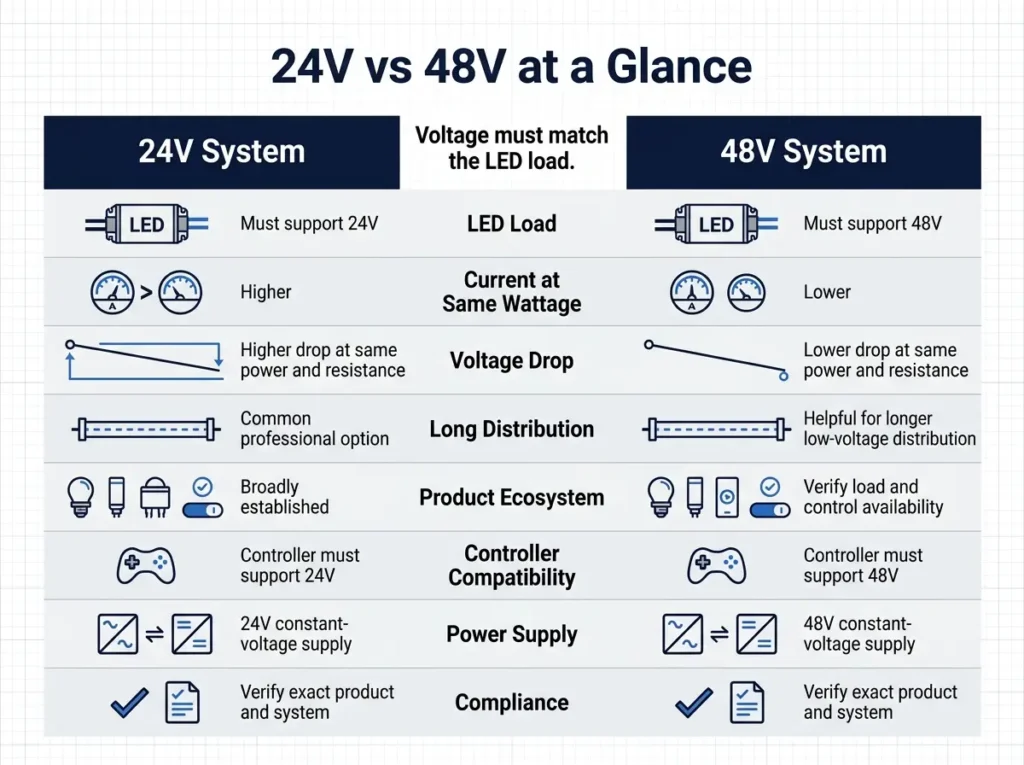
24V vs 48V at a Glance
| Factor | 24V system | 48V system |
|---|---|---|
| LED load | Must support 24V | Must support 48V |
| Current at same wattage | Baseline | Half the 24V current |
| Conductor voltage drop at same power/resistance | Higher | Lower |
| Long remote distribution | Common professional option | Can provide additional current reduction |
| Product ecosystem | Broadly established | Verify load/control availability |
| Controller | Must support 24V | Must support 48V |
| Supply | 24V constant voltage | 48V constant voltage |
| Class 2/compliance | Verify exact system | Verify exact system |
1. Load Compatibility Comes Before Distribution Benefits
Do not replace a 24V supply with a 48V supply merely to reduce voltage drop.
The LED load has to be designed for 48V.
This is the same rule covered in 12V vs 24V LED Power Supply: How to Choose: system voltage is an electrical compatibility requirement, not a performance setting that can be increased at will.
IEC 61347-2-13:2024 is the current IEC safety standard for electronic controlgear for LED light sources and covers rated output characteristics. See IEC 61347-2-13:2024.
2. Why 48V Carries Half the Current
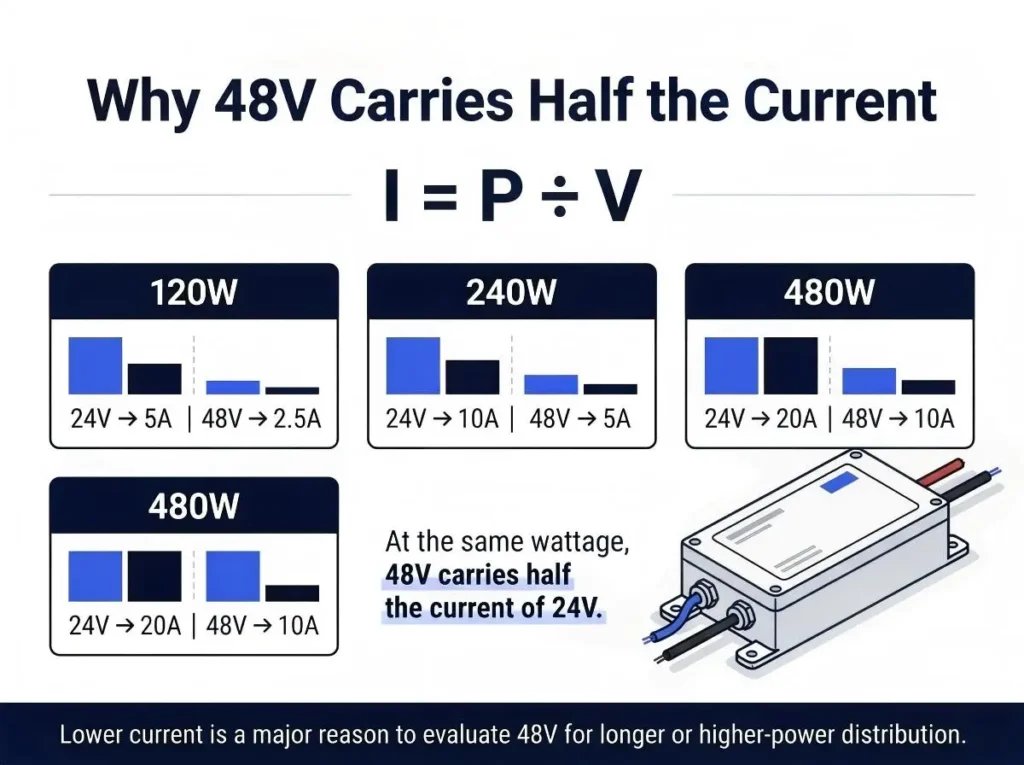
For a DC load:
I = P ÷ V
Consider a 240W load.
24V: 240W ÷ 24V = 10A
48V: 240W ÷ 48V = 5A
For 120W:
- 24V → 5A
- 48V → 2.5A
For 480W:
- 24V → 20A
- 48V → 10A
This current reduction is the main engineering reason to evaluate 48V for longer or higher-power low-voltage distribution.
3. How 48V Changes Voltage Drop
For a conductor:
Vdrop = I × R
Assume:
- load = 240W;
- circuit resistance = 0.10Ω.
At 24V:
10A × 0.10Ω = 1.0V
At 48V:
5A × 0.10Ω = 0.5V
Percentage drop:
- 24V: 1.0 / 24 ≈ 4.17%
- 48V: 0.5 / 48 ≈ 1.04%
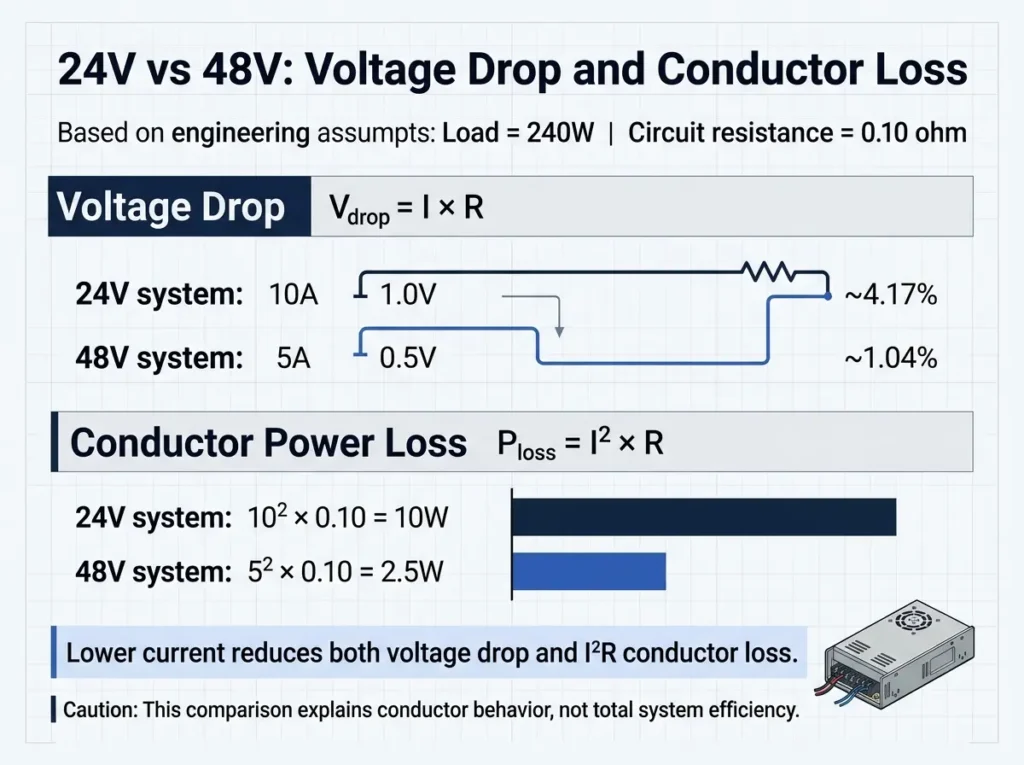
This simplified example explains why higher-voltage DC distribution can be attractive.
It does not establish a universal LED-strip run length. The strip’s internal resistance and circuit architecture still matter.
4. Why 48V Can Help Long Linear Lighting
Long architectural runs create two related problems:
- voltage drop in supply conductors;
- voltage drop along the LED strip’s own copper paths.
48V reduces current for the same delivered power, helping with distribution. It can also be paired with strip designs intended for longer runs.
However, maximum run length is a product specification.
Do not publish a universal statement such as “48V always runs 30 meters without injection.” Verify:
- strip voltage;
- watts per foot/meter;
- manufacturer maximum run;
- feed method;
- injection requirement;
- allowable voltage variation;
- conductor layout.
For application design, see LED Strip Lighting.
5. 48V Is an Established Commercial Output Option
48V constant-voltage LED power products exist in the professional market.
MEAN WELL currently lists constant-voltage families with 12V, 24V and 48V options: MEAN WELL LED power-supply product families.
Its SPWM family also illustrates an important procurement point: voltage availability can vary by wattage. The published range lists 12V/24V on some models and 24V/48V on another. See MEAN WELL SPWM constant-voltage LED drivers.
Therefore:
Never assume every wattage in a product family supports every output voltage.
The same rule must be applied to FAHOLD products after the current catalog and exact datasheet are verified.
6. Does 48V Allow Smaller Wire?
Potentially, but not automatically.
At the same power, 48V carries half the current of 24V. Lower current can reduce the conductor cross-section required to meet a particular voltage-drop target.
Final conductor selection still depends on:
- current;
- length;
- conductor material;
- allowable voltage drop;
- ampacity;
- ambient temperature;
- bundling;
- wiring method;
- applicable requirements.
The correct conclusion is:
48V reduces the current component of the conductor-sizing problem; it does not eliminate conductor calculations.
7. Does 48V Reduce Power Loss?
For the same conductor resistance and delivered load power, yes, resistive conductor loss falls with current.
Ploss = I² × R
Using the 240W example and 0.10Ω:
24V:
10² × 0.10 = 10W
48V:
5² × 0.10 = 2.5W
Under these controlled assumptions, the conductor loss is lower at 48V.
But this does not mean the total 48V lighting system is “four times more efficient.” Total system efficiency also includes:
- AC/DC conversion;
- LED load;
- controls;
- operating temperature;
- actual wiring topology.
The calculation describes conductor loss, not complete system efficiency.
8. Advantages of 24V
Broad ecosystem
24V strips, modules, controllers and power supplies are widely established.
Suitable for many professional applications
Correctly designed 24V distribution can serve a wide range of architectural and signage systems.
Existing-project compatibility
If a project is already 24V, remaining at 24V may reduce redesign and component-compatibility risk.
Product availability can outweigh theoretical voltage benefits
A theoretical 48V distribution advantage is irrelevant if the required LED load or control hardware is not available at 48V.
9. Advantages of 48V
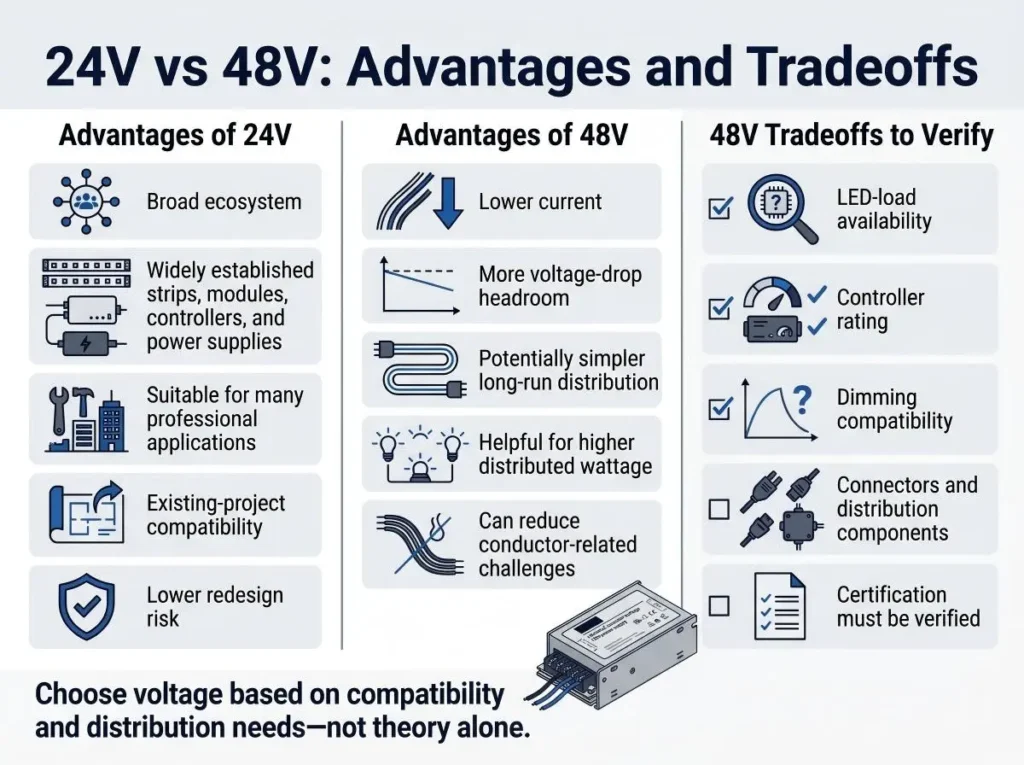
Lower current
This is the primary engineering benefit.
More voltage-drop headroom
Lower current reduces conductor drop, while the same absolute drop represents a smaller percentage of 48V.
Potentially simpler long-run distribution
Depending on the exact LED product, 48V may reduce feed points or conductor requirements.
That must be verified against the actual strip/module datasheet.
10. 48V Tradeoffs to Verify
Before moving from 24V to 48V, confirm:
LED-load availability
Do not design the supply architecture before confirming the load.
Controller rating
A 12–24V controller is not automatically suitable for 48V.
Dimming compatibility
Verify the power supply, controller and LED load together.
Connectors and distribution components
Check voltage/current ratings across the complete circuit.
Certification
Verify the exact product; do not infer compliance from nominal voltage.
11. North American Class 2: Verify, Do Not Assume
A 48V label alone does not prove that a system is Class 2.
UL’s discussion of UL 2108 explains that low-voltage lighting systems and Class 2 configurations have defined construction and performance requirements: UL Solutions — UL 2108 Low-Voltage Lighting Systems.
UL technical material also discusses Class 2 voltage context for low-voltage lighting: UL Code Authorities — Low-Voltage Lighting / UL 2108 discussion.
For procurement:
Verify the exact listed/certified power unit, output limits and system configuration before making a Class 2 claim.
12. 24V vs 48V for Signage
For Sign Lighting, voltage selection follows the module specification.
For a new architecture, compare:
- total wattage;
- branch current;
- cabinet dimensions;
- remote supply distance;
- wire routing;
- number of branches;
- service access;
- environmental conditions;
- module/controller availability.
48V can reduce distribution current, but only if compatible signage loads and controls are available.
13. 24V vs 48V for Architectural LED Strip
Ask:
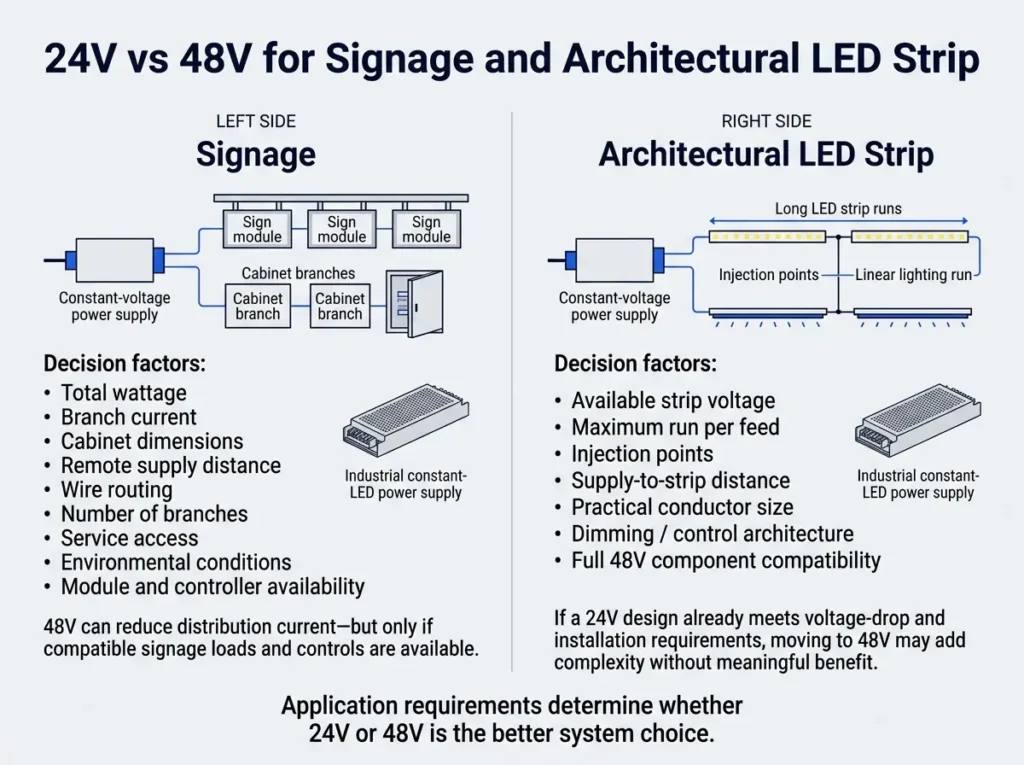
- Which voltages are available for the required strip?
- What is the manufacturer’s maximum run per feed?
- How many injection points are required?
- How far is the supply from the strip?
- What conductor size is practical?
- What dimming/control architecture is required?
- Does every component support 48V?
If a 24V design already meets voltage-drop and installation requirements with margin, changing to 48V may add complexity without meaningful benefit.
If the project has long remote runs or high distributed wattage, 48V deserves closer evaluation.
14. Wattage Must Still Be Sized Separately
Changing from 24V to 48V does not remove the need to calculate load wattage.
For a 200W load:
- 24V ≈ 8.33A;
- 48V ≈ 4.17A.
The supply still needs adequate usable power under actual temperature and input conditions.
Use How to Size an LED Power Supply for an LED Load for the sizing and derating workflow.
For the separate question of whether a higher-rated wattage can be used after voltage is matched, continue with Can You Use a Higher-Wattage LED Power Supply?.
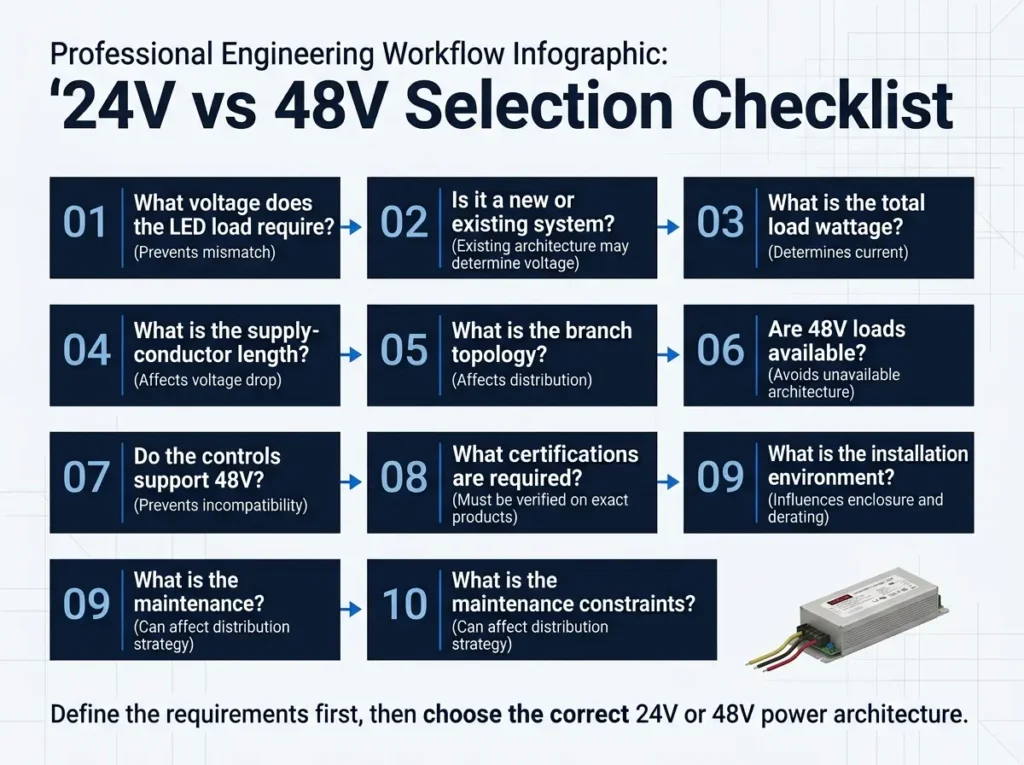
24V vs 48V Selection Checklist
| Question | Why it matters |
|---|---|
| What voltage does the LED load require? | Prevents mismatch |
| New or existing system? | Existing architecture may determine voltage |
| Total load wattage? | Determines current |
| Supply-conductor length? | Affects voltage drop |
| Branch topology? | Affects distribution |
| Are 48V loads available? | Avoids unavailable architecture |
| Do controls support 48V? | Prevents incompatibility |
| Required certifications? | Must be verified on exact products |
| Environment? | Influences enclosure and derating |
| Maintenance constraints? | Can affect distribution strategy |
If the requirements are defined, send them to FAHOLD for product-level review,Find a Suitable LED Power Supply.
FAQ
Is 48V better than 24V for LED lighting?
Not universally. At the same wattage, 48V carries half the current and can reduce distribution voltage drop, but the load and all associated equipment must support 48V.
Can I use a 48V supply on a 24V LED strip?
Not for a conventional 24V constant-voltage strip unless its manufacturer explicitly specifies compatibility.
Why does 48V have less voltage drop?
At the same power, 48V requires half the current. Lower current reduces voltage drop across the same conductor resistance.
Does 48V allow longer strip runs?
It can when the strip is designed for longer 48V operation. Maximum run length is product-specific.
Is 48V more efficient than 24V?
It can reduce conductor I²R losses. Total system efficiency still depends on the supply, LED load, controls, wiring and operating conditions.
Is a 48V LED power supply Class 2?
Do not assume so from voltage alone. Verify the exact power unit’s certification, output limits and system configuration.
Find the Right LED Power Supply for Your Project
Share the core electrical and application requirements. We will narrow the available FAHOLD platforms to the options most relevant to your project.