Table of Contents
To size a 24V Class 2 LED power supply, calculate the maximum wattage of each LED load, divide that wattage by 24V to find its current, and match every branch to an appropriately rated output circuit. A 192W dual-output supply is not the same as one 192W output: if it provides two 24V/4A channels, each channel is rated for a maximum of 96W. After allocating the loads, check power-supply derating, cable voltage drop, the LED strip’s permitted run length, input voltage, and the certification of the exact model.
This guide focuses on load distribution for 24V constant-voltage LED strips, architectural linear lighting, and multi-zone light boxes. If you need the basic definition of Class 2, start with What Is a Class 2 Power Supply?. If you need a broader North American equipment-approval process, use the UL Class 2 LED Power Supply Selection Guide.
Quick sizing sequence
- Confirm the load requires regulated 24V DC constant voltage, not a constant-current driver.
- Obtain the strip’s maximum rated W/m or W/ft, and calculate the powered length and load of each branch.
- Convert branch watts to amps; for a 24V load,
I (A) = P (W) ÷ 24. - Apply any project-specific design allowance and manufacturer derating, then choose enough separately rated outputs.
- Verify each output’s current, actual wiring plan, voltage at the farthest LED, applicable installation conditions, and exact-model Class 2 documentation.
| Question | Engineering answer |
|---|---|
| Can a 24V Class 2 supply have more than 100W total output? | A multi-output product can have a higher combined rating when the individual circuits are designed and evaluated appropriately. |
| Is 192W enough for a 150W lighting installation? | Only if the load is correctly distributed and neither output is overloaded after applicable derating. |
| Can I put all 150W on one 96W channel? | No. A combined 192W nameplate does not increase an individual 96W channel’s rating. |
| Should I combine two 24V outputs to get 8A? | Not unless the exact manufacturer’s instructions expressly approve paralleling those outputs. |
| Does 24V automatically mean Class 2? | No. Voltage alone does not establish the output classification or a product Listing. |
When Does a 24V LED Lighting Project Need a Class 2 Power Supply?
24V Constant-Voltage Loads Are Not Automatically Class 2
A 24V LED strip is a load specification: its modules and current-limiting elements are designed for a 24V DC source. Class 2 describes the characteristics of a qualifying power source/output circuit, including limits under applicable conditions. These labels answer different questions.
A supply marked “24V, 10A” might deliver the correct voltage to an LED strip, but it should not be described as a Class 2 output solely from those numbers. In North American projects, the required source classification and the specific model’s approvals must be assessed separately from normal operating wattage. The published scope of UL 1310, Class 2 Power Units states that each applicable output provides Class 2 power levels under the National Electrical Code; it does not turn every low-voltage power supply into a Class 2 product.
Applications Where Distribution Matters
24V constant-voltage systems are common in architectural coves, retail display outlines, illuminated light boxes, hospitality linear lighting, and some signage. In these applications, the designer often has several physical zones rather than one compact load. That creates a choice between several separate supplies and one supply with multiple rated outputs.
Why Output Architecture Changes the Design
A single-output 96W unit is suitable only when its one output can support the assigned load and the installation conditions. A 192W unit with two 96W outputs can feed two appropriately sized groups; it is not one unrestricted 192W branch. The same distinction applies to three- and four-channel products. That is the central engineering issue developed below.
What Determines the Size of a 24V Class 2 LED Power Supply?
LED Voltage, Maximum Power Density, and Powered Length
Begin with the exact LED strip datasheet. A strip’s nominal voltage is not enough. You need its stated maximum electrical power per meter or foot, allowed supply tolerance, and manufacturer limits for a single fed run. A 9.6W/m strip and a 19.2W/m strip draw very different currents at the same 24V rating.
Check whether the datasheet gives a typical power value or a maximum design value. For power-source selection, use the relevant worst-case demand rather than a low nominal estimate. Account for any simultaneous operation of separate zones.
Number of Zones and Where Power Enters the Load
Map the physical installation before picking the power supply. A 16m installation may consist of four independently fed 4m sections, not one 16m electrical run. For each section, record power, location, conductor route, expected current, and its intended supply channel. Count LED branches and power-supply output circuits separately: one properly rated output may feed more than one parallel LED branch if the combined current, distribution hardware, and wiring method are approved.
Temperature, AC Input, Dimming, and Enclosure
The rated output shown in a model table may not equal available continuous output at every ambient temperature or enclosure condition. Review the model’s temperature-versus-load guidance and installation instructions. Also verify whether the job has 120Vac or 277Vac input, requires 0–10V or another control type, and places the supply in a protected, damp, or wet location.
Use this sample project worksheet before calculating:
| Required input | Illustrative project assumption | Verification source |
|---|---|---|
| LED technology | 24V constant-voltage tape | LED strip datasheet |
| Strip power density | 9.6W/m | Maximum rated strip data |
| Total illuminated length | 16m | Lighting drawing |
| Electrical segments | Four 4m sections | Feed-layout drawing |
| Lighting zones | Two zones of 8m each | Controls schedule |
| AC source | 120Vac or 277Vac | Project electrical schedule |
| Dimming | To be confirmed | Control-system specification |
| Environmental conditions | Indoor, enclosure-dependent | Installation requirements |
How to Calculate 24V LED Power Supply Wattage and Current
Step 1 — Calculate Total LED Load
For a uniform strip rated by length:
Total load (W) = strip power density (W/m) × powered length (m)
For example, a 4m section of strip rated at 19.2W/m represents 4 × 19.2 = 76.8W. When sections use different strip types, calculate each separately and sum only those connected to the same designated output.
Step 2 — Convert Power Into 24V Output Current
Load current (A) = load power (W) ÷ 24V
The 76.8W section above draws 76.8 ÷ 24 = 3.2A at the nominal voltage in the simplified design calculation. A 153.6W installation represents 153.6 ÷ 24 = 6.4A combined current, but that number alone does not specify how many output circuits are required.
Step 3 — Check Usable Capacity, Not Just the Nameplate
You may use an 80% utilization target as a preliminary engineering assumption where project specifications and manufacturer instructions permit it. Under this assumption, a branch designed for a nominal 96W/4A output would be limited to 96 × 0.80 = 76.8W, or 4 × 0.80 = 3.2A of planned load.
However, 80% is not a universal NEC Class 2 rule and does not replace a product’s thermal derating curve. If the manufacturer specifies a lower available output for the actual ambient or installation, use the lower capacity. If the project calls for a different documented allowance, calculate with that requirement instead.
A practical selection test is:
Assigned branch load ≤ applicable usable output for that exact channel
The applicable usable output is determined from the channel rating, manufacturer derating, and project-specific allowance—not simply from a fixed percentage found online.
Step 4 — Check Each Output Independently
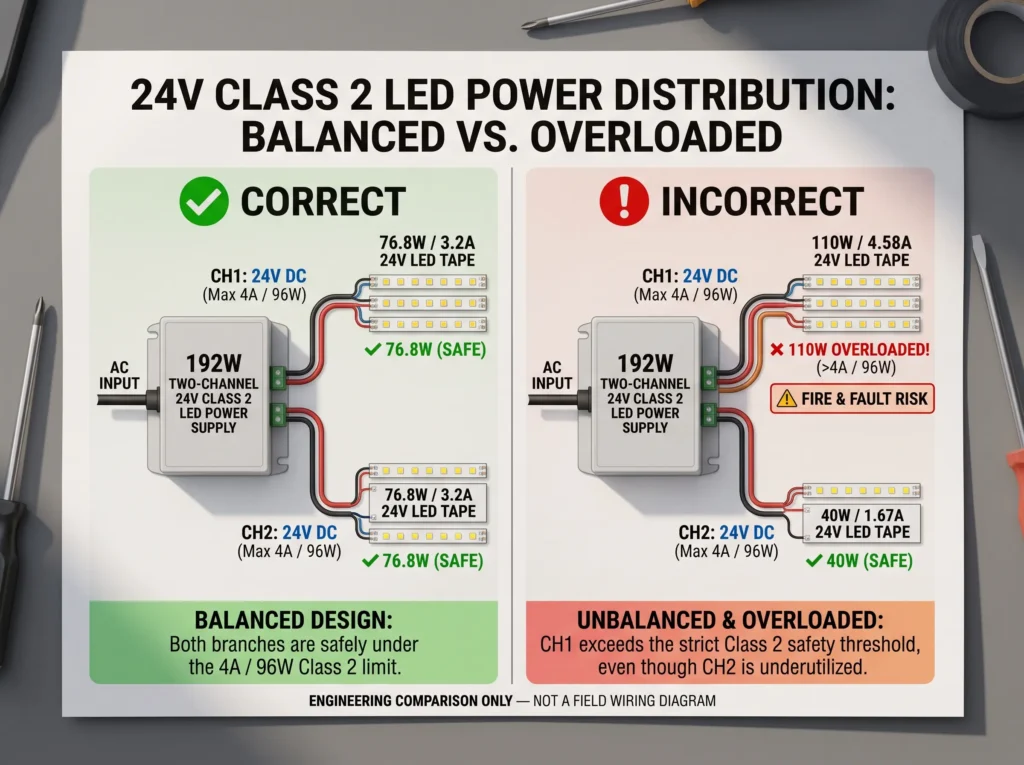
Take a nominal 192W model with two 24V/4A outputs. Its published combined rating is 2 × 96 = 192W. A pair of 70W branches may be suitable from a nameplate perspective. A 110W branch and a 40W branch are not suitable on that arrangement merely because the combined 150W is below 192W. The 110W branch demands approximately 110 ÷ 24 = 4.58A, exceeding one 4A output’s rating.
For initial arithmetic, use the FAHOLD LED Strip Power Supply Calculator. Then return to the branch worksheet here; a general wattage calculator cannot approve an output architecture or the finished installation.
Single-Output vs Multi-Channel 24V Class 2 Power Supplies
When One 24V Output Is Enough
A single-output unit reduces the number of power circuits inside the supply, but it does not remove the need for branch and feeder design. FAHOLD’s L2 product table lists a 24V/2.5A/60W model and a 24V/4A/96W model. A localized 45W or 72W installation might start with these candidates, subject to actual usable capacity and installation requirements.
If two physical LED strips are connected in parallel to one output, their combined current is what that output must deliver. Two 2A strips use 4A together; creating two terminal branches does not create two independently limited Class 2 outputs.
Why a 192W Two-Channel Product Is Not One 192W Circuit
The FAHOLD L2-200X-024-2 is published as 24V, 2 × 4A, 192W combined. The product provides the opportunity to allocate loads to two separately rated channels. The designer must verify that each channel’s assignment remains within 4A/96W and any applicable lower usable rating.
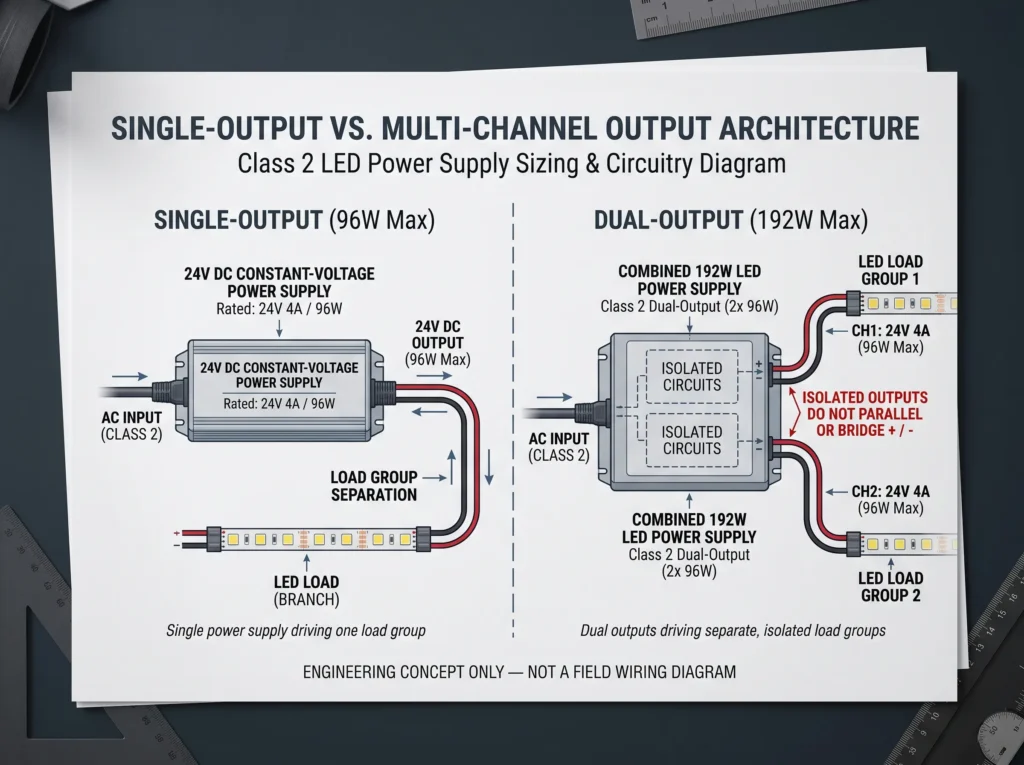
| Product architecture | Rated output 1 | Rated output 2 | Combined maximum |
|---|---|---|---|
| 96W single output | 24V × 4A = 96W | — | 96W |
| 192W dual output | 24V × 4A = 96W | 24V × 4A = 96W | 192W |
Those figures come from the L2 series technical table and describe nominal rated output, not automatic permission to operate at full load under all field conditions.
How 288W and 384W Models Scale Through More Outputs
The same model family lists a 288W, three-output configuration (3 × 24V/4A) and a 384W, four-output configuration (4 × 24V/4A). Adding channels increases the number of separately allocated circuits, not the continuous current rating of each circuit.
This can simplify a light-box design with several remote zones, but it requires a more deliberate output schedule and labeled branches. Do not assume that a multi-channel unit automatically provides individual dimming control for each branch; channel count and dimming functionality are different specifications.
Can You Connect Outputs in Parallel?
Never join separate outputs to create a higher-current 24V source unless the exact manufacturer’s documentation expressly permits that connection. Their control/protection behavior may not support current sharing, and paralleling could undermine the evaluated source configuration. Likewise, do not treat multiple pairs of terminals as separate Class 2 outputs without checking the manufacturer’s circuit definition.
How to Allocate 24V LED Loads Across Multiple Outputs
Make the Zone Schedule Before Choosing Channel Count
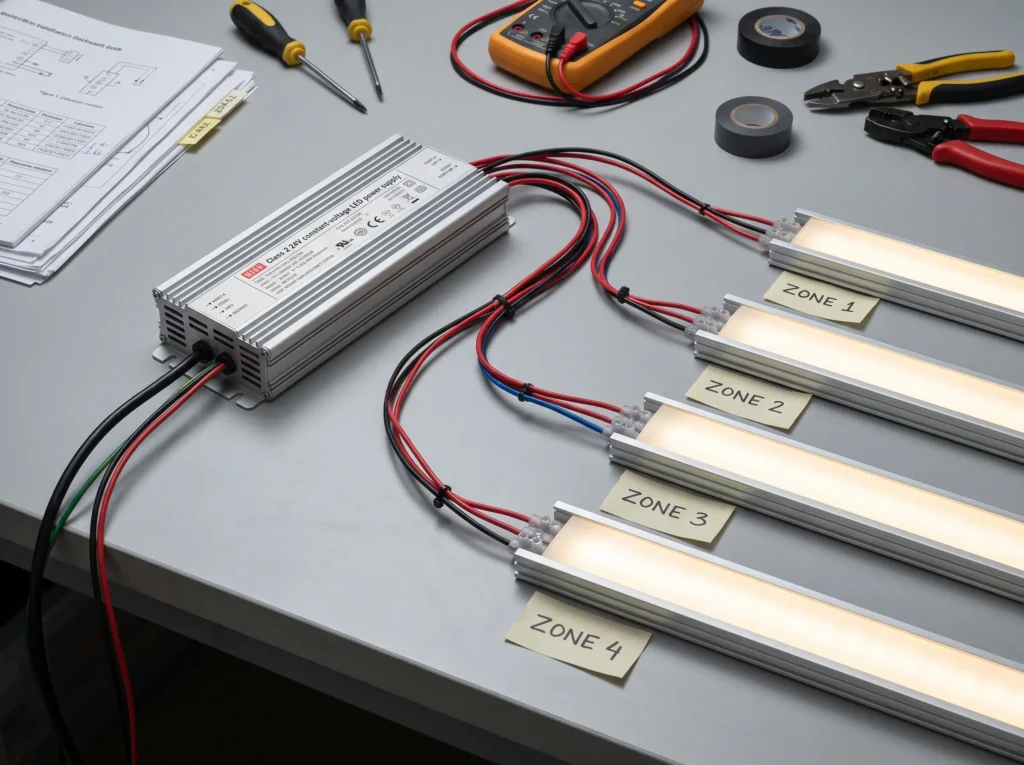
Start with the lighting drawing. Mark each illuminated region, the proposed driver location, the LED product, strip length, maximum wattage, and distance from the output. A two-zone installation may be electrically four strips with two strips on each rated output. A four-zone display might place one zone on each of four outputs to simplify servicing.
An output-circuit schedule could look like this:
| Circuit | Connected sections | Calculated load | Load current | Nominal output limit | 80% design target | Preliminary check |
|---|---|---|---|---|---|---|
| CH1 | Two × 4m at 9.6W/m | 76.8W | 3.2A | 96W / 4A | 76.8W | Meets assumption |
| CH2 | Two × 4m at 9.6W/m | 76.8W | 3.2A | 96W / 4A | 76.8W | Meets assumption |
| Combined | Four sections / 16m | 153.6W | 6.4A total | 192W combined | 153.6W | Check wiring and conditions |
The current values assume nominal 24V operation and the stated strip ratings. Actual driver capability and LED behavior remain subject to their datasheets.
Identify an Unbalanced-Load Failure Before Installation
Suppose a designer connects 110W to CH1 and 40W to CH2 of the same 192W supply. The combined load is only 150W, yet CH1 would need approximately 4.58A. It exceeds that channel’s 4A rated output. Leaving spare capacity on CH2 does not transfer the unused amperage to CH1.
The correct response is to redesign which LED sections are assigned to which outputs, choose a different documented architecture, or use separate supplies—while respecting the LED strip’s permitted run lengths and independent output boundaries.
Multiple Feeds Are Not the Same as Paralleled Outputs
A single adequately rated output can sometimes feed multiple approved parallel LED branches from its own terminals or an appropriate distribution point. This is different from connecting two separate supply outputs together. Always verify cable ampacity, terminal ratings, output-current total, protection requirements, and the LED manufacturer’s feed instructions.
Three Worked 24V Class 2 Power Supply Sizing Examples
The following are illustrative engineering calculations, not installed project case studies. The LED strip power densities and lengths are assumptions; the quoted output architectures are from FAHOLD’s published L2 model table. Each example must still pass model-specific derating, approved wiring, and certification review.
Example 1 — 96W Single-Output Supply for Architectural LED Strip
Design brief: A protected indoor cove uses 4m of 24V constant-voltage strip rated at 19.2W/m. One locally mounted power supply serves the run. The lighting designer initially targets 80% of a candidate output’s rated power.
- Connected load:
4m × 19.2W/m = 76.8W. - Nominal output current:
76.8W ÷ 24V = 3.2A. - Nominal channel rating needed at 80% target:
76.8W ÷ 0.80 = 96W. - Initial candidate: L2-100X-024, 24V/4A/96W.
Engineering interpretation: The example fits a 96W output at the selected 80% utilization target. That does not approve one-end feeding of any arbitrary 4m strip; verify the specified tape’s allowed run, conductor loss, driver temperature rating, control configuration, and mounting instructions. A dimming requirement may determine the suitable model variant.
Example 2 — 192W Dual-Output Supply for Two Lighting Zones
Design brief: A commercial display has 16m of 24V strip rated at 9.6W/m, arranged into four separately fed 4m sections. Two lighting zones each consist of two 4m sections. The design intends one rated output circuit per zone.
- Entire load:
16m × 9.6W/m = 153.6W. - Combined nominal current:
153.6W ÷ 24V = 6.4A. - Each 4m section:
4m × 9.6W/m = 38.4Wor1.6A. - Each zone / output:
2 × 38.4W = 76.8Wor3.2A. - Initial candidate: L2-200X-024-2, rated 2 × 24V/4A, 192W combined.
| Output | Connected load segments | Zone load | Current | Channel rating | Planned utilization |
|---|---|---|---|---|---|
| CH1 | Two separately fed 4m runs | 76.8W | 3.2A | 96W / 4A | 80% |
| CH2 | Two separately fed 4m runs | 76.8W | 3.2A | 96W / 4A | 80% |
| Total | Four 4m runs | 153.6W | 6.4A | 192W combined | 80% |
Engineering interpretation: This is a valid preliminary allocation calculation, provided the parallel branches are wired correctly and each channel’s usable rating remains sufficient. It is not permission to route 16m as one continuous end-fed strip or to join CH1 and CH2 together. If independent dimming of the two lighting zones is required, confirm the selected control hardware actually provides it; two power outputs do not necessarily mean two independently controllable outputs.
Example 3 — 384W Four-Channel Supply for a Large LED Light Box
Design brief: A large retail light box contains four separately designated lighting regions. Each region uses 6m of 24V LED strip at 12W/m. Assume each region is divided into two separately fed 3m segments where the strip supplier permits that arrangement.
- One region:
6m × 12W/m = 72W. - One region current:
72W ÷ 24V = 3A. - Four-region total:
4 × 72W = 288W. - System current summed across channels:
288W ÷ 24V = 12A. - Each region is assigned to a distinct 24V/4A/96W output.
- Initial candidate: L2-400X-024-4, 4 × 24V/4A, 384W combined.
| Output | Connected load | Current | Rated output | Planned utilization |
|---|---|---|---|---|
| CH1 | 72W | 3A | 96W / 4A | 75% |
| CH2 | 72W | 3A | 96W / 4A | 75% |
| CH3 | 72W | 3A | 96W / 4A | 75% |
| CH4 | 72W | 3A | 96W / 4A | 75% |
| Total | 288W | 12A total | 384W combined | 75% |
Engineering interpretation: The design uses four separate outputs, each below its stated 4A rating under the assumptions shown. Whether one shared enclosure or several locally placed drivers is better depends on feeder lengths, access for maintenance, thermal conditions, and control requirements. It would be wrong to connect the entire 288W system to just one 96W branch.
What the Three Cases Establish
| Scenario | Total actual LED load | Output allocation | FAHOLD L2 candidate | Key engineering decision |
|---|---|---|---|---|
| Architectural cove | 76.8W | 1 × 76.8W | L2-100X-024, 96W | One output, check margin and strip feed |
| Two-zone display | 153.6W | 2 × 76.8W | L2-200X-024-2, 192W | Split physical zones across two channels |
| Large light box | 288W | 4 × 72W | L2-400X-024-4, 384W | Independently size four output circuits |
These candidates come from model-level output ratings. Confirm exact variant, Class 2 status, certification scope, protection, and available output at installation conditions before approving procurement.
Voltage Drop and Wiring Design in 24V Multi-Channel Systems
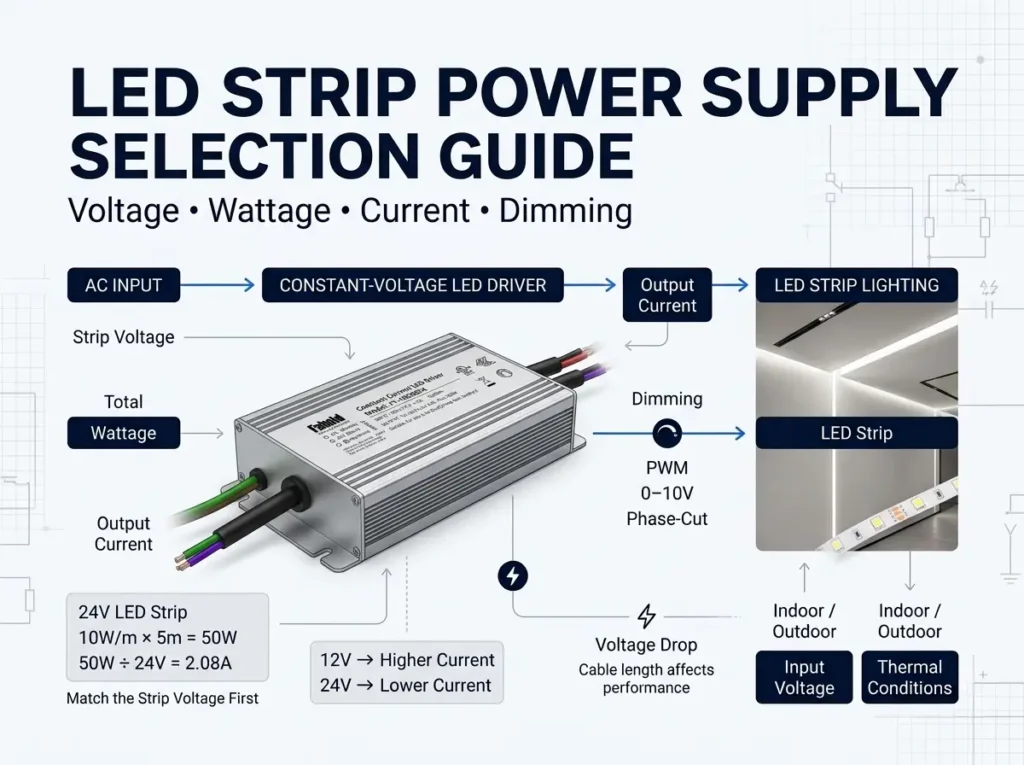
Why 24V Systems Draw Less Current Than Equivalent 12V Loads
For the same electrical power, doubling the system voltage from 12V to 24V halves the nominal current. A 96W load would draw 8A at 12V or 4A at 24V, assuming correctly designed loads at their respective rated voltages. Reduced current can improve feeder voltage-drop performance in a like-for-like conductor path—but it does not allow a 12V LED strip to be supplied at 24V.
For a wider discussion of system-level voltage choice, see 24V vs 48V LED Power Supply.
Check the Feeder and the Strip Itself
Voltage drop occurs both in the external cable and within the strip’s copper traces. In a simplified conductor model, Vdrop = I × R for the complete relevant current path. As an illustration, if the total feeder-loop resistance is 0.15Ω and it carries 3.2A, the approximate drop is 3.2 × 0.15 = 0.48V or 2% of 24V—before other losses and load effects are assessed.
This is only a first-pass estimate, not a universal allowable voltage-drop limit. The LED strip maker may specify a maximum feed length or more stringent voltage tolerance. Measure at the LED terminals under realistic load conditions, especially at the most distant sections. The FAHOLD Voltage Drop Guide covers detailed feeder and distribution calculations.
Use Approved Feed Points, Not Arbitrary Run-Length Rules
An additional feed point, midpoint feed, or multiple separately fed strips may reduce voltage variation. Do not assume a universal maximum length for every 24V strip: product power density, PCB copper, construction, and manufacturer instructions matter. All wires, connectors, power-injection points, and branch protection must be appropriate to the actual design.
Where an output serves multiple loads, account for the total branch current and do not accidentally create a connection between two independently limited power-supply outputs through a common LED conductor.
Which FAHOLD 24V Class 2 LED Power Supply Should You Choose?
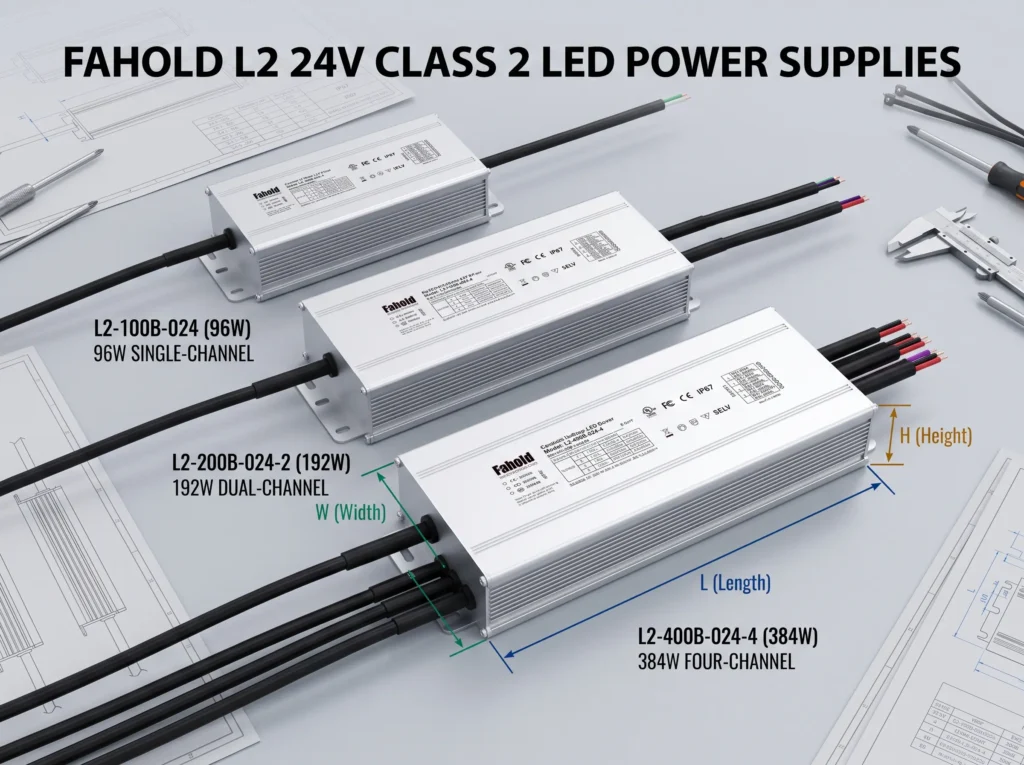
FAHOLD publishes the following 24V L2 nominal output options with 100–277Vac rated input. The X is a configuration placeholder; request the exact orderable variant and its documents rather than treating X as a single fixed specification.
| L2 series model | Output arrangement | Rated combined power | Typical initial fit |
|---|---|---|---|
| L2-060X-024 | 1 × 24V/2.5A | 60W | Compact single load |
| L2-100X-024 | 1 × 24V/4A | 96W | One higher-power zone |
| L2-200X-024-2 | 2 × 24V/4A | 192W | Two separately powered groups |
| L2-300X-024-3 | 3 × 24V/4A | 288W | Three distribution circuits |
| L2-400X-024-4 | 4 × 24V/4A | 384W | Four independently assigned circuits |
When an Enclosed L2-A Option Is More Appropriate
The FAHOLD L2-A Class 2 enclosed series adds a junction-box/enclosure architecture and compatible multi-mode dimming options on selected configurations. Published 24V models include a 96W single output, a 192W dual output, a 288W three-output configuration, and a 384W four-output configuration. These may be more suitable where the project needs that enclosure style and control integration.
Do not assume a standard L2 model and an L2-A model share identical control terminals, environmental approvals, or installation instructions. Select by the specific orderable SKU and project requirements, not only by nominal wattage.
Move From Electrical Fit to Model Approval
A sizing match is a starting point. Before placing a bulk order, obtain the current datasheet, approved drawing, model identification, certification evidence, dimming specification if applicable, and environmental/temperature limitations. For procurement discussion, FAHOLD offers Class 2 LED power-supply manufacturer and OEM project support.
Common 24V Class 2 Power Supply Sizing Mistakes
Mistake 1: Choosing by Total Wattage Alone
Problem: A buyer sees 192W on the enclosure and assigns one 150W load to a single output.
Consequence: A 96W/4A output would be overloaded, even if the enclosure’s combined rated output is higher.
Correct approach: Read the per-output current and power, then allocate branches accordingly.
Mistake 2: Loading One Channel While Others Are Mostly Empty
Problem: One output receives 110W, the other 40W.
Consequence: At nominal 24V, the larger branch requires about 4.58A, which exceeds a 4A channel rating.
Correct approach: Redistribute the LED sections into eligible independently fed branches, or revise the number/type of supplies. Unused current on another output is not automatically transferable.
Mistake 3: Ignoring Heat and the Actual LED Product
Problem: The planned branch just fits the paper rating, but the driver is installed in a hot cavity and the LED strip’s listed power figure was only typical.
Consequence: The design may have insufficient usable capacity or poor thermal reliability.
Correct approach: Use maximum specified load and actual environmental derating. Confirm the strip’s supported length per feed and the driver’s permitted mounting conditions.
Mistake 4: Assuming Dimming or Parallel Operation Comes With More Channels
Problem: The project assumes every output is independently dimmable or connects outputs to increase current without authorization.
Consequence: Control compatibility, output protection, or approved circuit classification may be compromised.
Correct approach: Verify control-input function, whether outputs track one another, and expressly allowed wiring methods from the exact model manual.
North American Class 2 Compliance and Model Verification
Verify the Particular Output Arrangement
“Class 2” concerns a qualifying source and its outputs; it is not proven by the term “24V” or by dividing the total wattage by the number of terminals. UL 1310’s published scope explicitly addresses Class 2 power units and the Class 2 power levels of individual outputs. The applicable certification pathway for a specific lighting product may depend on its construction and intended use.
Confirm Product Listing, Input, and Installation Conditions
Confirm the full orderable model identifier, output description, cUL/UL Listing or Recognition information as applicable, and the conditions under which the certification applies. The UL Product iQ database is an authoritative tool for checking product certification information and applicable categories. A website’s product description is useful for screening, but it is not an independent certification lookup.
The LED lighting assembly, wiring, power-source installation, and environmental requirements must be evaluated as a system. Do not assume that a Class 2-marked supply alone approves every enclosure or installed light-box configuration. Consult the project’s governing codes and the qualified designer/installer.
Frequently Asked Questions
What size Class 2 power supply do I need for a 24V LED strip?
Multiply the strip’s maximum rated watts per meter by the length actually supplied, convert watts to current at 24V, then compare that load with the usable capacity of the intended output circuit. A 76.8W load requires about 3.2A at 24V; a nominal 96W/4A output is a possible candidate if the manufacturer’s derating, wiring and project requirements allow it. The voltage rating alone is not proof of Class 2 status.
Can a 24V Class 2 power supply provide more than 100W?
A complete multi-output unit can have a combined nameplate rating greater than 100W while using separately limited output circuits. For instance, FAHOLD lists a 192W product with two rated 96W outputs. That does not mean either output may individually supply 192W. Confirm the product’s actual certified output classification and installation restrictions.
What is the difference between a 96W single-output and a 192W dual-output supply?
The nominal 96W model has one 24V/4A output. The 192W dual-output model has two 24V/4A outputs, each assigned its own load within its limit. One 150W branch is not acceptable on either 96W channel just because the whole unit has 192W combined capacity.
Can several 24V LED strips share one Class 2 output?
They may be connected as properly designed parallel load branches when the strip manufacturer, supply instructions, conductor and terminal ratings, and circuit rules allow it. Add all strip currents on that output. Two 1.6A segments together demand approximately 3.2A from the shared 24V output, before appropriate design checks.
Can I connect two Class 2 outputs together?
Do not parallel distinct outputs unless the specific manufacturer provides an approved, explicit method for that exact model. Multiple outputs are not interchangeable with a higher-current single output. They may have different protection and control behavior, and unauthorized combining can defeat the intended circuit architecture.
How many outputs are needed for a 288W LED installation?
There is no reliable answer from 288W total alone. It depends on how much power is assigned to each independently rated output, derating, and the physical branch arrangement. In a four-zone design with 72W per zone, four 24V/4A channels would each carry 3A. A different allocation could call for another architecture even with the same total watts.
Is every 24V Class 2 LED power supply UL Listed?
No. A claim about Class 2 output design is not interchangeable with independent certification evidence for the full model. Request its actual certification information, marking, category and applicable conditions. Verify the model through the certifier’s published directory as appropriate, and check that the installation matches the evaluated configuration.
Get a 24V Class 2 Power Supply Configuration for Your Project
Have a 24V strip-lighting or multi-zone light-box job? FAHOLD can review your proposed branch schedule and help identify a matching single-output or multi-channel L2/L2-A configuration for technical evaluation. The most useful request is not simply “I need 200W”; it is the maximum load on each planned output, the site input voltage, and the installation conditions.
For a useful engineering RFQ, include:
- Application and target market (architectural cove, light box, signage, etc.).
- Exact 24V strip/module model, rated W/m or W/ft, and maximum installed length.
- Total load and load by branch/zone; share a drawing if available.
- Proposed number of outputs and required control/dimming system.
- AC input, ambient temperature, location, enclosure/IP needs, and certification requirements.
- Required sample quantity, estimated production quantity, and timing.
Next step: Send Your 24V Class 2 Power Supply Requirements to FAHOLD or compare the L2 24V output configurations before requesting an exact-model datasheet. Engineering review and certification verification remain necessary before installation or purchase approval.
Find the Right LED Power Supply for Your Project
Share the core electrical and application requirements. We will narrow the available FAHOLD platforms to the options most relevant to your project.