Table of Contents
A Class 2 power supply is a power source with output circuits limited to specified voltage, current and power levels under applicable North American electrical safety requirements. In LED lighting, Class 2 describes the output circuit classification, not merely a low-voltage label. A 12V or 24V supply is not automatically Class 2, and a multi-output unit may have more than 100W of combined rated power while maintaining separate Class 2 outputs.
That distinction matters when specifying power for LED signs, light boxes, architectural LED strips and commercial lighting. A design can have the right voltage and enough total watts yet still use the wrong output architecture for a project requiring Class 2 circuits.
At a glance:
| Question | Practical answer |
|---|---|
| Is Class 2 the same as low voltage? | No. Low output voltage by itself does not establish a Class 2 classification. |
| Is every Class 2 power supply limited to 100W total? | No. Limits apply to qualifying output circuits; multi-output products can have a higher combined rating. |
| Can Class 2 power be 12V or 24V DC? | Yes, provided the exact output circuit satisfies the applicable requirements. |
| Does a Class 2 label prove a particular UL Listing? | No. Check the product’s certification mark, file and exact model separately. |
| What should an LED designer check first? | LED voltage, load per circuit, output configuration and the project’s required classification. |
What Does Class 2 Mean in a Power Supply?
Class 2 Is a Power-Limited Circuit Classification
In North American practice, Class 2 identifies a category of limited-energy power sources and connected circuits. The intent is to limit the electrical energy available at the output, including under specified abnormal conditions, so that associated wiring and equipment can be evaluated under the relevant Class 2 rules.
A Class 2 supply may convert building AC voltage into regulated DC voltage for low-voltage equipment. The essential feature is not the conversion itself—it is that the particular output is designed and evaluated to remain within applicable Class 2 limits.
UL 1310, Class 2 Power Units, addresses a category of Class 2 power supplies. Its published scope specifies a maximum output of 60V for continuous DC and 42.4V peak for AC, alongside the requirement that each output provide Class 2 power levels in accordance with the National Electrical Code (NEC). Those voltage ceilings do not mean every supply below them qualifies as Class 2: current, power and the certified configuration still matter. See the UL 1310 scope.
Why Low Voltage Alone Does Not Mean Class 2
Imagine two power supplies marked 24V DC:
- Supply A: a 24V output designed and evaluated as a Class 2 circuit.
- Supply B: a 24V output with a substantially higher unrestricted current capability and no verified Class 2 classification.
Both may operate the same type of 24V LED module under normal conditions. That does not make them interchangeable for a Class 2 installation. The difference is in how output energy is limited, assessed and identified—not in the nominal DC voltage printed on the label.
For background on regulated 12V/24V LED systems, read What Is a Constant Voltage LED Power Supply?. It explains the output-voltage concept; this article addresses the additional Class 2 distinction.
How Does a Class 2 Power Supply Work?
From AC Input to Regulated DC Output
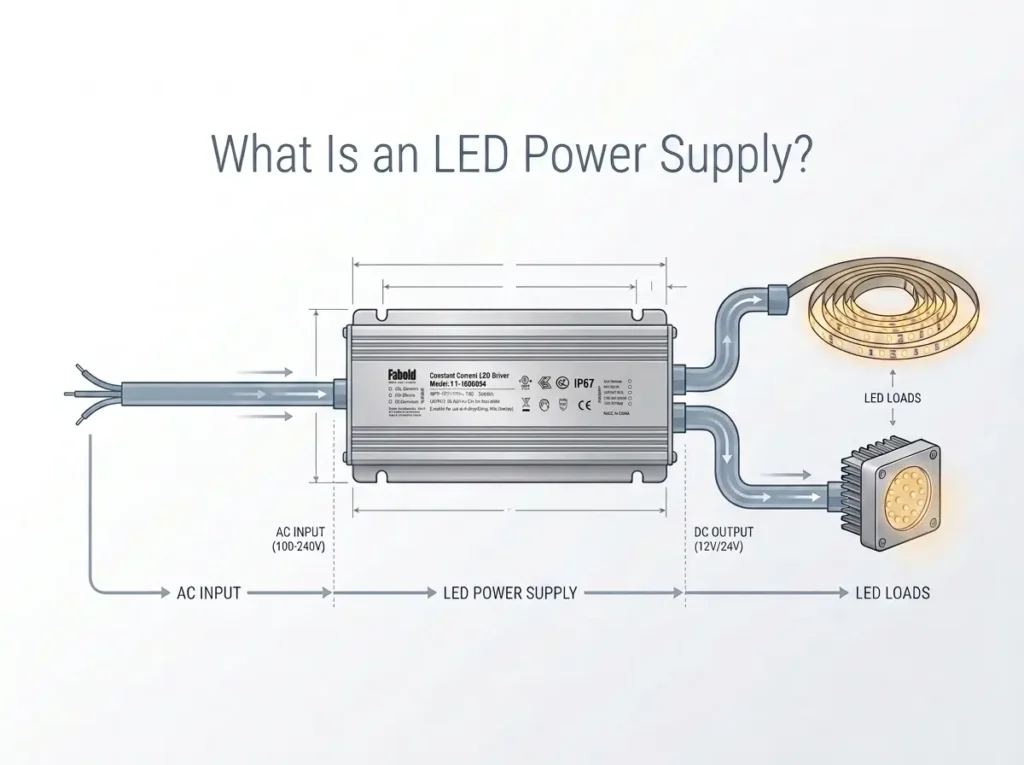
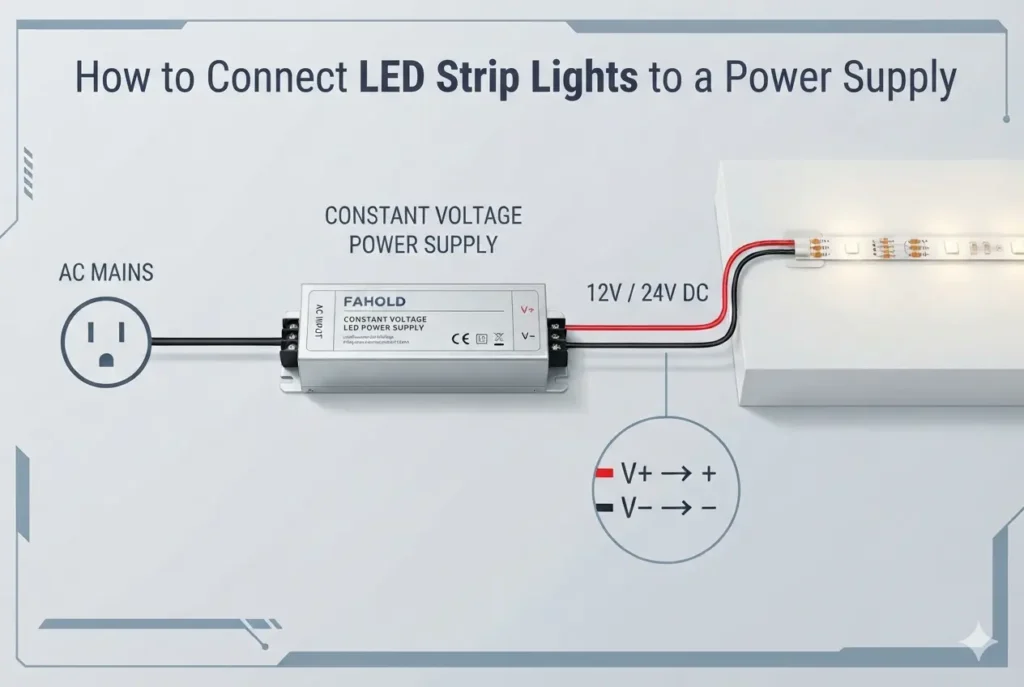
In a typical constant-voltage LED power supply, the input stage accepts a specified AC voltage range, the conversion stage produces regulated DC, and the output circuitry supplies compatible LED loads. A Class 2 design also incorporates the construction and output-limiting provisions necessary for its applicable evaluation.
The simplified flow is:
Building AC input
       |
       v
Input and power-conversion stages
       |
       v
Regulation and required output-limiting functions
       |
       v
Class 2-rated DC output circuit
       |
       v
Compatible LED modules or LED strips
A supply rated for 100–277Vac input may have a 12Vdc or 24Vdc output, but these are two different specifications. The AC input rating tells you which mains supplies the product can accept. The output classification tells you what kind of limited-energy DC circuit is available to the load.
How Output Limiting Is Applied
Class 2 output behavior can involve current limiting, power limiting and protection under abnormal operating conditions, depending on the product design and applicable standard. A rated output current is useful when sizing the load, but a nameplate current figure alone is not sufficient evidence of compliance; the exact product must be evaluated for the required classification.
Because the source remains an electrical device, Class 2 does not mean “no shock risk,” “no wiring rules,” or “suitable for any installation.” The end product and installed lighting system must still meet applicable requirements.
One Output Circuit vs Multiple Class 2 Outputs
A single-output product feeds one rated DC circuit. A multi-output product can supply several separately limited circuits from the same enclosure, provided the outputs are configured and evaluated accordingly.
Single-output arrangement                 Multi-output arrangement

AC --> Power supply                       AC --> Power supply
            |                                          |
         Output 1                                 Output 1  Output 2
            |                                          |       |
       LED branch                                 LED branch A  LED branch B

One rated output circuit                 Each output has its own stated limit
Important: Do not connect separate DC outputs together to obtain a higher current unless the exact manufacturer’s instructions explicitly permit that connection. Multiple available terminals are not automatically multiple independently Class 2-limited circuits; verify how the model’s outputs are defined.
Class 2 Power Supply Voltage, Current and Power Limits
The Limits Are About the Output Circuit, Not a Single Marketing Number
You may see Class 2 summarized as “100VA maximum.” That shorthand can be helpful for understanding the limited-power concept, but it is not a universal design test for every voltage, output type or product configuration. The permissible values and evaluation conditions depend on the applicable rules and source characteristics.
Three parameters need separate attention:
- Voltage: the maximum permitted output voltage for the applicable classification and source type.
- Current: the rated and limited current available from a particular output.
- Power: the electrical power associated with that output and its specified operating conditions.
For a DC constant-voltage load, nominal power can be estimated by:
Power (W) = Output voltage (V) × Output current (A)
That formula is useful for understanding a datasheet. It is not a substitute for a Class 2 certification or an abnormal-condition evaluation.
Why a Multi-Channel Class 2 Unit Can Exceed 100W Total
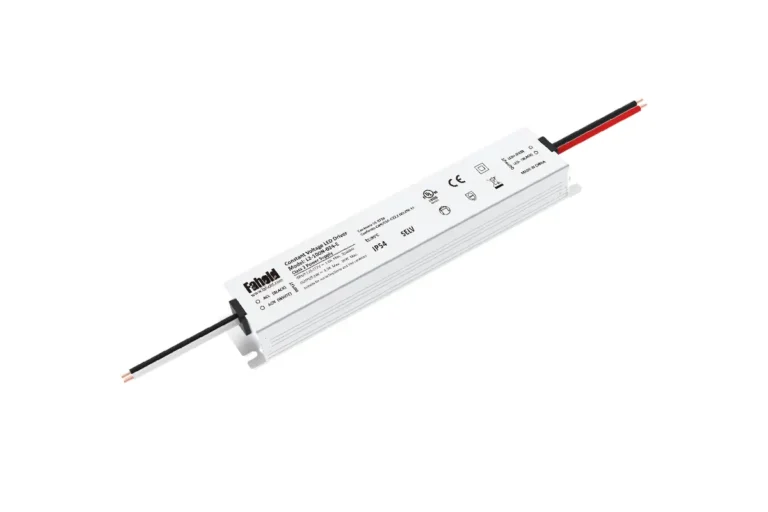
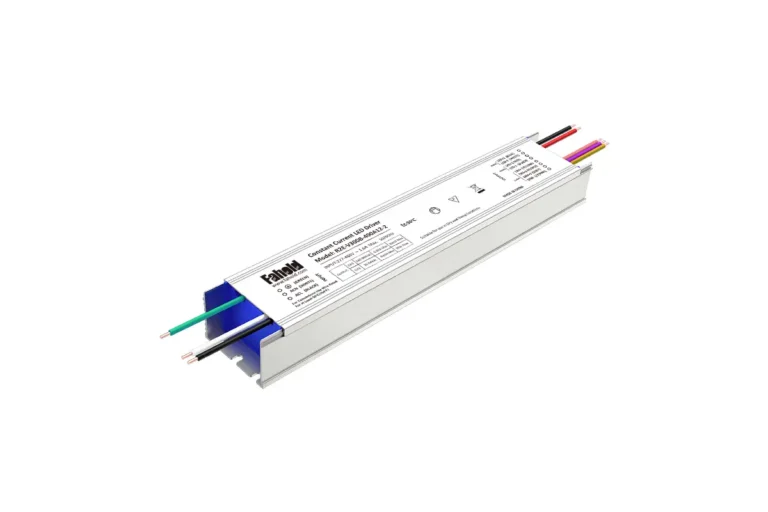
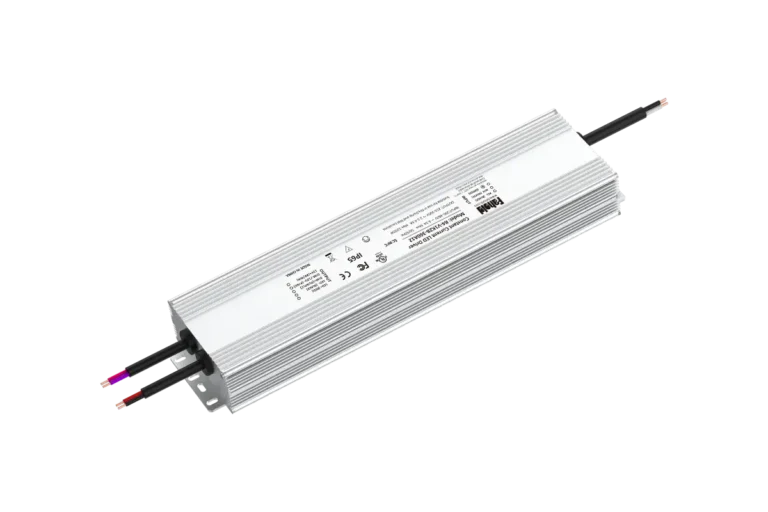
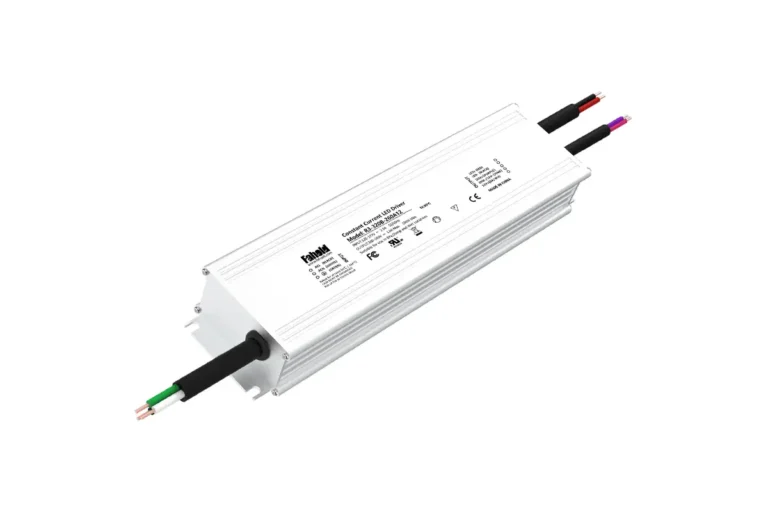
FAHOLD’s L2 multi-channel LED power supply series provides real examples of why total product wattage and power per output must be kept separate.
| FAHOLD L2 model | DC output arrangement | Rated power per output | Combined rated output |
|---|---|---|---|
| L2-060X-012 | 1 × 12V / 5A | 60W | 60W |
| L2-120X-012-2 | 2 × 12V / 5A | 60W | 120W |
| L2-100X-024 | 1 × 24V / 4A | 96W | 96W |
| L2-200X-024-2 | 2 × 24V / 4A | 96W | 192W |
Source: published FAHOLD L2 series specifications. These figures describe rated outputs, not a universal Class 2 limit or independent verification of every model’s certification.
The 120W model does not present 120W as one unrestricted 12V output. Its published arrangement is two 12V / 5A outputs. Similarly, the 192W model is listed as two 24V / 4A outputs. A designer must respect the applicable rating and classification of each output, rather than allocate the entire combined power to one branch.
An illustrative 24V signage installation might distribute 75W to one output and 70W to the other. Those are distinct branch loads; whether the overall product and installation satisfy Class 2 requirements still depends on the specific model’s evaluated configuration, instructions and project rules.
For a more detailed North American selection workflow, see How to Choose a UL Class 2 LED Power Supply for North American Lighting Projects.
Class 1 vs Class 2 Power Supply: Basic Differences
The phrases Class 1 power supply and Class 2 power supply appear in searches, but the relevant comparison is between Class 1 and Class 2 circuit requirements in the applicable electrical code—not simply two quality grades of power supply.
| Comparison | Class 1 circuit | Class 2 circuit |
|---|---|---|
| Main distinction | Circuit permitted and installed under Class 1 requirements | Circuit supplied by a qualifying power-limited Class 2 source |
| Output energy | Not necessarily restricted to Class 2 levels | Restricted to applicable Class 2 output limits |
| Wiring evaluation | Follows the applicable Class 1 wiring provisions | Follows the applicable Class 2 provisions and equipment instructions |
| Typical specification question | What source, conductor protection and wiring rules apply? | Is this exact source/output marked and evaluated for Class 2? |
| Interchangeable just because voltage matches? | No | No |
Neither category should be treated as a substitute for proper circuit design, installation instructions or inspection. In particular, the distinction does not mean every Class 1 installation is unsuitable for LEDs; the correct choice depends on the system requirements.
A separate Class 1 vs Class 2 article can explore installation differences in more detail. Here, the key takeaway is simply that circuit classification affects the power-source and wiring decisions, even when both systems use low-voltage LED loads.
Class 2 Power Supply Standards and Markings
NEC Rules Establish the Installation Context
The National Electrical Code (NFPA 70) provides the broader North American framework for limited-energy circuits and associated installations. The precise article and provision references should be checked against the NEC edition adopted by the project jurisdiction: the 2026 NEC is current, and the NEC has been reorganizing limited-energy material in Chapter 7. See NFPA’s NEC development page.
A Class 2 power supply does not, by itself, certify the finished sign, luminaire, cable system or installation. Installation conditions can impose additional requirements.
UL 1310, UL 8750 and UL 2108 Are Not Interchangeable
Different standards apply to different product scopes:
| Standard | What its published scope addresses | Why an LED project may encounter it |
|---|---|---|
| UL 1310 | Class 2 power units | Evaluation of qualifying standalone Class 2 power-unit products |
| UL 8750 | LED equipment used in lighting products, including drivers and controllers | Evaluation of LED drivers and associated LED-lighting equipment |
| UL 2108 | Low-voltage lighting systems and certain components | System-level requirements for specified low-voltage lighting installations |
These are scope descriptions, not a claim that any one certification automatically satisfies the others. For example, an LED driver may be assessed under requirements applicable to LED equipment, while the complete lighting installation has further requirements. UL’s discussion of UL 8750 and LED drivers with wired controls shows why the control circuit and output classification may need separate evaluation.
How to Recognize Class 2 Information on a Label
When checking an actual product, look for the output designation and any Class 2 marking, then match them to the correct datasheet and certification record. A useful label review includes:
- Manufacturer and exact model number.
- Input voltage and frequency.
- Output voltage, current and rated power, including per-channel values where relevant.
- Class 2 information associated with the applicable output configuration.
- Applicable certification mark or certification file information.
- Environmental and installation markings where required.
Do not confuse the Roman numeral Class II double-insulation symbol (a square within a square) with a North American Class 2 power-limited circuit designation. There is no universal pictogram that replaces checking the wording, technical data and applicable certification.
A supplier’s statement that a product is “tested to UL standards” is also not identical to verifying that the exact model carries the listing or certification required by the project. When UL certification is claimed, search the actual model, manufacturer or file in UL Product iQ, or request the appropriate documentation.
Where Are Class 2 Power Supplies Used in LED Lighting?
The most useful way to think about Class 2 is as an electrical-output requirement that appears inside a specific lighting application, rather than as an application on its own.
LED Signs, Channel Letters and Light Boxes
Commercial signs can contain many LED modules distributed over separate letters or illuminated panels. Their total load may be substantial even though individual branches remain relatively small.
For these systems, the relevant questions are the LED module voltage, number of load sections, current in each section and the rated outputs available to supply them. FAHOLD’s L2 Class 2 LED power supply models are organized around 12V/24V applications with single- and multi-channel configurations. See also FAHOLD Sign Lighting Solutions for application context.
Architectural LED Strip Lighting
Cove lighting, display shelving and linear architectural details often use constant-voltage LED strips. In projects requiring Class 2 power, the strip voltage is just the start: circuit distribution, conductor lengths, dimming interface and enclosure construction matter as well.
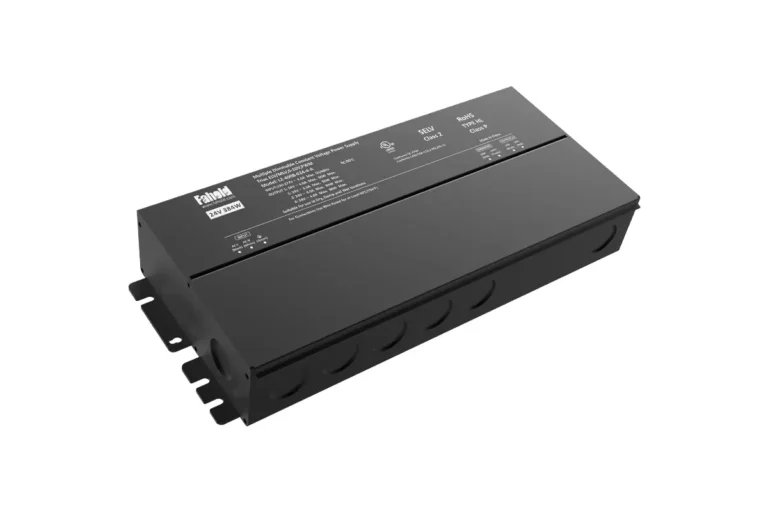
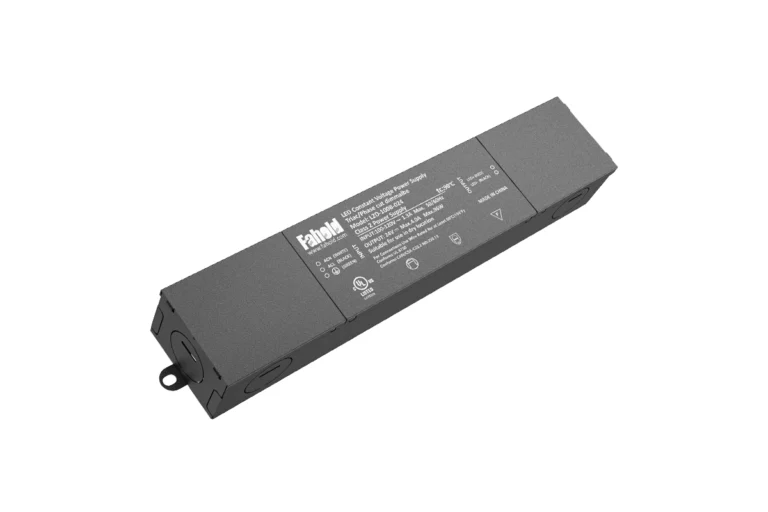
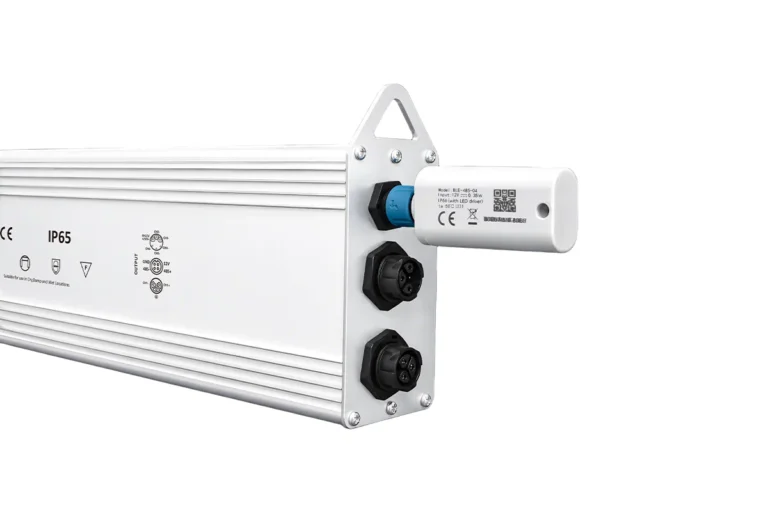
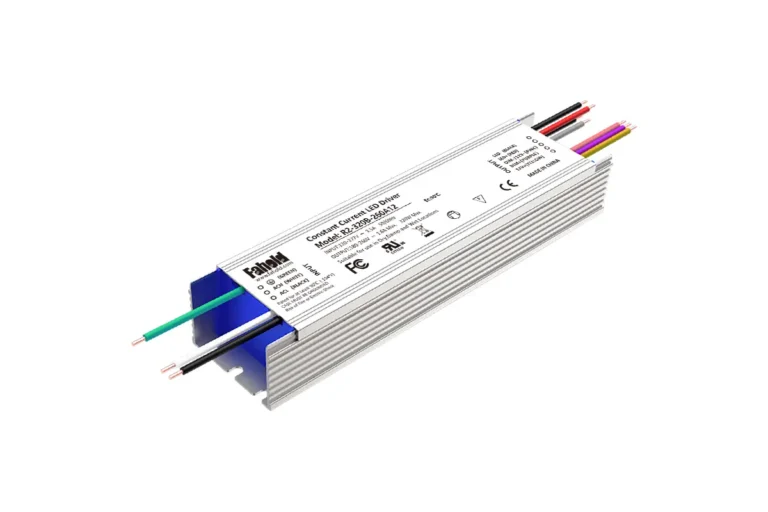
An enclosed power-supply format can be useful where the driver is installed as part of the building’s lighting infrastructure. FAHOLD’s L2-A enclosed Class 2 series is an example of a 12V/24V architectural platform; relevant configurations include multiple output and dimming options. For lighting-system design considerations, see LED Strip Lighting Solutions.
Light Boxes, Display Cabinets and Commercial Interiors
Backlit display panels and retail fixtures may distribute power across numerous modules. Designers should not assume the whole assembly can simply connect to the highest-wattage DC output available. Load distribution, fixture construction and the product’s intended installation conditions should guide the choice.
Protected vs Wet-Location Installations
Class 2 and ingress protection answer different questions. Class 2 concerns output-circuit limits; an IP rating addresses the degree of protection against dust and water ingress under the applicable test conditions. A Class 2 output does not make a supply waterproof, and an IP67 enclosure does not automatically establish Class 2 status.
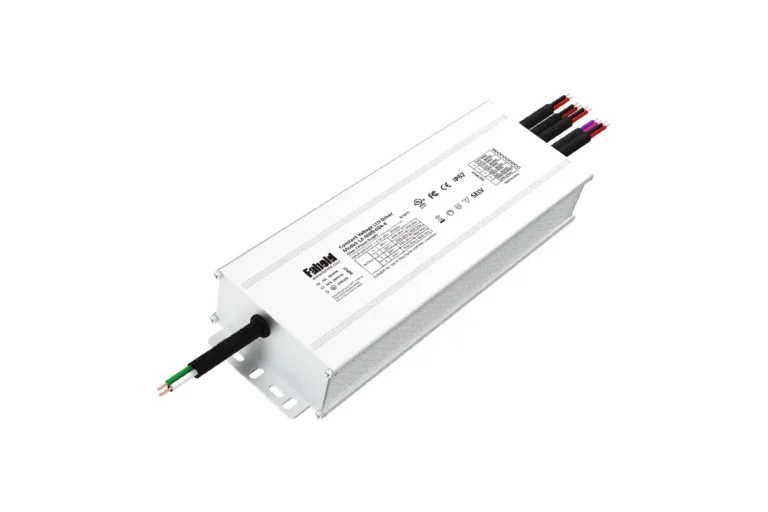
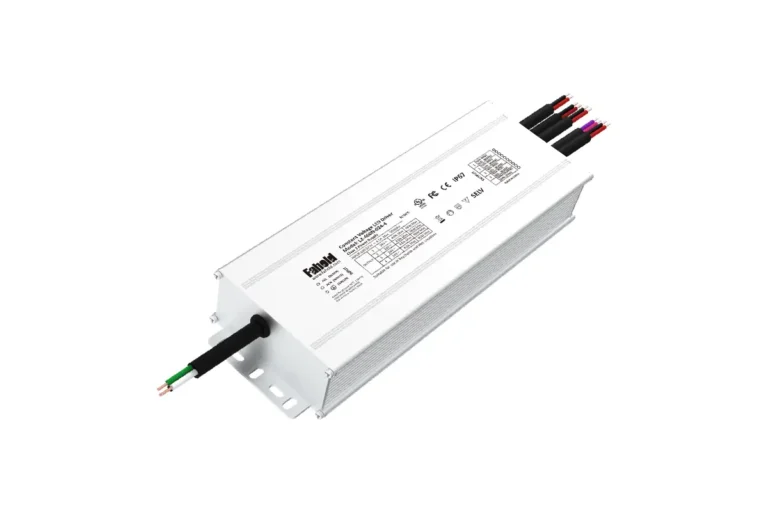
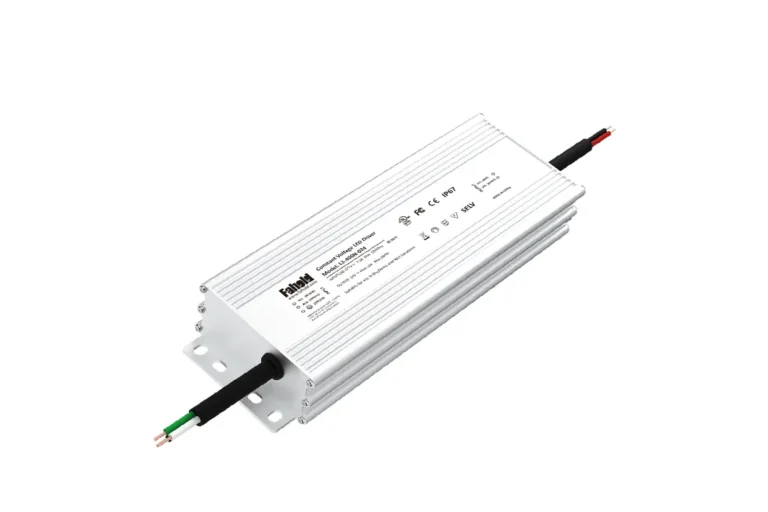
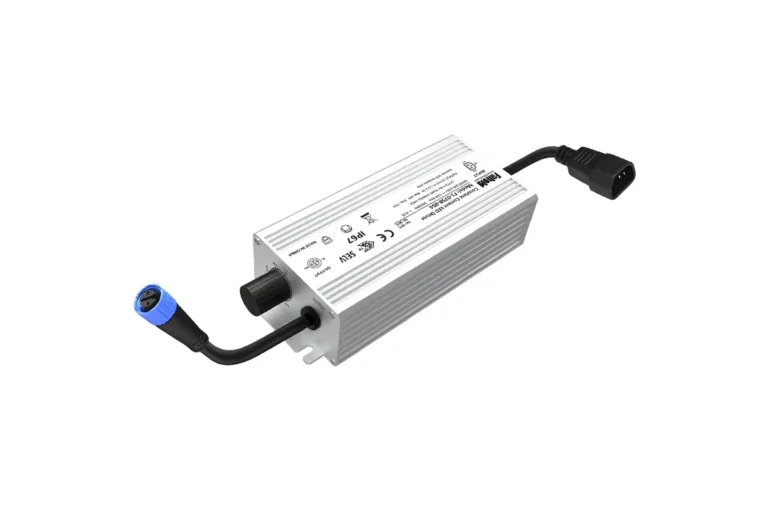
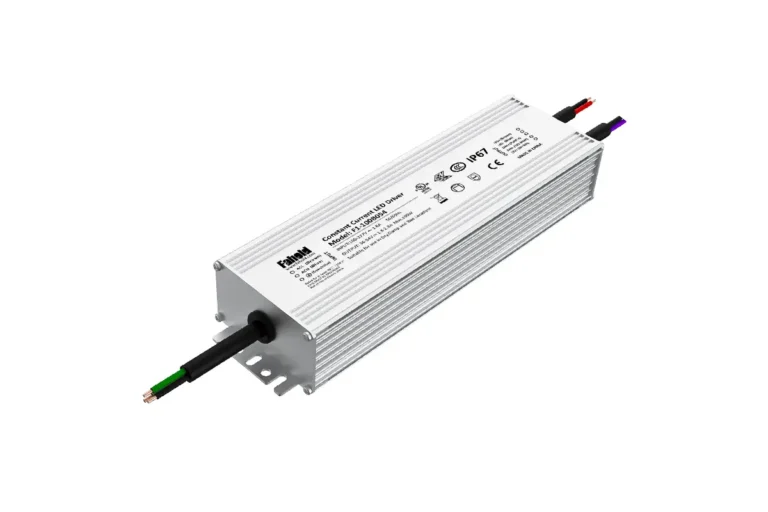
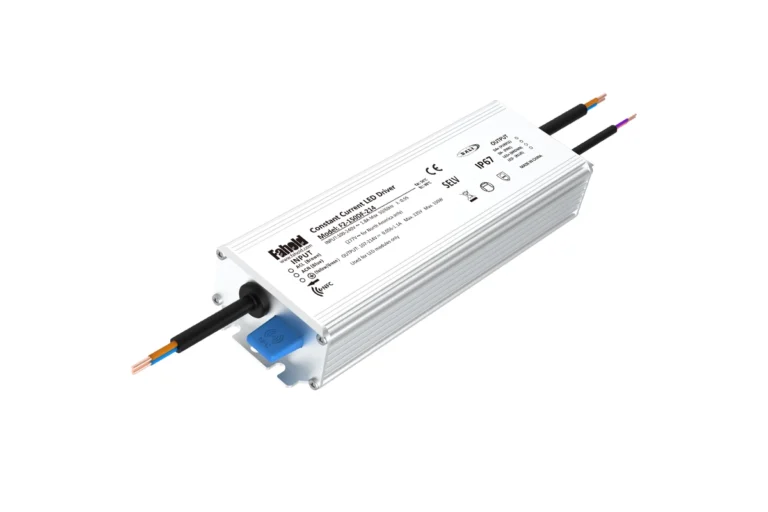
For installations requiring a waterproof power-supply platform, FAHOLD’s L2-F IP67 series is a possible product family to evaluate. The exact configuration, certification and installation method still need verification. Exposed cable splices, connectors and the rest of the lighting system require their own environmental assessment.
12V vs 24V Class 2 LED Power Supplies
Start With the LED Load’s Rated Voltage
A 12V LED module generally requires a compatible regulated 12V supply; a 24V strip generally requires a compatible 24V supply. Do not change a system to 24V merely because an available driver has a larger rated output or because 24V seems easier to wire.
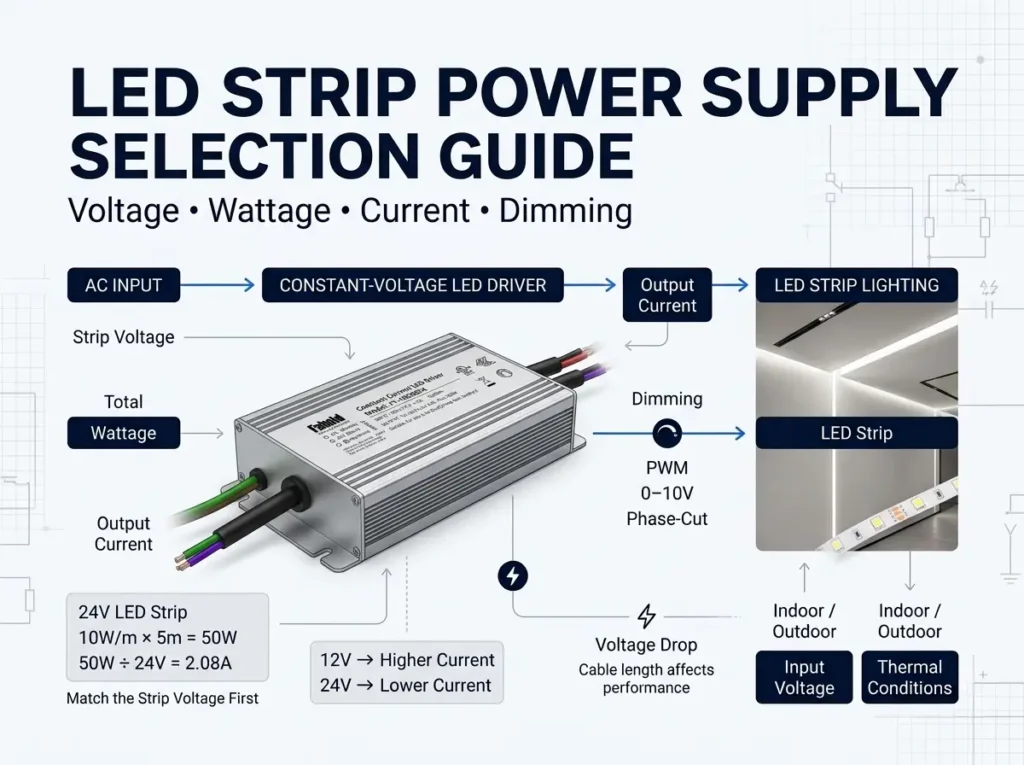
At the same nominal power, 24V usually draws less current than 12V:
| Example load | Current at 12V | Current at 24V |
|---|---|---|
| 48W | 4A | 2A |
| 72W | 6A | 3A |
| 96W | 8A | 4A |
These calculations illustrate load current, not permitted Class 2 source ratings. The actual LED product must support the chosen voltage, and each output must stay within its stated limits.
Current, Wiring and Voltage Drop
Higher current increases voltage drop along a conductor with the same resistance. That is one reason 24V systems can be advantageous in some longer-run designs. But source classification is a separate matter: a 24V power supply with unsuitable output limits does not become Class 2 merely because its wiring losses are lower.
For a detailed explanation, see LED Strip Voltage Drop: Causes and Solutions.
When More Than One Output Circuit Is Needed
Consider three physically separate lighting sections with loads of 45W, 50W and 55W. The combined connected load is 150W. Whether one output can supply them is not resolved by the 150W total alone. The designer must check the requirements for each circuit, the available output arrangement and whether the outputs are genuinely separate, evaluated circuits.
If the proposed architecture serves multiple branches from one supply, Can Multiple LED Strips Share One Power Supply? explains general constant-voltage distribution. The Class 2 conditions still have to be assessed in addition to those load calculations.
Do You Need a Class 2 Power Supply for Your LED Project?
Class 2 is not automatically mandatory for every 12V or 24V LED installation. It may be specified by the luminaire or sign design, the intended wiring method, a product listing, the project specification or requirements of the jurisdiction and authority having jurisdiction (AHJ).
A practical first-pass decision is:
| If your project says… | What to verify next |
|---|---|
| “12V/24V low voltage” | Whether Class 2 is actually required; voltage alone does not decide it. |
| “Use Class 2 outputs” | The exact source/output marking, circuit limits and approved configuration. |
| “UL Listed supply required” | Which certification scope and exact model are acceptable. |
| “Total lighting load exceeds one output’s capacity” | Whether properly configured multiple outputs or supplies are needed. |
| “Outdoor / wet location” | The supply’s environmental suitability and all related system components. |
If the project already calls for Class 2, start with the engineering-led North American UL Class 2 LED power supply selection guide. It covers the next steps—branch loading, input range, control requirements, environmental selection and model-level approval—without repeating the basic definition.
Common Misconceptions About Class 2 Power Supplies
“Every 24V power supply is Class 2.” — False. Output voltage is one specification; power limiting and verified classification are others.
“A Class 2 product can never have more than 100W on its label.” — False. Multi-output products may have a higher combined rating because the relevant outputs are separately limited and evaluated. Never assume this simply from the number of terminals.
“Class 2 and UL Listed mean the same thing.” — False. Class 2 describes a source or circuit classification. UL Listing or another recognized certification status must be verified for the exact product and applicable scope.
“A Class 2 supply does not need proper wiring or installation checks.” — False. Equipment instructions, conductor requirements, environmental conditions and the applicable electrical code still govern the installation.
“A waterproof power supply must be Class 2.” — False. Waterproof construction and limited-energy output are independent characteristics.
“Any Class 2 power supply is suitable for LED strips.” — False. It must also match the LED load’s required voltage, usable current, power architecture, control interface and operating conditions.
Frequently Asked Questions
Is a 24V power supply automatically Class 2?
No. A 24V label specifies nominal output voltage, not the circuit’s limited-energy classification. Check the model’s output ratings, Class 2 designation and applicable certification documentation.
Is a Class 2 power supply always limited to 100W?
Not as a statement about the entire enclosure. The applicable Class 2 limits concern qualifying output circuits and conditions. A multi-channel product can have a higher total nameplate rating while providing separately limited outputs. Use the exact product data and relevant evaluation, not a universal wattage shortcut.
What is the difference between Class 1 and Class 2 power supplies?
The practical distinction is in the power-source and circuit requirements. Class 2 circuits are supplied by sources evaluated to meet prescribed limited-energy output conditions. Class 1 circuits follow different source and wiring requirements. The correct installation approach depends on the adopted electrical code and equipment.
What symbol identifies a Class 2 power supply?
Look for the Class 2 output designation in the product labeling and documentation, together with the manufacturer’s model and relevant certification information. Do not confuse this with the Class II double-insulation symbol. An icon by itself is not reliable proof of an output’s Class 2 classification.
Can I use a Class 2 power supply outdoors?
Only if the exact power supply is suitable for the installation environment, including its enclosure, temperature limits, mounting and wiring requirements. Class 2 status does not independently establish outdoor or wet-location suitability.
Is a Class 2 power supply the same as a constant-voltage LED driver?
No. Constant voltage describes output regulation; Class 2 describes a limited-energy circuit classification. A product may be both, but neither term automatically implies the other.
How can I verify a claimed UL Class 2 product?
Request the exact model’s datasheet and certification details. If the manufacturer claims UL certification, use the relevant listing identifier, company name or model in UL Product iQ, and confirm the approval covers the configuration and market involved.
Explore Class 2 LED Power Supply Options for Your Project
Once the basic Class 2 requirement is clear, the next decision is which output configuration matches the lighting application. FAHOLD offers different constant-voltage product platforms worth evaluating:
| Your application | FAHOLD platform to review | Primary selection question |
|---|---|---|
| Channel letters, illuminated signs, distributed light boxes | L2 multi-channel Class 2 series | How many separately rated output circuits does the load require? |
| Enclosed architectural and commercial LED strip lighting | L2-A Class 2 series | What enclosure, voltage, dimming and channel configuration are needed? |
| Waterproof architectural power installations | L2-F IP67 series | Which exact model meets both environment and Class 2 output requirements? |
These are starting platforms, not blanket claims that every available model has the same certification, control features or electrical limits. Refer to the exact model documentation before approval.
Need to match a Class 2 source to an actual LED project? Send FAHOLD your LED voltage, load on each branch, expected number of output circuits, AC input, installation environment and target market. Our team can help identify relevant product platforms and the specifications to verify before ordering samples.
Explore Class 2 LED Sign Power Supplies →
Read the UL Class 2 Selection Guide →
Send Your Project Requirements to FAHOLD →
Technical References
The sources below support the article’s standards and certification context; exact requirements depend on the applicable edition, product category and installation:
- UL Standards & Engagement — UL 1310: Class 2 Power Units
- UL Standards & Engagement — UL 8750: LED Equipment for Use in Lighting Products
- UL Standards & Engagement — UL 2108: Low Voltage Lighting Systems
- NFPA — NFPA 70 / National Electrical Code
- UL Solutions — UL 8750 LED Drivers and Wired Controls
- UL Solutions — UL Product iQ Certification Search Guidance
- FAHOLD — L2 Series Model Specifications
Need Help With Your LED Power Supply Project?
Tell us what you are working on. We will review your application and recommend the most relevant FAHOLD solution.