Table of Contents
Yes. A higher-wattage constant-voltage LED power supply can often be used when its output voltage matches the LED load and all other electrical, control, environmental and installation requirements are satisfied.
A 24V LED load consuming 40W does not automatically draw 100W when connected to a compatible 24V, 100W supply. The wattage rating represents available capacity; the compatible load draws the current it requires within that capacity.
But “bigger is always better” is also wrong. Excess capacity can add cost and size, and efficiency, dimming behavior or load-range requirements must be checked on the exact product.
For the complete selection workflow, see How to Choose an LED Power Supply. For load calculations, use How to Size an LED Power Supply.
Voltage Must Match; Wattage Is Capacity
Assume a constant-voltage LED load requires:
- 24VDC;
- 40W maximum load.
Its nominal current is:
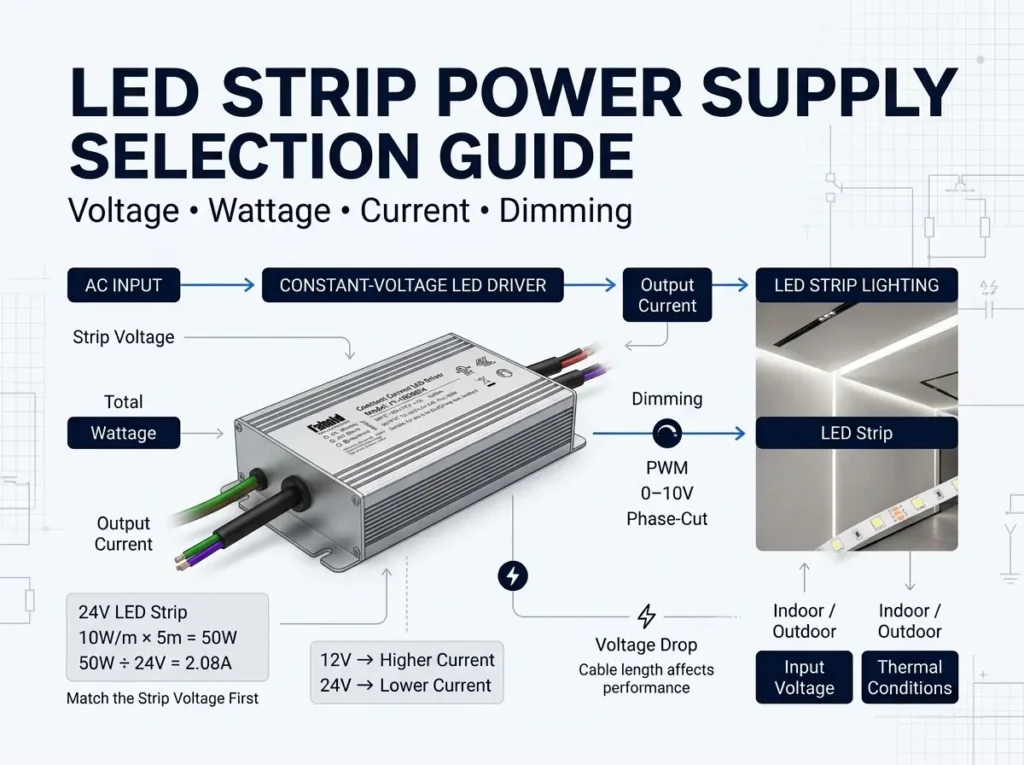
40W ÷ 24V ≈ 1.67A
A compatible supply must maintain 24V and provide sufficient usable current. A supply capable of more than 1.67A does not normally force its full rated current into the load.
MEAN WELL explains constant-voltage operation as maintaining output voltage while output current varies with load condition: MEAN WELL — Constant Voltage and Constant Current LED Power Supply.
This is why a higher wattage rating at the correct voltage is fundamentally different from a higher voltage.
Example: 40W Load on a 100W Supply
Suppose:
- LED load: 24V CV;
- load: 40W;
- candidate supply: 24V, 100W.
The load requires approximately 1.67A. The supply has additional capacity, but the load does not become 100W simply because that capacity exists.
Before approval, still verify:
- output voltage;
- rated current;
- specified load range;
- temperature/input derating;
- efficiency at the intended load;
- dimming/control compatibility;
- dimensions;
- environmental requirements;
- certifications.
The correct conclusion is therefore:
Extra wattage can be acceptable after the complete candidate specification is checked.
Why Overload Is Different From Oversizing
Oversizing means the supply has more capacity than the load requires.
Overload means the load demands more than the supply is designed to provide.
MEAN WELL notes that when a CV supply exceeds its rated-current region, overload protection can activate and this abnormal condition is not intended for continuous operation: MEAN WELL LED Power Supply Technical Q&A.
So a 100W supply on a compatible 40W load and a 40W supply on a 100W load are not equivalent situations.
Higher Wattage Does Not Fix Wrong Voltage
A 12V, 30W LED strip should not be connected to a 24V supply merely because that supply has enough watts.
Voltage compatibility comes first.
If the system voltage is still being selected, see 12V vs 24V LED Power Supply.
Is More Wattage Better for Reliability?
Not automatically.
Operating below maximum capacity can provide useful headroom, especially when temperature or input conditions reduce usable output. But reliability also depends on:
- ambient/case temperature;
- thermal design;
- component quality;
- input voltage;
- enclosure airflow;
- load profile;
- manufacturer derating.
Do not present a generic “80% rule” as a universal code requirement.
Use:
Maximum load → candidate datasheet → loading/derating → final rating
When Extra Capacity Can Be Useful
Future expansion
Extra capacity can accommodate future compatible branches, provided wiring, controllers, connectors and voltage-drop limits are also checked.
Thermal derating
A higher nominal rating may be necessary when elevated ambient temperature reduces usable output.
Standardized procurement
OEMs may standardize around fewer ratings to simplify inventory, provided the selected supply remains compatible across the intended applications.
When Oversizing Can Be a Poor Choice
Larger enclosure
Higher-capacity supplies may be physically larger and harder to integrate into signs, coves or luminaires.
Light-load efficiency
Efficiency can vary with operating point. Do not assume a 300W supply powering 30W is automatically more efficient than a closer-rated unit.
Dimming and minimum load
Some products may specify load-range or control constraints. Only state a minimum-load requirement when the exact datasheet supports it.
Cost
Unused capacity that solves no engineering or procurement problem may simply add cost.
Dimming Is a Separate Compatibility Check
A higher-wattage supply can have enough electrical capacity and still be wrong for the control system.
Verify the required interface—such as 0–10V, DALI, phase-cut or another architecture—on the exact product.
The DALI Alliance defines LED control gear as a specific component within a DALI system: DALI Alliance — DALI Systems.
LED Strip Example
For LED Strip Lighting, assume three compatible 24V branches:
| Branch | Load |
|---|---|
| A | 25W |
| B | 30W |
| C | 20W |
| Total | 75W |
The supply must support the combined 75W under actual conditions.
A larger supply does not eliminate checks for branch current, conductor size, voltage drop, controller capacity or power injection.
Sign Lighting Example
For Sign Lighting, one large supply is not automatically better than several smaller supplies.
Evaluate module voltage, total load, branch distribution, cabinet temperature, wire runs, serviceability and project requirements.
UL 2108 is relevant to North American low-voltage lighting systems; UL’s discussion shows why Class 2 and low-voltage configurations require system-level evaluation: UL Solutions — UL 2108 Low-Voltage Lighting Systems.
Oversizing Decision Table
| Check | Requirement |
|---|---|
| Output voltage | Must match load |
| Usable output capacity | Must exceed maximum load under actual conditions |
| Load range | Must comply with datasheet |
| Derating | Check temperature/input conditions |
| Dimming/control | Must match project |
| Dimensions | Must fit installation |
| Environment | Must meet project exposure |
| Certification | Verify exact product |
| Extra capacity | Should solve a real project need |
Should You Use 300W for a 30W Load?
It may operate if all specifications are compatible, but a 10× capacity ratio needs a reason.
Check efficiency at the intended load, dimensions, cost, control behavior, specified load range and future expansion. A closer standard rating is usually easier to justify when the extra capacity provides no project value.
Why This Article Does Not Recommend a FAHOLD Model
Wattage alone cannot identify the correct product.
Model matching also requires:
- output voltage;
- AC input;
- dimming/control;
- IP/environment;
- certification;
- dimensions;
- exact loading/derating conditions.
Once these are known, send the project specifications to FAHOLD.
For the underlying architecture, continue with the Constant Voltage LED Power Supply Guide.
FAQ
Can I use a 100W LED power supply for a 50W load?
Potentially yes, if voltage and every other relevant specification are compatible. The 50W load does not automatically consume 100W.
Can a power supply have too many amps?
A higher current rating represents available capacity in a compatible CV system. The load normally draws what it requires.
Is oversizing always better?
No. Headroom can be useful, but excessive capacity can add size/cost and may place the supply at an unfavorable operating point.
Do I always need 20% headroom?
No universal percentage replaces the datasheet. Calculate maximum load and verify the candidate’s loading and derating requirements.
Does a bigger power supply solve voltage drop?
No. Voltage drop is primarily a wiring/distribution issue involving current, resistance and run length.
Need Help With Your LED Power Supply Project?
Tell us what you are working on. We will review your application and recommend the most relevant FAHOLD solution.