Table of Contents
If a commercial LED strip project already specifies 24VDC and 0-10V dimming, the driver selection is not simply a matter of finding a product with the same voltage and a higher wattage number.
A suitable driver must match the 24V constant-voltage load, provide enough usable output for the connected LED load, accept the project AC input, work correctly with the specified 0-10V control system, and meet the installation and compliance requirements of the project.
For North American commercial and architectural lighting, the selection normally starts with these checks:
| Project Requirement | What to Confirm |
|---|---|
| LED load | 24V constant-voltage LED strip |
| AC input | 120V, 277V, or a wider commercial input range |
| Connected load | Actual maximum LED wattage |
| Driver capacity | Sufficient usable output under project conditions |
| Dimming | 0-10V interface and controller compatibility |
| Installation | Dry, damp, wet, enclosed, or exposed location |
| Output architecture | Single output or multiple branches |
| Compliance | Required North American listing / Class 2 configuration |
| Wiring | Output current, branch current, cable length and voltage drop |
If you are still determining whether the LED load requires constant voltage or constant current, start with the Constant Voltage LED Power Supply Guide before selecting a model.
Start With the Actual 24V LED Load
The output voltage is the first hard compatibility check.
A 24V LED strip requires a compatible 24V constant-voltage output. A driver with the correct wattage but the wrong output voltage is not an acceptable substitute.
After voltage, calculate the actual connected load.
For example, suppose a project uses:
- 12 m of 24V LED strip;
- strip power: 10 W/m.
The connected load is:
12 m × 10 W/m = 120W
The corresponding nominal output current is:
120W ÷ 24V = 5A
That gives the engineering team a much better starting point than simply requesting “a 150W power supply.”
For a repeatable calculation workflow, use the LED Strip Power Supply Calculator.
Do not turn a fixed headroom percentage into a universal rule
A common shortcut is to multiply every LED load by 1.2 and call the result the required driver wattage.
That may be useful as an early estimate, but professional selection should also account for:
- the driver’s permitted operating range;
- temperature and input-voltage derating;
- enclosure conditions;
- expected maximum simultaneous load;
- future expansion;
- dimming behavior at the intended load point;
- project-specific design margin.
A higher-rated driver can be acceptable when voltage and the rest of the specification remain compatible, but bigger is not automatically better. See Can You Use a Higher-Wattage LED Power Supply? for the separate oversizing decision.
Confirm That 0-10V Is the Actual Control Requirement
“Dimmable” is not a complete control specification.
A commercial project may use:
- 0-10V;
- phase-cut / TRIAC;
- ELV or MLV;
- PWM;
- another control architecture.
If the lighting controls schedule specifies 0-10V, verify that the selected driver configuration supports that interface and that the controller behavior is compatible with the driver.
The North American 0-10V interface is covered by ANSI C137.1, which defines interface and performance requirements for 0-10V dimmable drivers and controls. See the ANSI C137.1-2022 standard listing.
This matters when:
- qualifying a new control system;
- matching a driver to an existing wall control;
- replacing a driver in an installed system;
- evaluating low-end dimming performance;
- deciding whether off behavior is handled by the driver, controller, or separate switching.
Two drivers labeled “0-10V” should not be assumed to behave identically in every control system.
Why 100-277Vac Input Is Useful in North American Commercial Projects
Commercial projects may encounter different branch voltages across buildings, fixture schedules, or project types.
A driver platform with a 100-277Vac rated input range can reduce the number of driver platforms that fixture manufacturers, distributors, or project suppliers need to qualify when their products may be used on both 120V and 277V systems.
This does not mean every project requires a wide-input driver.
If an installation is fixed to one known line voltage, the complete project specification still determines the appropriate product. But for repeatable commercial fixture platforms, wider input coverage can simplify qualification and sourcing.
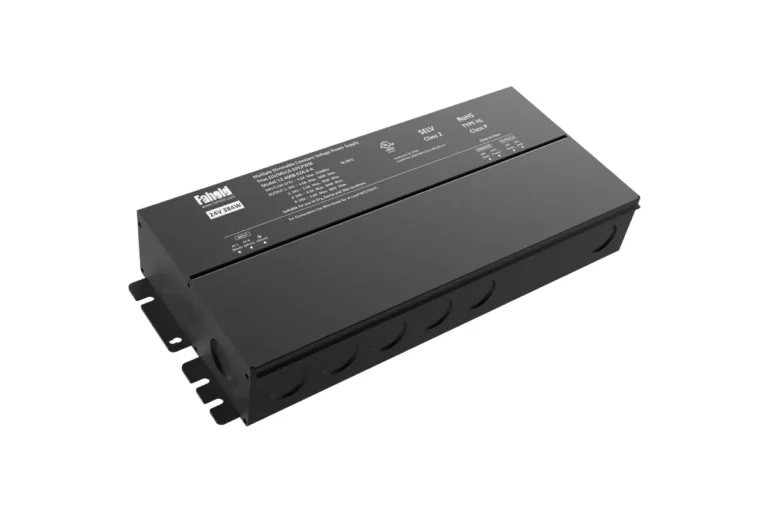
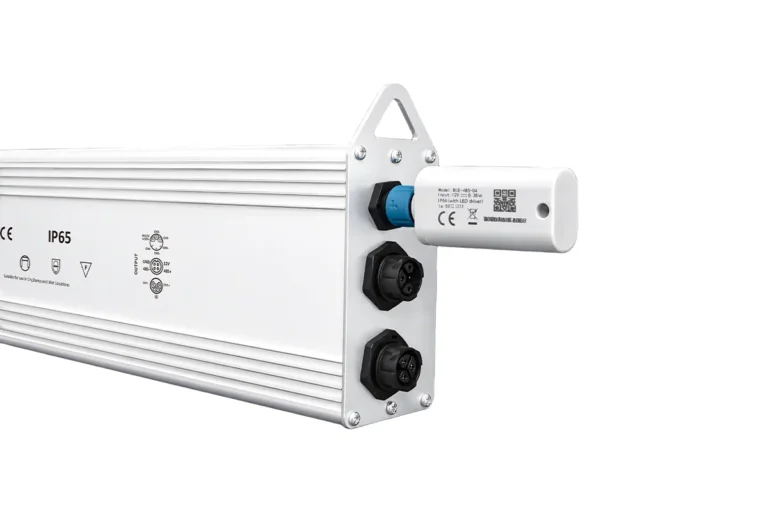
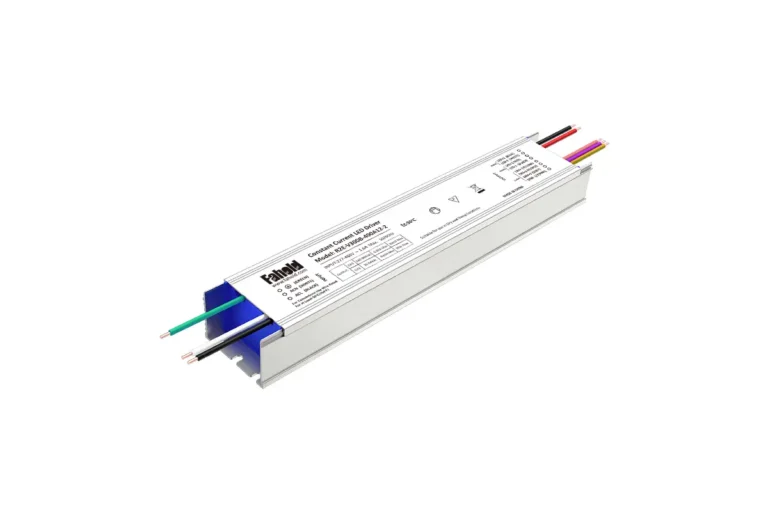
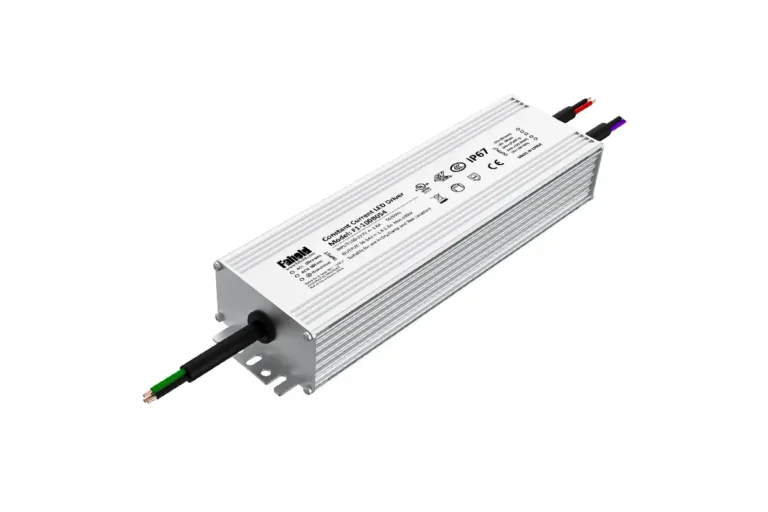
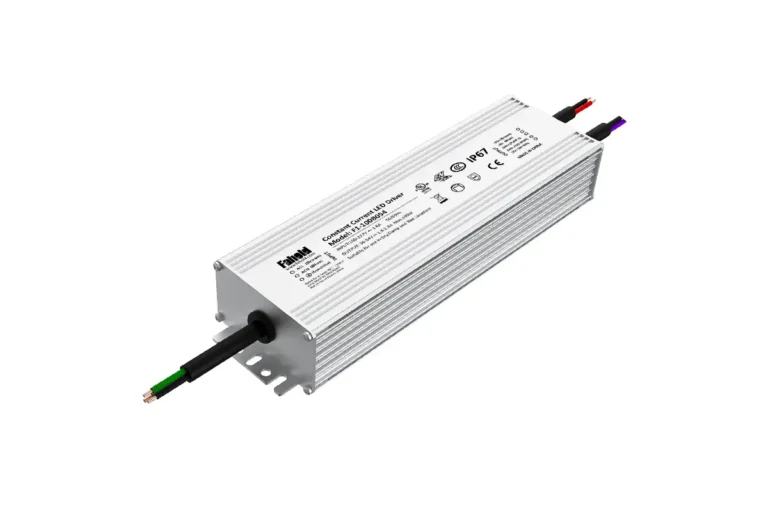
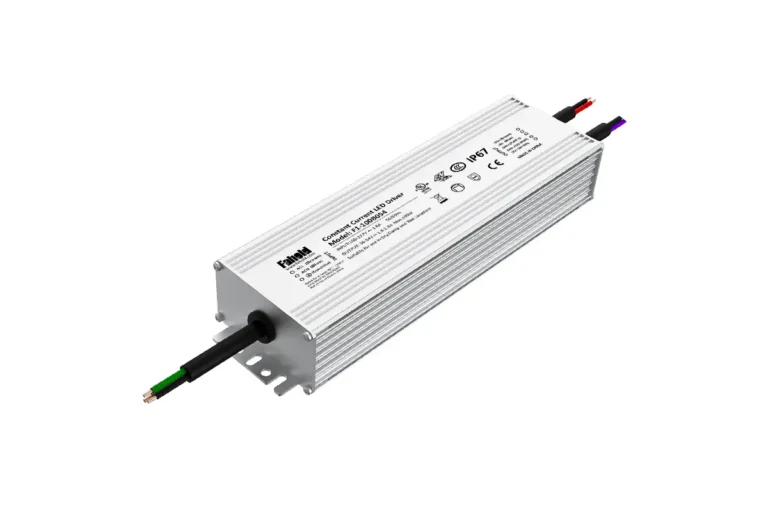
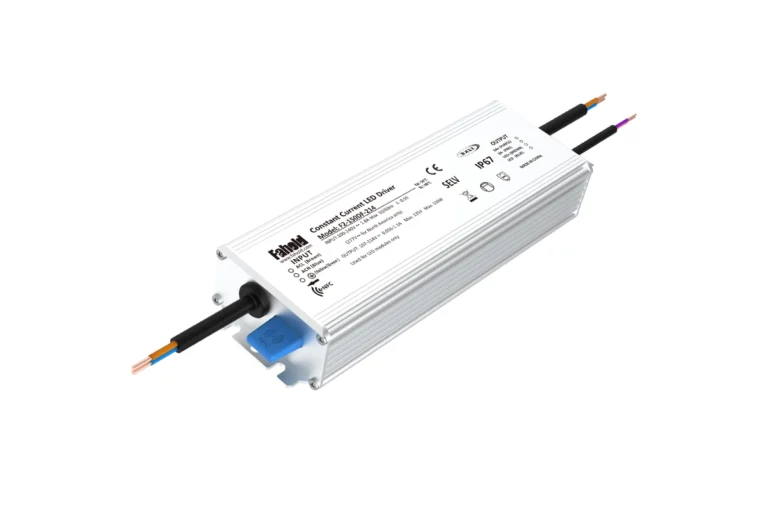
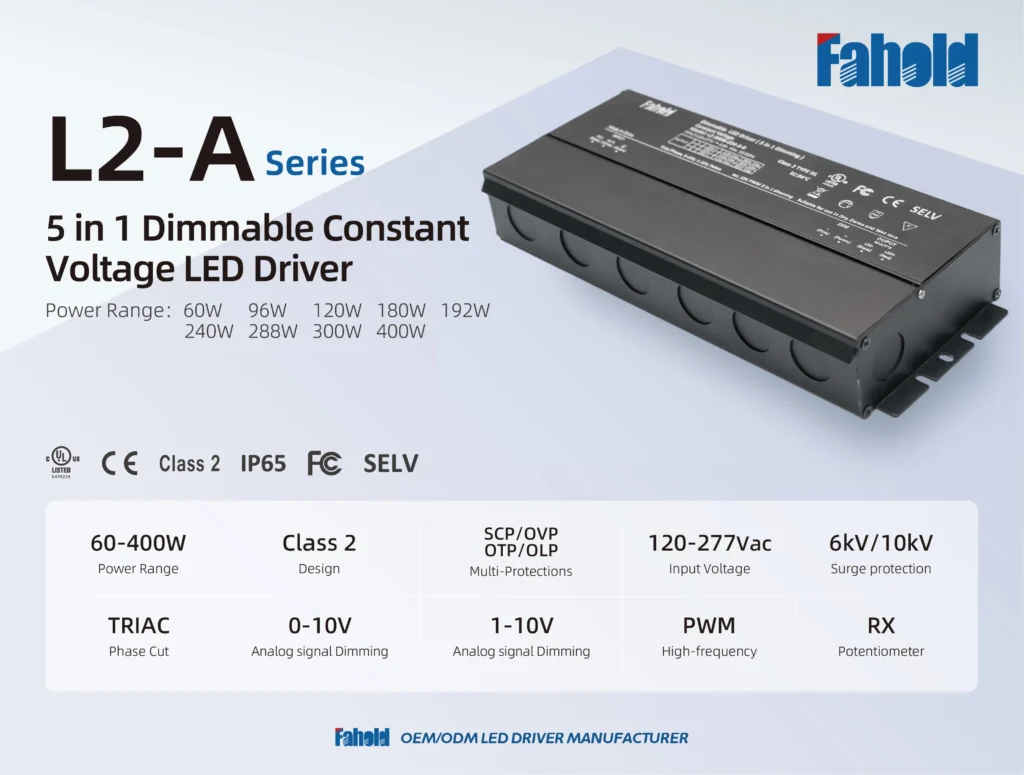
This is one reason the FAHOLD L2-A Series is relevant to North American commercial LED strip and architectural lighting. The current series uses 100-277Vac input, provides 12V and 24V constant-voltage outputs, and supports 0-10V in compatible dimmable configurations.
Class 2 Must Be Verified at the Exact Configuration Level
For projects that specify a Class 2 power architecture, do not infer compliance from total wattage alone.
The exact driver model, output configuration, circuit architecture, listing, and end-use requirements need to be checked together.
UL’s guidance on LED equipment and wired controls specifically addresses LED drivers, control circuits, and Class 2 output considerations under UL 8750. See UL Solutions: UL 8750 wired-control guidance.
This becomes especially relevant when a higher total driver wattage is divided across multiple output branches.
For example, a multi-output architecture may be more appropriate than one unrestricted high-current output when the luminaire or project design requires limited-power branches.
The practical selection question becomes:
Does the required total system wattage need to be delivered through one output, or distributed across multiple outputs?
That decision can affect wiring, branch loading, serviceability, Class 2 requirements, and the driver series that should be evaluated.
Decide Between Single-Output and Multi-Channel Power Distribution
Consider a commercial strip-lighting project with a total connected load near 160W.
That number alone does not tell you whether the best architecture is:
- one higher-current 24V output; or
- multiple 24V output branches.
The decision depends on the physical layout of the lighting system.
For example:
- one compact cove with a short feeder may favor a simple output architecture;
- multiple display bays may be easier to distribute across separate branches;
- several architectural runs returning to one driver location may benefit from multi-channel distribution;
- a Class 2 project may impose additional output-architecture requirements.
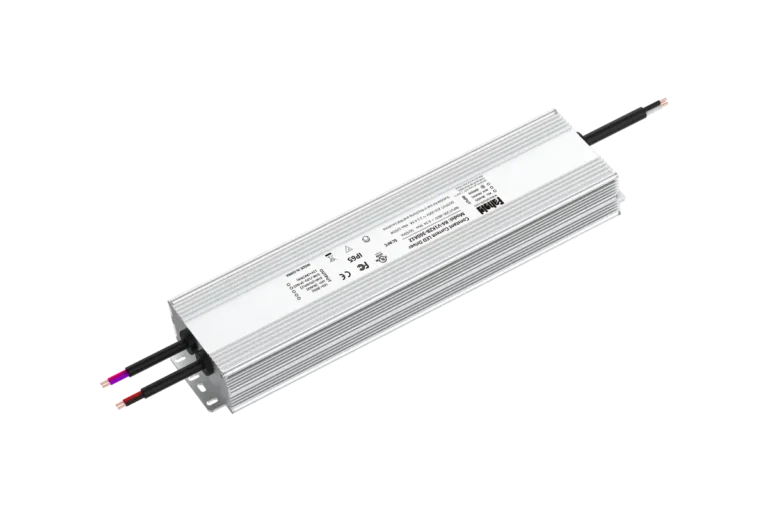
FAHOLD’s L2-A platform includes both single-channel and multi-channel configurations. Its current 24V technical table includes configurations with maximum outputs of approximately 60W, 96W, 192W, 288W and 384W, depending on model.
That makes the series useful for evaluating projects where load distribution matters as much as total wattage.
Example: a 160W commercial cove-lighting load
| Parameter | Project Requirement |
|---|---|
| Application | Commercial cove / linear lighting |
| LED strip | 24V constant voltage |
| Connected load | 160W |
| AC input | 120-277Vac |
| Dimming | 0-10V |
| Installation | Protected architectural location |
| Market | North America |
| Output requirement | Multiple branches preferred |
A 24V multi-channel configuration in the L2-A platform is a logical candidate for evaluation because the series combines the relevant voltage, input range, dimming direction, Class 2 architecture, and multi-channel options.
That is not the same as saying one specific model should automatically be ordered.
Before final model approval, confirm:
- the real branch loads;
- simultaneous maximum load;
- cable length;
- output current per branch;
- controller compatibility;
- ambient temperature;
- enclosure conditions;
- exact certification requirement.
This is the difference between product matching and simply matching a wattage label.
Check Voltage Drop Before Increasing Driver Wattage
Long LED strip runs often create a second problem: voltage drop.
If the far end of a 24V strip becomes visibly dimmer, increasing the driver from 200W to 300W does not automatically solve the issue.
Voltage drop depends on current and resistance in:
- feeder cable;
- connectors;
- terminals;
- PCB copper;
- branch layout.
For a simplified conductor:
Vdrop = I × R
At the same 24V system voltage, a higher-current branch normally creates more conductor voltage drop than a lower-current branch if resistance remains the same.
That means driver selection and distribution design need to be reviewed together.
For the calculation and troubleshooting workflow, see LED Power Supply Voltage Drop: Causes, Calculation & Fixes.
Choose the Driver by Installation Environment, Not by the Strip Location Alone
A strip installed outdoors does not automatically mean the driver itself must be exposed outdoors.
The driver may be:
- installed inside a protected electrical enclosure;
- mounted in a damp service area;
- installed in a wet location;
- directly exposed to outdoor conditions.
These scenarios should not be treated as identical.
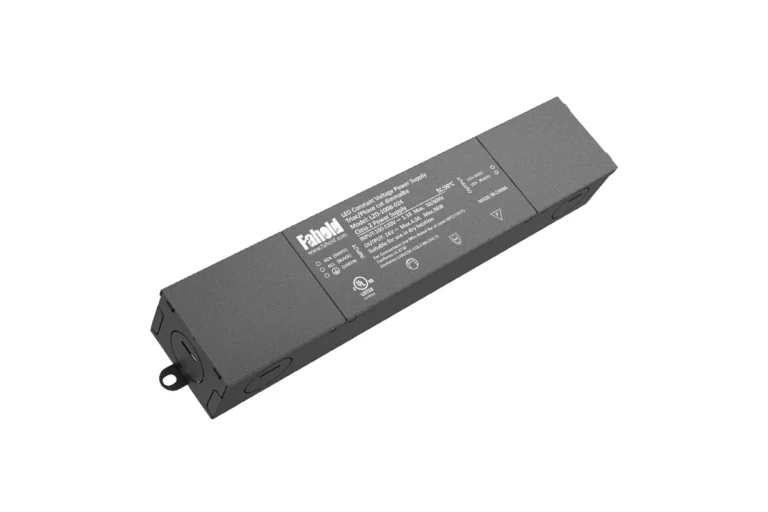
For protected architectural and commercial installations, the L2-A Series is a strong starting point because it combines an enclosed metal / junction-box architecture with 24V options, 100-277Vac input, Class 2 positioning, and multi-mode dimming.Review the FAHOLD L2-A Series specifications.
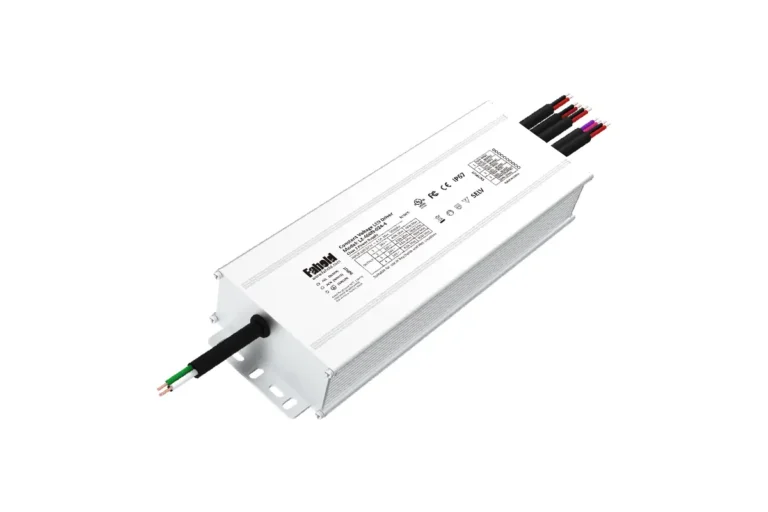
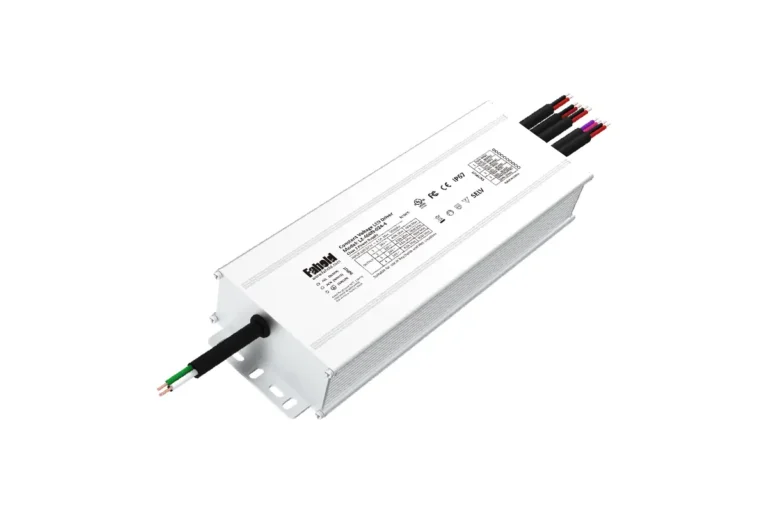
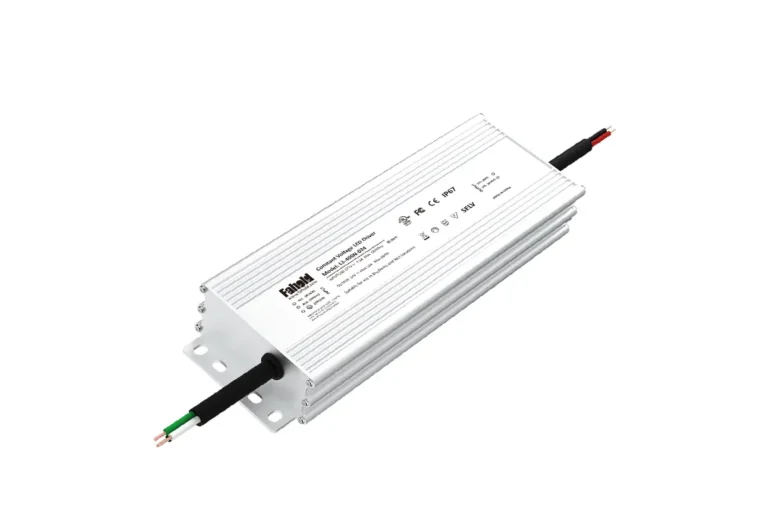
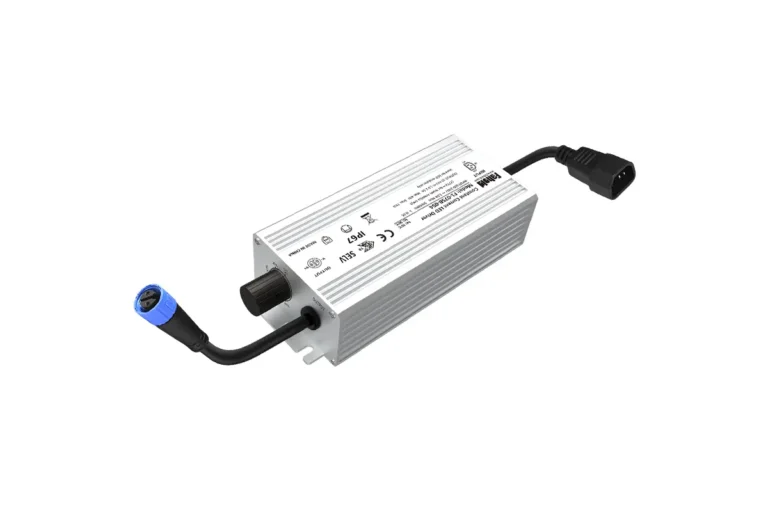
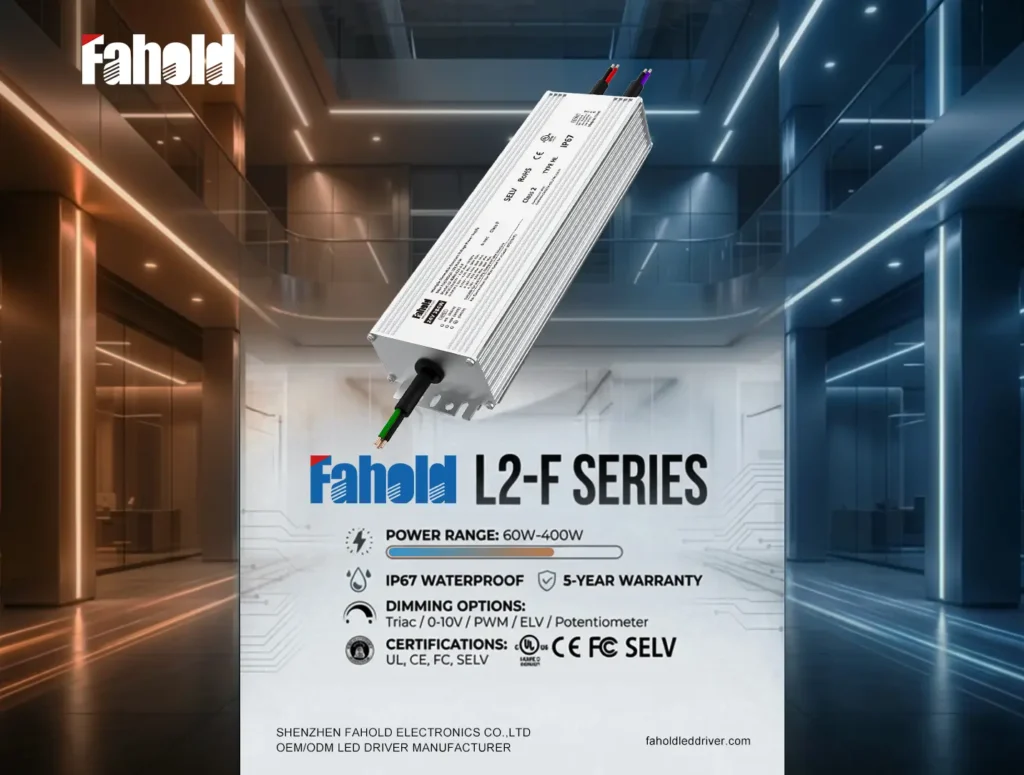
For projects where the driver itself requires a waterproof platform, the FAHOLD L2-F Series is the more relevant candidate to evaluate. L2-F is an IP67, 12V / 24V constant-voltage platform with 100-277Vac input and multi-mode dimming options, including 0-10V in compatible configurations.
| Project Condition | Better Starting Point |
|---|---|
| Protected commercial / architectural installation | L2-A |
| Integrated enclosure / junction-box direction | L2-A |
| Multi-channel Class 2 distribution | L2-A |
| Driver requires IP67 waterproof construction | L2-F |
| Wet-location architectural lighting | L2-F |
| Outdoor waterproof constant-voltage application | L2-F |
The environment can therefore change the recommended series even when the 24V output, total load, and 0-10V control requirement remain the same.
For the broader application context, see FAHOLD’s LED Strip Lighting Solutions.
When a 24V 0-10V Driver Is the Right Direction
A 24V 0-10V constant-voltage driver is a strong candidate when the project has all or most of the following characteristics:
- the LED strip is designed for 24VDC;
- the lighting-control specification calls for 0-10V;
- the driver has sufficient usable output for the real connected load;
- the AC input range matches the site;
- the selected output architecture fits the branch layout;
- the enclosure / IP rating matches the installation;
- the exact model meets the required North American compliance conditions.
It is not the right direction when:
- the LED load requires constant current;
- the strip is designed for 12V or 48V instead of 24V;
- the control system requires DALI or another unsupported interface;
- the required environment exceeds the driver’s protection rating;
- the exact model does not satisfy the required listing or project certification;
- the load distribution exceeds the allowable output / branch conditions.
This conditional approach is important for both new designs and replacement projects.
A replacement should never be approved solely because two drivers share the same nominal voltage and wattage.
What to Send Before Asking for a Driver Recommendation
If you want a supplier to narrow the model list quickly, provide the engineering information that actually controls the selection.
A useful RFQ for a 24V 0-10V commercial LED strip project should include:
| Information | Example |
|---|---|
| LED strip voltage | 24VDC |
| Watts per meter / foot | 10 W/m |
| Total powered length | 16 m |
| Maximum connected load | 160W |
| AC input | 120-277Vac |
| Dimming | 0-10V |
| Number of branches | 2 |
| Installation environment | Damp / protected |
| Class 2 requirement | Required |
| Target market | United States |
| Estimated quantity | Project-specific |
| Existing model | Include if replacement project |
If the project is still at system-design stage, the How to Choose an LED Power Supply guide provides the broader selection sequence.
Have a Real Load Schedule? Match the Driver to the Project
If your 24V strip layout, connected wattage, branch count, AC input, and 0-10V control requirement are already known, the next step is not another generic wattage estimate.
Send the actual project data so the driver can be screened against:
- output voltage and usable power;
- single or multi-channel architecture;
- 0-10V control requirement;
- installation environment;
- Class 2 / certification requirements;
- mechanical and wiring constraints.
For a replacement project, include the existing driver’s model number or datasheet. That allows FAHOLD to compare the electrical, control, environmental, and compliance requirements before proposing an alternative.
Send your 24V LED strip project requirements to FAHOLD.
Need Help With Your LED Power Supply Project?
Tell us what you are working on. We will review your application and recommend the most relevant FAHOLD solution.