Table of Contents
The calculator handles the arithmetic. The rest of this guide explains how to verify the inputs, account for derating and project conditions, and avoid common sizing mistakes.
Use the LED strip power supply calculator below to calculate LED load, output current, and an optional capacity target from your strip voltage, rated power per meter or foot, and the length powered by one supply.
LED Strip Power Supply Calculator
Calculate LED load, output current, and the minimum design capacity for one power supply.
Power supply sizing result
Your LED strip has a nominal load of 76.8 W and requires approximately 3.20 A at 24 VDC. The calculated capacity target starts at 76.8 W of usable output. Verify the candidate power supply under the actual project conditions.
Final selection should also verify input voltage, ambient temperature, derating, dimming/control, installation environment, wiring, and voltage drop. Extra wattage does not correct voltage drop.
Calculate each branch separately and add the maximum simultaneous loads before sizing the power supply.
The multiplication is easy.
The part that causes bad power-supply selections is deciding what number should go into the multiplication.
If a strip is rated at 9.6 W/m and you are powering 5 m, the nominal load is:
9.6 W/m × 5 m = 48 W
That part takes seconds.
The mistakes usually happen before or after it:
- using the wattage of a different strip variant;
- entering the total strip purchased instead of the length powered by one supply;
- assuming a fixed 20% margin is a universal rule;
- sizing from average dimmed consumption rather than the maximum design condition;
- forgetting that several branches can operate at the same time;
- treating power-supply efficiency as extra DC output wattage;
- assuming extra wattage fixes voltage drop.
A useful LED strip power supply calculator should therefore give you three separate answers:
- the LED load in watts;
- the load current in amps;
- the calculated capacity target before product-specific derating and operating conditions are checked.
It should not pretend one formula can finish the entire design.
For the full topic map, use the LED Strip Power Supply Guide. This page stays focused on the calculation itself.
The Core Calculation
For a constant-voltage LED strip rated in watts per meter:
LED Load (W) = Strip Power (W/m) × Powered Length (m)
For a strip rated in watts per foot:
LED Load (W) = Strip Power (W/ft) × Powered Length (ft)
Then calculate output current:
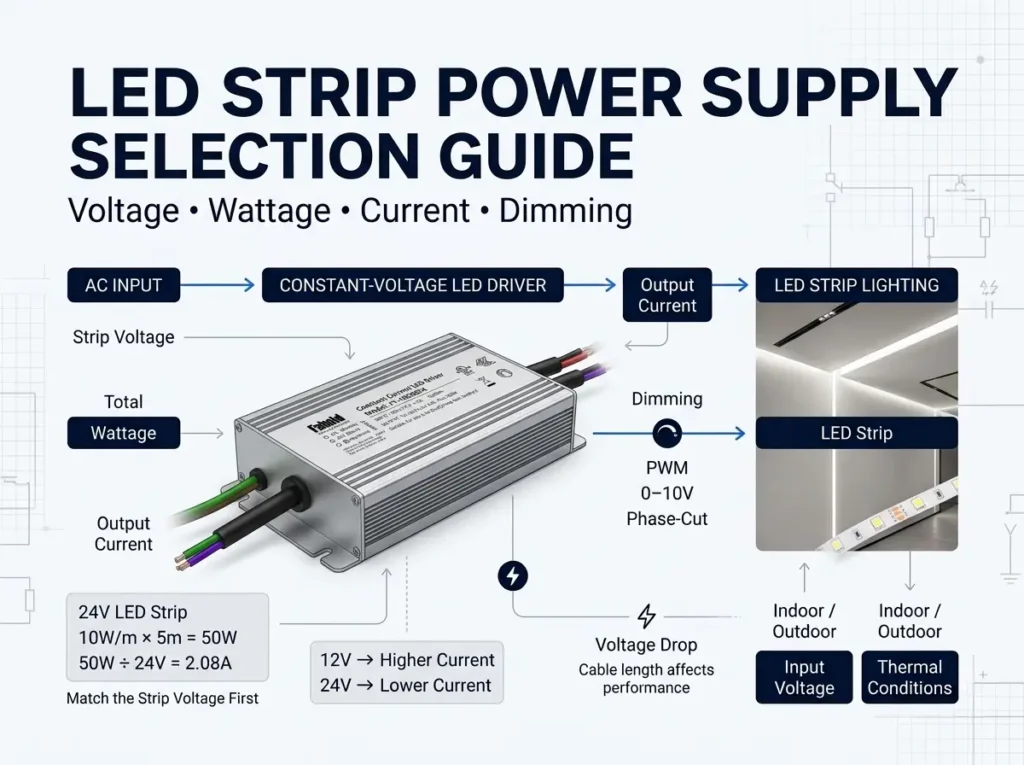
Current (A) = LED Load (W) ÷ Strip Voltage (V)
That gives the electrical load the power supply must support on its DC output.
Example: 24V strip, 8 m, 9.6 W/m
9.6 W/m × 8 m = 76.8 W
Current:
76.8 W ÷ 24 V = 3.2 A
So the design starts with:
- 24 VDC output
- 76.8 W maximum nominal strip load
- 3.2 A load current
Do not round this immediately to a product model.
The next question is whether the candidate supply can provide enough usable output under the real installation conditions.
Before You Calculate Anything, Check the Label You Are Using
A calculator cannot repair bad source data.
The best input is the manufacturer’s datasheet value for the exact strip SKU.
Do not assume two strips with the same LED density have the same W/m.
Two products can both be 24 V, 120 LEDs/m, and 10 mm wide while still having different rated power because the LED package, drive current, circuit design, CCT, RGB channel configuration, or product target is different.
Use the exact maximum power value supplied for the product
If the manufacturer gives:
14.4 W/m maximum
use that value for a maximum-load calculation unless the product documentation defines another design condition.
Do not replace it with a generic internet table.
Do not calculate from LED count alone
“60 LEDs/m” is not a power rating.
LED count can help identify a product family, but it is not enough to determine supply wattage.
The Number Most People Get Wrong: Powered Length
Suppose a project uses 30 m of LED strip in total.
That does not necessarily mean one power supply has a 30 m load.
Consider:
Supply A → 10 m
Supply B → 10 m
Supply C → 10 m
Each supply is sized from the load assigned to that supply.
Now compare:
One Supply
   ├── 10 m Branch A
   ├── 10 m Branch B
   └── 10 m Branch C
Here, one supply sees the combined maximum load of all three branches.
The correct calculator input is therefore not simply “total strip in the project.”
It is:
Total maximum LED load powered by the specific supply being sized.
If several strips share one source, use How Many LED Strips Can One Power Supply Run? after calculating the branch loads.
A Better Calculator Worksheet
| Input | Value | Where It Comes From |
|---|---|---|
| Strip voltage | ___ V | Exact strip datasheet |
| Strip power density | ___ W/m or W/ft | Exact strip datasheet |
| Powered length on this supply | ___ m or ft | Wiring plan |
| Branch 2 load, if any | ___ W | Wiring plan |
| Branch 3 load, if any | ___ W | Wiring plan |
| Maximum simultaneous LED load | ___ W | Sum of active branches |
| Load current | ___ A | W ÷ V |
| Candidate nominal output | ___ W | PSU datasheet |
| Applicable derating | ___ | PSU datasheet |
| Usable output at project condition | ___ W | PSU datasheet / curve |
| Remaining usable capacity | ___ W | Usable output − LED load |
The last two rows are what many simple calculators omit.
Worked Job 1: One 5 m Strip
Assume:
- voltage: 24 V;
- rated power: 12 W/m;
- length: 5 m.
Load:
12 W/m × 5 m = 60 W
Current:
60 W ÷ 24 V = 2.5 A
The power-supply requirement begins at:
24 VDC, at least 60 W / 2.5 A of usable output
Notice the wording: usable output, not merely “choose a 60 W label.”
If a candidate supply is subject to derating at the project’s temperature or input condition, the nominal rating and usable rating may not be the same.
MEAN WELL’s LED power-supply selection guidance explicitly links actual load, operating temperature, lifetime, and derating rather than treating nameplate wattage as the only selection criterion: MEAN WELL — LED Power Supply Selection and Derating Guidance.
Worked Job 2: Three Different Branches on One Supply
Assume one 24 V supply feeds:
- Branch A: 4 m at 9.6 W/m
- Branch B: 2.5 m at 14.4 W/m
- Branch C: 3 m at 7.2 W/m
Calculate each branch separately.
Branch A: 4 × 9.6 = 38.4 W
Branch B: 2.5 × 14.4 = 36 W
Branch C: 3 × 7.2 = 21.6 W
Combined maximum load:
38.4 + 36 + 21.6 = 96 W
Current at 24 V:
96 W ÷ 24 V = 4 A
The source sees a nominal 96 W / 4 A LED load when all three branches operate at their maximum design condition.
This is more reliable than averaging the three W/m values and multiplying by total length, because averaging can hide the fact that different branches use different products.
Worked Job 3: Same 96 W Load at 12 V vs 24 V
The LED load wattage does not change simply because system voltage changes.
For a hypothetical 96 W system:
12 V: 96 W ÷ 12 V = 8 A
24 V: 96 W ÷ 24 V = 4 A
Same nominal power. Different current.
That changes wire, controller, connector, and voltage-drop requirements. It does not mean you should double or halve the power-supply wattage.
For the system-voltage decision, see 12V vs 24V LED Strip: Which Voltage Should You Use?.
Do Not Add Power-Supply Efficiency to the DC Load Calculation
Suppose the LED strip requires 100 W DC output.
If a power supply operates at 90% efficiency at that condition, it draws more than 100 W from the AC input because some energy is lost inside the supply.
That does not mean the LED strip becomes a 111 W DC load.
Keep the two sides separate:
- DC output power determines whether the supply can power the LED strip.
- AC input power includes conversion losses.
If a power supply is rated for 100 W output, its efficiency affects input power and heat—not the arithmetic that turns a 100 W LED load into an artificial 111 W load.
Dimming Does Not Automatically Reduce the Design Load
A strip used at 50% brightness most of the day may consume less average power in real operation.
That does not automatically justify sizing the supply at 50% of the strip’s rated maximum.
Ask:
Can the control system ever command the strip to its full-power state?
If yes, the design normally needs to account for that maximum state.
A lower design load is only defensible when the system has a verified hard limit and the equipment documentation supports designing around that limit.
Do not use today’s measured dimmed power as a substitute for the product’s maximum design load.
RGB and RGBW: Do Not Invent a Multiplier
A generic rule such as:
“RGB always uses three times the single-color wattage”
is not reliable.
The correct value is the manufacturer’s maximum power specification for the exact RGB/RGBW strip.
Different products can use different channel currents, LED packages, simultaneous-channel limits, control methods, and thermal designs.
The calculator should accept the published maximum W/m or W/ft, not derive power from the number of color channels.
The 20% Rule: Useful Shortcut, Bad Universal Rule
Many LED strip calculators hard-code:
Required PSU = LED Load × 1.20
That produces a clean answer, but it hides a key question:
What does the 20% represent?
There are at least two different calculations people call “20% headroom.”
Add 20% above the load
For a 100 W load:
100 × 1.20 = 120 W
Keep the load at 80% of usable supply capacity
For the same load:
100 ÷ 0.80 = 125 W
These are not the same number because the percentage base is different.
For professional B2B content, state the load and usable capacity explicitly rather than hiding the decision behind a universal rule.
For the full margin discussion, see How Much LED Power Supply Headroom Should You Leave?.
For this reason, the calculator above keeps design headroom optional instead of automatically applying a fixed 20% allowance.
What Derating Does to the Calculation
Imagine:
- LED load: 96 W
- candidate nominal supply: 120 W
On paper:
120 − 96 = 24 W spare nominal capacity
Now assume the exact product datasheet permits only 80% output in the project’s operating condition.
Usable capacity:
120 × 0.80 = 96 W
Usable spare capacity:
96 − 96 = 0 W
The candidate has no usable headroom under that hypothetical derated condition.
This example is not FAHOLD product data.
The final sizing sequence is:
LED load → candidate PSU → applicable derating → usable output → project margin
not:
LED load × 1.20 → finished
MEAN WELL’s current selection guidance uses load-versus-temperature derating as part of system design: MEAN WELL — Output Load, Temperature and Derating.
The Calculator Should Not Solve Voltage Drop by Adding Watts
Suppose:
- supply output: 24 V;
- LED load: 80 W;
- remote strip is dim.
It is tempting to increase the PSU from 100 W to 150 W.
That may do nothing if the original supply is already maintaining 24 V at its output.
Voltage drop is primarily a distribution problem involving current and resistance:
Vdrop = I × R
Southwire’s professional calculator treats voltage drop as a conductor/current/distance problem and sizes conductors accordingly: Southwire Re³ Voltage Drop Calculator.
Keep two calculations separate:
Power-supply sizing
W/m × length → total load → usable PSU capacity
Voltage-drop design
current + conductor resistance + distance → voltage delivered at the load
P03-05 handles that second problem in LED Strip Voltage Drop Explained.
What If the Datasheet Gives Watts per Reel Instead of Watts per Meter?
Use the manufacturer’s stated basis.
If a 5 m reel is rated 60 W total, then:
60 W ÷ 5 m = 12 W/m
only if the specification clearly applies to the full 5 m reel and there are no other qualifiers.
Do not reverse-engineer W/m from an unclear marketplace listing.
For procurement work, missing power-density data is a reason to request the proper product specification rather than estimate from photos, LED count, or competing products.
What If the Strip Is Cut Into Several Pieces?
Cutting one strip into several sections does not change its total theoretical LED load if:
- the total powered length stays the same;
- all sections are the same strip;
- all sections can operate simultaneously at the same maximum condition.
Example:
One 6 m strip at 10 W/m:
6 × 10 = 60 W
Three 2 m sections of the same strip:
2 × 10 + 2 × 10 + 2 × 10 = 60 W
The total wattage is still 60 W.
What changes is the distribution:
- number of branches;
- cable lengths;
- branch current;
- voltage drop;
- control zoning.
Wattage calculation and wiring design should not be collapsed into one number.
A Useful Rule for Multi-Zone Projects
If zones can operate simultaneously, add them.
If they are electrically interlocked so only one zone can operate at a time, the maximum simultaneous load may be different.
Do not assume diversity simply because users “usually” do not turn everything on together.
For a design calculation, use the maximum operating state the control system actually allows.
That is more defensible than using average behavior.
How to Round the Result to a Commercial Power-Supply Rating
Suppose your verified calculation gives:
- strip load: 73.6 W;
- required voltage: 24 V;
- current: about 3.07 A.
Do not look for a “73.6 W power supply.”
Instead:
- identify standard candidate ratings above the load;
- check the exact candidate’s output voltage/current;
- apply any required derating;
- confirm usable capacity;
- confirm dimming, environment, certifications, dimensions, and AC input;
- choose the smallest standard candidate that satisfies the complete specification and any justified project margin.
“Round up” is therefore a product-selection action, not a new mathematical formula.
What Online LED Strip Calculators Often Get Wrong
A fast calculator is useful for arithmetic. It becomes misleading when it silently turns assumptions into engineering facts.
Watch for these shortcuts:
Hard-coded 20% headroom
Useful as a planning preset, but not a universal requirement.
Fixed “5 m maximum run” rules
Run length is product-specific.
Generic W/m values based on LED density
Use the exact strip datasheet.
Power-supply efficiency added to DC load
Efficiency affects AC input power and heat, not the LED’s required DC output wattage.
Dimming percentage used as guaranteed design load
Only valid where the system has a verified hard limit.
Voltage drop treated as extra wattage
Voltage drop needs a distribution calculation.
One project length entered even when several supplies split the load
Size each supply from the load actually assigned to it.
The formula is not the problem. Hidden assumptions are.
A Procurement Example: What to Send Before Asking for a Power Supply
A useful RFQ is more specific than:
“Need 150 W LED strip driver.”
Send:
| Requirement | Example Format |
|---|---|
| Target market | United States |
| Strip voltage | 24 VDC |
| Strip power density | 12 W/m |
| Total powered length per supply | 8 m |
| Calculated LED load | 96 W |
| Calculated output current | 4 A |
| Number of branches | 3 |
| Longest DC run | Project value |
| Control method | PWM / 0–10V / DALI / phase-cut / none |
| Installation | Indoor / enclosed / outdoor |
| Ambient/enclosure condition | Project value |
| Certification requirement | Project-specific |
| Maximum PSU dimensions | Project value |
Now a supplier can evaluate a real electrical requirement rather than guessing from one wattage number.
For FAHOLD’s application context, see LED Strip Lighting.
If you have the actual strip specification and installation conditions, contact FAHOLD for product matching.
Manual LED Strip Power Supply Calculation Formulas
Use this in a spreadsheet, calculator, or project worksheet.
Single strip type
LED Load (W)
= Power Density (W/m or W/ft) × Powered Length

Load Current (A)
= LED Load (W) ÷ Strip Voltage (V)
Multiple strip types / branches
Branch A Load
= Branch A W/m × Branch A Length

Branch B Load
= Branch B W/m × Branch B Length

Branch C Load
= Branch C W/m × Branch C Length

Maximum Simultaneous Load
= A + B + C

Total Current
= Maximum Simultaneous Load ÷ System Voltage
Candidate supply check
Usable PSU Output
= Candidate Rated Output adjusted according to the exact datasheet
  for the project temperature/input/mounting condition

Usable Spare Capacity
= Usable PSU Output − Maximum Simultaneous LED Load
Do not insert a generic derating factor unless the candidate datasheet provides the basis for it.
The Calculation Ends Before the Selection Does
When the arithmetic is complete, you know:
- the required output voltage;
- the maximum LED load;
- the required output current.
You still do not know the final power-supply model.
The final selection must also verify:
- AC input;
- usable output after derating;
- dimming/control;
- environmental suitability;
- certification;
- dimensions;
- terminals/wiring;
- project-specific requirements.
That broader decision belongs in How to Choose the Right Power Supply for LED Strip Lights.
The calculator should make the first part precise—not pretend the rest of the engineering does not exist.
How to Calculate Power Supply Wattage for LED Strips FAQ
How do I calculate the wattage needed for an LED strip power supply?
Enter the strip voltage, rated W/m or W/ft, and the length powered by one supply into the calculator above. The basic load calculation is power density × powered length, and output current is watts ÷ voltage. Then verify the candidate supply’s usable output under the actual operating conditions.
What size power supply do I need for a 5 m LED strip?
It depends on the exact strip power density and voltage. A 5 m strip rated 12 W/m has a 60 W LED load. You still need to check output voltage, current, derating, and the rest of the project specification.
Should I add 20% to my LED strip wattage?
Not automatically. A fixed margin can be a planning shortcut, but manufacturer loading/derating requirements and project conditions should determine the final usable capacity.
Does a 24V LED strip need fewer watts than a 12V strip?
Not if both strip systems have the same rated power. A 96 W load is still 96 W; the 24 V version draws less current.
Should I include power-supply efficiency in the LED wattage formula?
Not as extra LED output load. Efficiency affects AC input power and heat. Size the DC output from the LED load and the power supply’s rated/usable output specification.
Can one power supply run several LED strips?
Yes, if the strips use the same compatible system voltage and the supply supports their maximum simultaneous load. Branch current, voltage drop, controls, and wiring still require separate checks.
Can I size the power supply from measured dimmed consumption?
Only when the system has a verified hard operating limit that prevents a higher load. Otherwise, use the maximum design condition supported by the strip and control system.
Find the Right LED Power Supply for Your Project
Share the core electrical and application requirements. We will narrow the available FAHOLD platforms to the options most relevant to your project.