Table of Contents
There is no meaningful universal answer such as “one 200W power supply can run eight LED strips.”
The reason is simple:
an LED strip is not a standard electrical unit.
One “strip” might mean:
- a 1 m cut section at 4.8 W/m;
- a 5 m reel at 14.4 W/m;
- a 2 ft cabinet-light branch;
- a 24V COB tape;
- an RGBW strip with a very different maximum power;
- a branch that is normally dimmed but can still reach full output.
So the useful question is not:
How many strips can the power supply run?
It is:
How much simultaneous LED load can this power supply support, and can the distribution system carry that load correctly?
For identical branches, a first-pass count can be calculated:
Theoretical Strip Count = Usable Power-Supply Capacity ÷ Maximum Load per Strip Branch
Then round down to a whole branch.
But that result is only a capacity screen.
The final number can be lower because of:
- output-current limits;
- controller limits;
- terminal or distribution-block limits;
- trunk conductor current;
- branch voltage drop;
- strip maximum-run/feed requirements;
- thermal or input-voltage derating;
- zoning and serviceability.
This article focuses on that difference between a theoretical count and an engineered count.
For the full LED-strip power-supply topic map, start with the LED Strip Power Supply Guide.
Stop Counting Reels. Count Powered Branches.
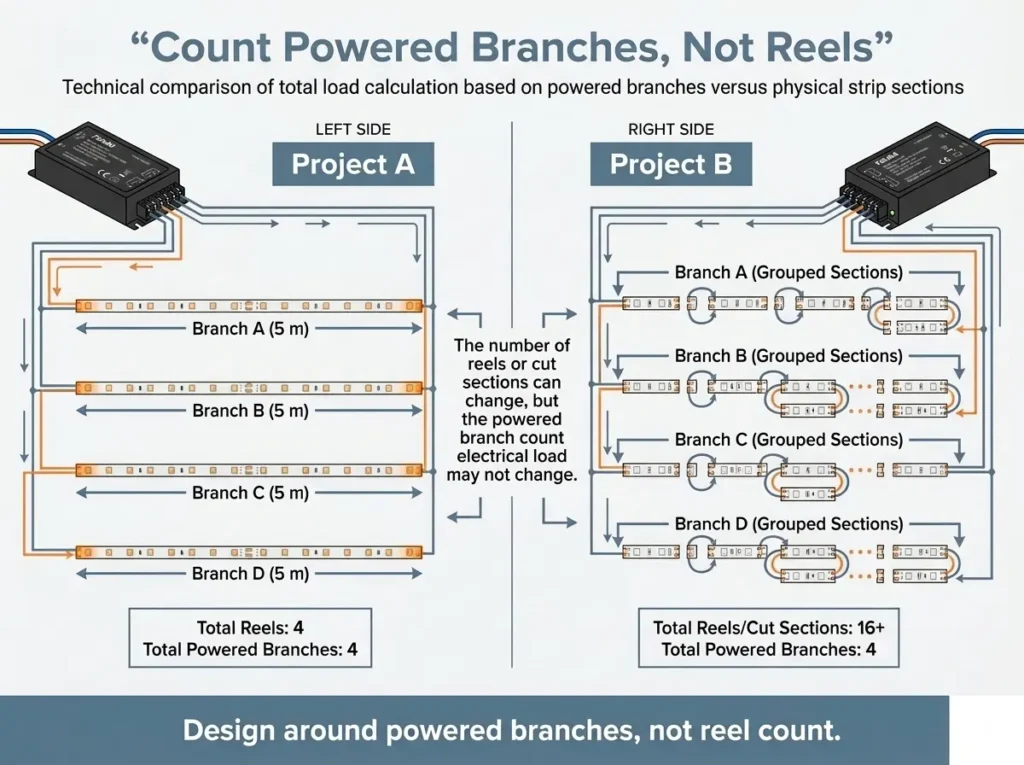
A common mistake is to use the number of reels as the design unit.
Imagine two projects.
Project A
Four 5 m reels are each connected as one separate branch:
            ┌── 5 m Branch A
            ├── 5 m Branch B
Power Supply├── 5 m Branch C
            └── 5 m Branch D
Project B
The same 20 m of strip is physically cut into ten shorter sections but electrically grouped into four powered branches.
The material count changed.
The electrical load assigned to the supply may not have changed at all.
That is why a procurement or engineering calculation should record:
- powered length per branch;
- W/m or W/ft of that branch;
- number of branches;
- maximum simultaneous load.
“Number of reels” is useful for purchasing.
It is usually a poor unit for sizing one power supply.
The First Number: Maximum Simultaneous Load
For each branch:
Branch Load = Strip Power Density × Powered Length
Then:
Maximum Simultaneous Load = Sum of all branches that can be on at the same time
Example:
| Branch | Strip Rating | Powered Length | Maximum Load |
|---|---|---|---|
| A | 9.6 W/m | 4 m | 38.4 W |
| B | 9.6 W/m | 4 m | 38.4 W |
| C | 9.6 W/m | 2 m | 19.2 W |
| D | 9.6 W/m | 2 m | 19.2 W |
| Total | 115.2 W |
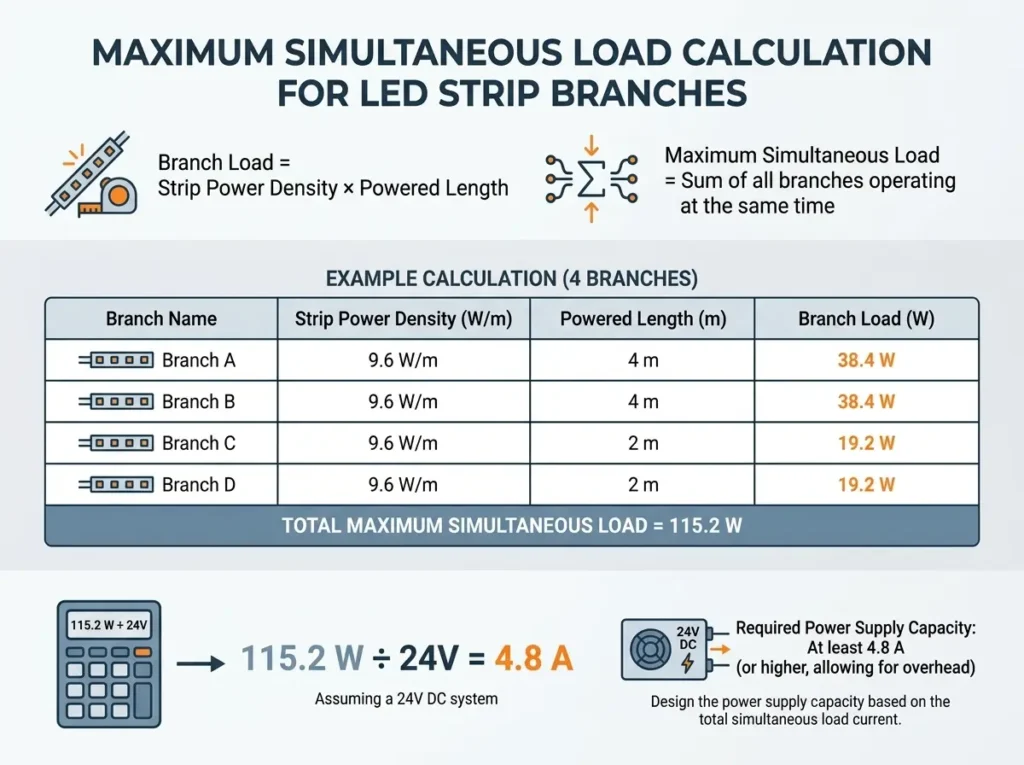
If all four branches can operate simultaneously, the source sees a nominal maximum LED load of:
115.2 W
At 24V:
115.2 W ÷ 24V = 4.8 A
Those two numbers—115.2 W and 4.8 A—are more useful than saying “four strips.”
For the dedicated arithmetic, see How to Calculate Power Supply Wattage for LED Strips.
For Identical Branches, You Can Calculate a Theoretical Count
Assume a hypothetical project with:
- 24V LED strip branches;
- each branch maximum load = 18W;
- candidate power supply usable output at project conditions = 180W.
Then:
180W ÷ 18W = 10 branches
Theoretical capacity count:
10
At 24V, each branch current is:
18W ÷ 24V = 0.75A
Ten branches would draw:
0.75A × 10 = 7.5A
This is where many online answers stop.
A real design review does not.
Now the system has to answer:
- Can the candidate supply provide the required output current?
- Can its output terminal arrangement support the distribution method?
- Can the trunk or distribution block carry 7.5A?
- Can any downstream controller carry the total or per-channel current?
- Are the branch conductors sized correctly?
- Are the longest branches still within acceptable voltage-drop and strip-feed limits?
- Is 180W truly usable at the installation temperature and AC input?
The 10-strip result is mathematically correct under its assumptions and can still be an incomplete engineering answer.
The Real Count Is the Count That Passes Every Bottleneck
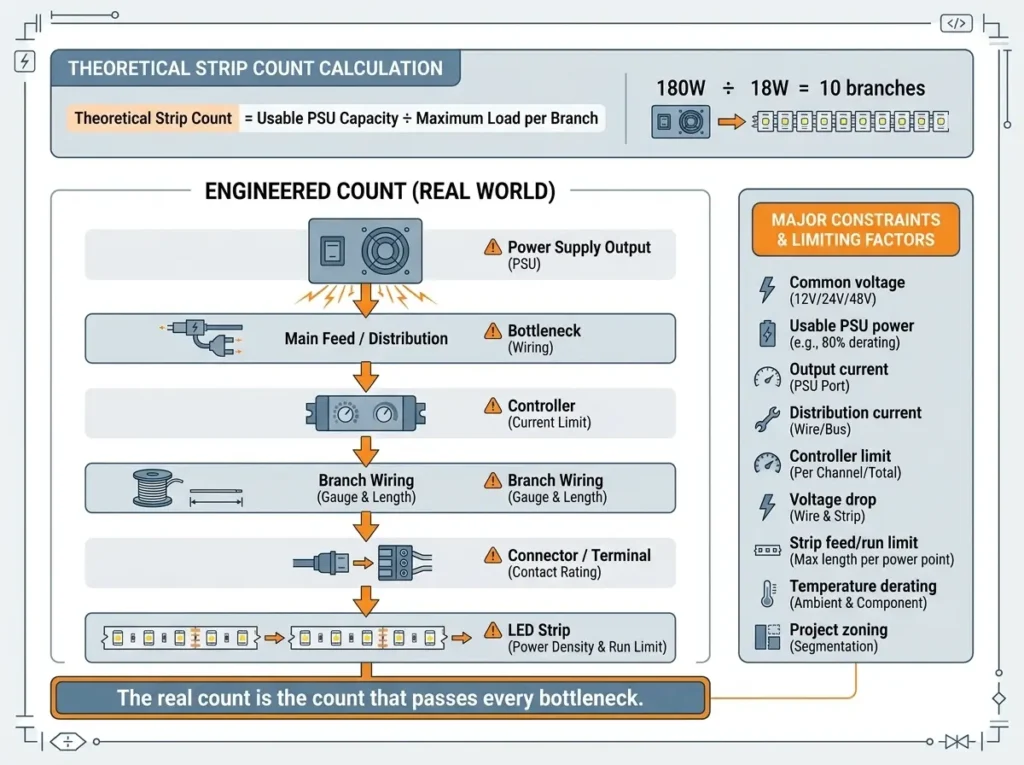
Think of one power supply feeding many strip branches as a chain of capacities:
Power Supply Output
        ↓
Main Feed / Distribution Point
        ↓
Controller (if used)
        ↓
Branch Wiring
        ↓
Connector / Terminal
        ↓
LED Strip
The system is only valid when every relevant element can support the intended operating condition.
A useful review table looks like this:
| Constraint | What to Check | Can It Reduce the Number of Strips? |
|---|---|---|
| Common voltage | All directly connected strips require same source voltage | Yes |
| Usable PSU power | Maximum simultaneous load ≤ usable output | Yes |
| PSU output current | Total current within verified output capability | Yes |
| Main distribution | Trunk / distribution hardware suitable for combined current | Yes |
| Controller | Total and per-channel limits | Yes |
| Branch wiring | Current + distance + conductor | Yes |
| Voltage drop | Remote strip receives acceptable voltage | Yes |
| Strip feed/run limit | Product-specific maximum powered path | Yes |
| Environment / derating | Usable output at actual condition | Yes |
| Project zoning | Failure domain / service / independent control | Yes |
The lowest practical constraint wins.
That is the number worth designing around.
Wattage and Current Usually Describe the Same Load — Do Not “Derate Twice”
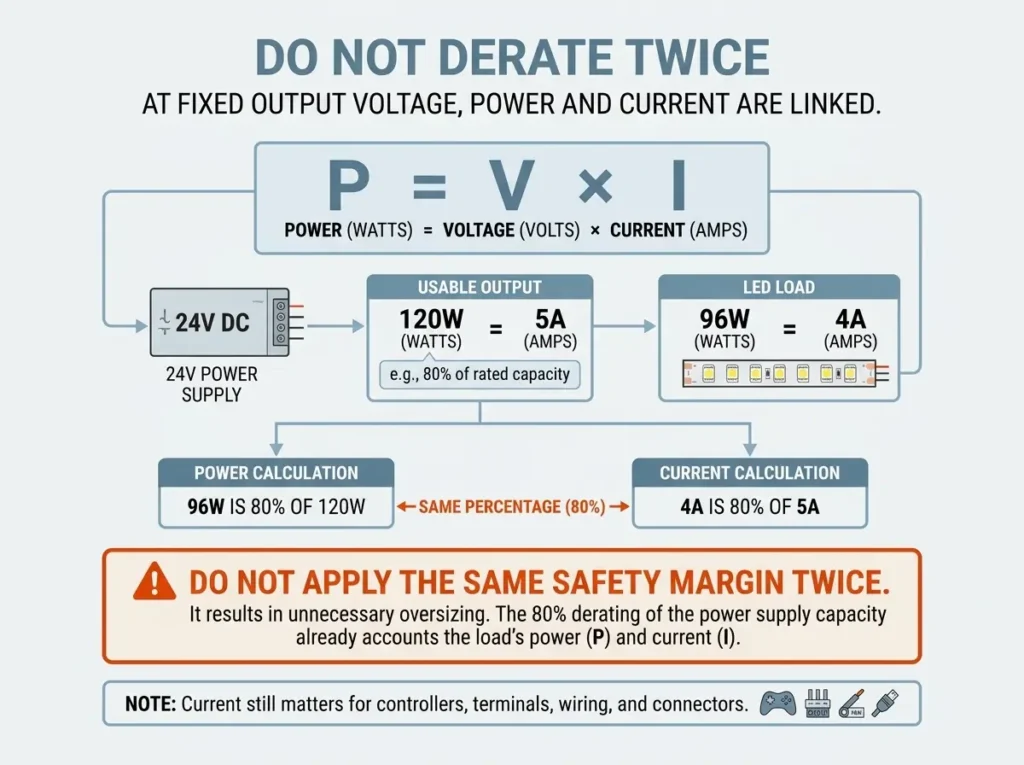
At a fixed output voltage:
P = V × I
So if a 24V supply has a verified usable output of 120W, that corresponds to:
120W ÷ 24V = 5A
If your LED load is:
96W ÷ 24V = 4A
then the same load is:
- 80% of 120W;
- 80% of 5A.
Do not calculate a wattage margin and then apply the same margin again to current as though they were two independent loading penalties.
Current still matters separately for:
- controller channels;
- terminals;
- wiring;
- connectors;
but the PSU’s output watts and amps are mathematically linked at its fixed output voltage.
This distinction prevents accidental double-oversizing.
Mixed Strip Branches: Do Not Average the Wattage
Suppose one supply feeds three 24V strip types:
- Branch A: 4 m at 7.2 W/m
- Branch B: 3 m at 14.4 W/m
- Branch C: 5 m at 9.6 W/m
Calculate each branch:
A = 4 × 7.2 = 28.8W
B = 3 × 14.4 = 43.2W
C = 5 × 9.6 = 48W
Combined load:
28.8 + 43.2 + 48 = 120W
Current:
120W ÷ 24V = 5A
Calling this “three LED strips” hides almost everything that matters.
The three branches have different:
- wattages;
- currents;
- lengths;
- possible voltage-drop behavior.
For mixed projects, branch-by-branch calculation is more reliable than averaging W/m or using one standard strip value.
Theoretical Count vs Engineered Count: A Controller Example
Assume:
- 24V system;
- each strip branch = 18W / 0.75A;
- PSU usable output = 180W / 7.5A;
- one downstream controller is used;
- controller datasheet permits 6A total output.
The PSU alone suggests:
180 ÷ 18 = 10 branches
But the controller allows:
6A ÷ 0.75A = 8 branches
If all branches pass through that one controller, the engineered count is no longer ten.
It is at most eight under these stated hypothetical conditions, before checking wiring and voltage drop.
The point is not that controllers are usually 6A.
The point is:
A component downstream of the power supply can become the real system limit.
Always use the actual controller datasheet.
A Main Feed Can Become the Bottleneck Before the PSU Does
Imagine eight identical 24V branches, each drawing 1A.
If all current travels through one main feed before the distribution point:
Main-feed current = 8A
Each branch conductor may carry only 1A.
That means the system contains two very different conductor-sizing problems:
- an 8A trunk;
- eight 1A branches.
Using the same wire size everywhere because “each strip only draws 1A” can miss the trunk-current requirement.
Southwire’s Re³ Voltage Drop Calculator evaluates conductor sizing from current, run length, voltage, conductor characteristics, and the selected design target: Southwire Re³ Voltage Drop Calculator.
For North American work, this is a stronger basis than copying one universal AWG-per-strip rule.
Why Physical Layout Can Lower the Practical Strip Count
Two systems can have identical total wattage and very different distribution quality.
Compact cabinet
        ┌→ Branch A
PSU ────┼→ Branch B
        ├→ Branch C
        └→ Branch D

All branches short
Large architectural run
PSU ───────────────→ Branch A
     ─────────────────────→ Branch B
     ─────────────────────────────→ Branch C
Same total wattage.
Different:
- conductor lengths;
- voltage drop;
- material usage;
- service access.
At some point, adding another long branch to one central supply can be less sensible than adding a distributed power supply closer to that load.
So “PSU still has spare watts” does not automatically mean “keep adding strips.”
For strip-specific voltage-drop diagnosis and feed architecture, use LED Strip Voltage Drop Explained.
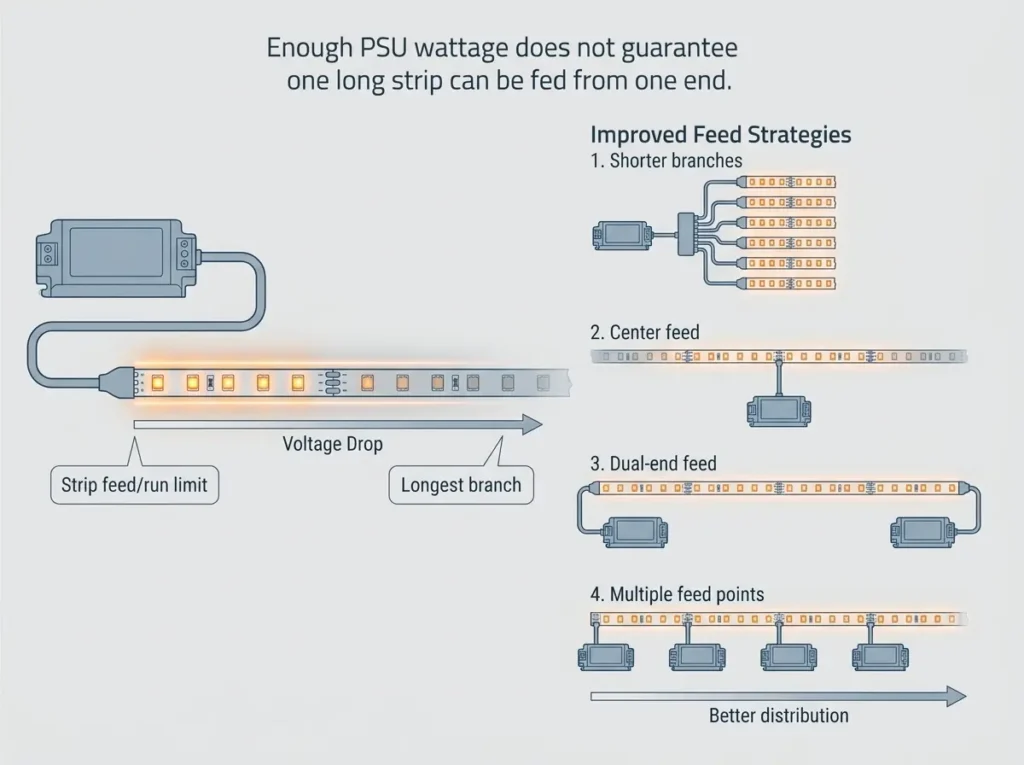
The Strip Itself Can Become the Limit
Suppose a power supply has more than enough capacity for 20 m of LED strip.
That does not prove one 20 m strip can be powered from one end.
The strip PCB carries current through its own copper traces.
The exact maximum powered length per feed depends on the selected strip’s:
- voltage;
- W/m or W/ft;
- PCB construction;
- copper width/thickness;
- current-regulation architecture;
- manufacturer instructions.
That means:
Power-supply capacity and strip maximum-run capability are different limits.
You can have enough PSU wattage and still need:
- multiple feed points;
- shorter branches;
- center feeding;
- dual-end feeding;
- distributed supplies.
Do not turn PSU wattage into a universal strip-length rule.
What “Parallel” Means in a Multi-Strip System
For conventional compatible constant-voltage strip branches, the conceptual distribution is:
            ┌── Strip A
24V Source ─┼── Strip B
            └── Strip C
Each branch receives the intended system voltage.
Their currents add at the source.
MEAN WELL’s LED power-supply technical FAQ explicitly notes that smaller LED loads can be connected in parallel and powered by a single higher-wattage power supply, while also warning that current distribution has to be considered. MEAN WELL — LED Load and Power-Supply Application Q&A.
This should not be confused with connecting multiple power-supply outputs together.
The load branches may be parallel.
The power supplies themselves should only be paralleled when the exact products explicitly support that function.
Do Not Add a Second Power Supply by Tying Its Output to the First
When one supply reaches its practical limit, the next idea is often:
“Can I connect another 24V power supply to the same DC bus?”
Do not assume that is acceptable.
MEAN WELL’s LED power-supply FAQ states that its LED power supplies without parallel current-sharing capability are not suitable for simple output paralleling; for higher-power applications, it recommends either using a suitable higher-wattage supply or dividing the LED load into smaller sections powered by individual supplies. MEAN WELL — Parallel Operation of LED Power Supplies.
That supports an important design distinction:
VALID CONCEPT TO EVALUATE

PSU A → LED Zone A
PSU B → LED Zone B
is not the same as:
DO NOT ASSUME THIS IS ALLOWED

PSU A ─┐
       ├── Shared DC Bus → LED Loads
PSU B ─┘
Only the exact power-supply documentation can authorize output paralleling.
When One Large Power Supply Stops Being the Best Architecture
A single large source can simplify:
- AC connection count;
- centralized service;
- spare-part inventory;
- coordinated dimming where the control architecture permits it.
But as the number of strips grows, one centralized source can also create:
- higher trunk current;
- longer low-voltage cable runs;
- more complex distribution;
- a larger failure domain;
- harder branch troubleshooting;
- controller/current concentration.
A useful engineering question is:
If I add one more strip, what gets worse besides the wattage number?
If the answer includes:
- another long DC run;
- a much larger trunk conductor;
- a controller approaching its limit;
- a difficult service route;
- more remote voltage drop;
then splitting the system can be more rational even when the power supply still has nominal capacity.
The goal is not to maximize “strips per PSU.”
The goal is to produce a system that is electrically valid, serviceable, and appropriate for the project.
Failure Domain Matters in Commercial Projects
Suppose one 240W supply feeds eight retail-shelf branches.
If that source fails, all eight branches can go dark.
Now compare two supplies feeding four branches each.
The second design introduces another power supply, but it can reduce the number of loads affected by one source failure.
This does not mean two supplies are automatically better.
It means failure impact is a legitimate design input.
For commercial and OEM projects, consider:
- acceptable outage area;
- spare availability;
- access to the supply;
- replacement time;
- whether control zones match power zones.
This factor is rarely visible in online “how many strips?” calculators, but it matters in real installations.
Control Zones Can Make the Electrical Count Irrelevant
Imagine one power supply has enough capacity for ten LED-strip branches.
But the project requires:
- Zone A: independently dimmed;
- Zone B: separately switched;
- Zone C: emergency/always-on;
- Zone D: different control schedule.
The source may still be shared in some control architectures, but the project has moved beyond a simple “ten strips on one output” problem.
The designer now has to verify:
- controller topology;
- channel current;
- common-voltage compatibility;
- fault isolation;
- required control interface.
This is why a power-supply count should never be decided before the control architecture is known.
If the project is still at the general selection stage, see How to Choose the Right Power Supply for LED Strip Lights.
Identical Branches: Use a Count Formula, Then Try to Break It
For identical branches, this is a useful first-pass method:
Capacity count
N = floor(Usable PSU Output Power ÷ Maximum Branch Power)
Assume:
- usable PSU output = 144W;
- each branch = 24W.
Then:
144 ÷ 24 = 6
Initial result:
6 branches
Now try to disprove the result.
Check:
- six-branch total current;
- trunk current;
- controller total/per-channel current;
- connector/distribution capacity;
- longest branch voltage drop;
- strip run/feed limits;
- operating-temperature derating.
If every constraint passes, six is defensible.
If one constraint fails at five, the practical answer is not six.
This “calculate, then try to break the answer” approach is more robust than treating the first division result as a finished design.
Different-Length Strips: Count Is Almost Meaningless
Assume three 24V strip branches:
| Branch | Length | Rating | Load |
|---|---|---|---|
| A | 1 m | 12 W/m | 12 W |
| B | 5 m | 12 W/m | 60 W |
| C | 8 m total, split into manufacturer-approved feeds | 12 W/m | 96 W |
| Total | 168 W |
The system has “three strips.”
But electrically:
- one branch is 12W;
- one is 60W;
- one is 96W.
Saying “the PSU runs three strips” communicates very little.
For mixed or unequal branches, specify:
Maximum simultaneous connected load = 168W
and then document the branch architecture.
That language is far more useful for engineering, procurement, and RFQ review.
One More Trap: “Normally Only Five Strips Are On”
Suppose ten branches are installed, but the operator says:
“Users normally turn on only five.”
Should the power supply be sized for five?
Not unless the control system actually prevents more than five from operating simultaneously and the design is intentionally based on that verified limit.
Human behavior is not an interlock.
If ten branches can be commanded on together, the design load should normally reflect that possible operating state.
This distinction matters in:
- retail controls;
- scene controllers;
- smart-building systems;
- RGB/RGBW installations;
- scheduled zones.
Use the maximum operating condition the system can actually produce, not the average behavior you expect.
A Power Supply Can Pass the Wattage Test and Fail the Voltage-Drop Test
Imagine five identical 24V branches at 20W each.
Combined load:
5 × 20W = 100W
Current:
100W ÷ 24V ≈ 4.17A
A candidate supply may have enough usable capacity.
But if one branch is 3 ft away and another is 45 ft away, those branches do not have the same distribution resistance.
The remote branch may become the practical limit even though the source still has capacity.
This is exactly why P03-06 and P03-05 need to remain separate:
- this page answers how many loads one source can support;
- The guide on LED Strip Voltage Drop Explained answers where the voltage is lost and how to diagnose it.
Do not solve a branch-voltage problem by adding more PSU wattage.
North America: Low Voltage Does Not Automatically Mean Unlimited Branching
A 12V or 24V system is low voltage, but nominal voltage alone does not define the complete North American safety/listing architecture.
UL Solutions discusses UL 2108 as the Standard for Low Voltage Lighting Systems and notes that the power unit and system configuration are part of the applicable evaluation. UL Solutions — UL 2108 Low-Voltage Lighting Systems.
For a real project, verify:
- exact power-unit certification/listing;
- output configuration;
- equipment instructions;
- conductor/protection requirements;
- complete system architecture.
Do not assume:
“It is 24V, therefore I can add as many branches as the wattage permits.”
The electrical capacity calculation and the compliance review are related but separate tasks.
Commission the Worst Legitimate Operating State
After installation, do not test only one branch at a time if the system can operate all branches together.
A useful commissioning condition is the maximum legitimate simultaneous load.
Under that condition, check:
- PSU output voltage;
- main distribution voltage;
- branch-start voltage;
- remote branch voltage;
- controller behavior;
- connectors/terminals for abnormal heating;
- visible brightness consistency.
This can expose problems that disappear during a light-load test.
For example:
- one branch alone works;
- all eight branches together cause source voltage to collapse.
That points toward a very different root cause than:
- source voltage remains stable;
- only Branch H is dim.
The second case is more likely to involve that branch’s distribution path, connection, or load.
A Practical Approval Sheet for Multi-Strip Projects
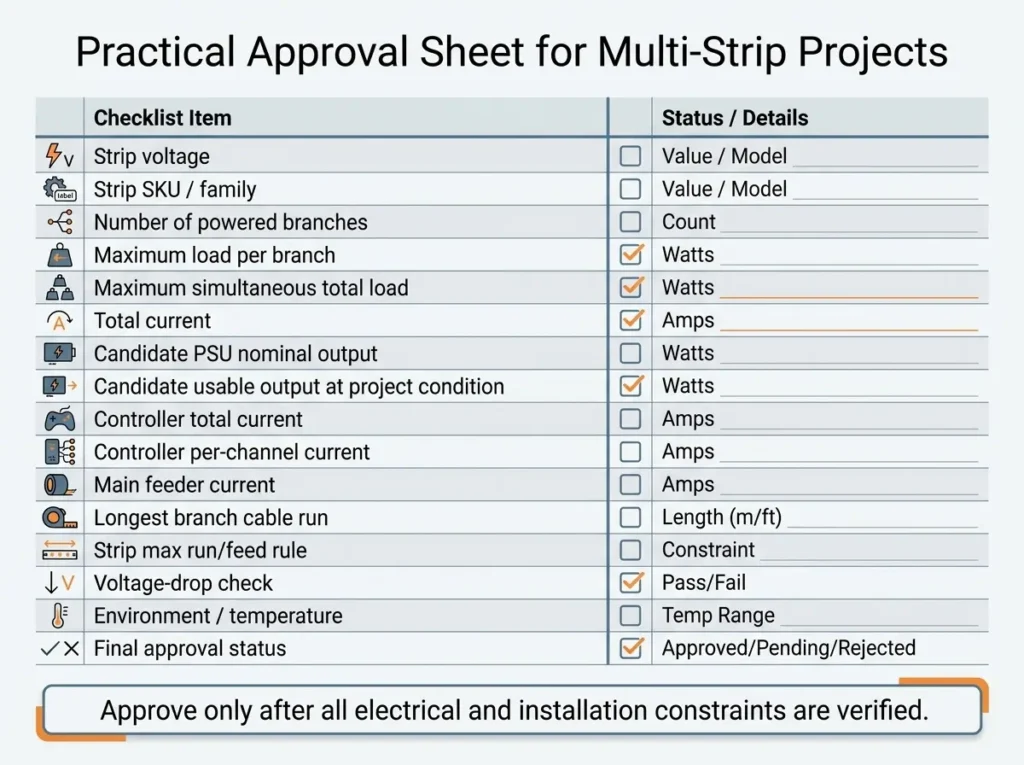
Before approving one supply for multiple LED-strip branches, fill in this table.
| Item | Project Value |
|---|---|
| Strip voltage | ___ VDC |
| Strip SKU / family | ___ |
| Number of powered branches | ___ |
| Maximum load per branch | ___ W |
| Maximum simultaneous total load | ___ W |
| Total current | ___ A |
| Candidate PSU nominal output | ___ W / A |
| Candidate usable output at project condition | ___ W / A |
| Controller total current | ___ A |
| Controller per-channel current | ___ A |
| Main feeder current | ___ A |
| Longest branch cable run | ___ |
| Strip max run/feed rule | Exact manufacturer data |
| Voltage-drop target | Project-specific |
| Installation environment | ___ |
| Certification/system requirement | ___ |
| Failure-domain requirement | ___ |
If one row is unknown, that unknown may be more important than the strip count.
What to Send FAHOLD Instead of “How Many Strips Can This Driver Run?”
A useful RFQ should contain:
- target market;
- AC input;
- LED-strip voltage;
- exact W/m or W/ft;
- powered length per branch;
- number of branches;
- maximum simultaneous load;
- longest DC run;
- dimming/control method;
- indoor/outdoor/enclosed environment;
- certification requirements;
- available mounting space.
For FAHOLD’s application-level context, see LED Strip Lighting.
Once those values are known, contact FAHOLD for specification-based matching.
If all strips require the same constant voltage, one power supply can run as many branches as the maximum simultaneous load, usable output capacity, current path, controller, wiring, voltage drop, strip feed limits, and project requirements all allow.
The wattage division gives you a candidate number.The distribution design decides whether that number is real.
FAQ How Many LED Strips Can One Power Supply
“Can one 24V power supply run four 24V strips?”
Possibly. Add the maximum wattage of all four strips, calculate the combined current, and then verify usable source capacity, controller/distribution current, voltage drop, and the exact strip feed limits.
“Can I connect 12V and 24V strips to the same 24V output?”
Not directly as conventional fixed-voltage loads. Directly connected branches must be compatible with the source voltage.
“If I have spare watts, can I add another strip?”
Only after checking the additional branch’s current path, controller/terminal limits, voltage drop, and strip feed requirements. Spare PSU wattage alone is not enough.
“Can I use two power supplies to increase the available current?”
Do not tie outputs together unless the exact power supplies explicitly support parallel operation. Dividing the LED load into separately powered zones is a different architecture.
“Should I size from the average number of strips normally on?”
Use the maximum operating state the control system can legitimately produce unless a verified hard limit prevents more branches from operating simultaneously.
“Is one large supply better than several smaller ones?”
Not universally. Compare trunk current, DC cable distance, control zoning, failure impact, service access, and total project requirements.
Need Help With Your LED Power Supply Project?
Tell us what you are working on. We will review your application and recommend the most relevant FAHOLD solution.