Table of Contents
The main difference between a 12V and 24V LED strip system is not brightness by itself. It is the electrical voltage the strip is designed to receive.
If the LED strip is already selected, the answer is simple:
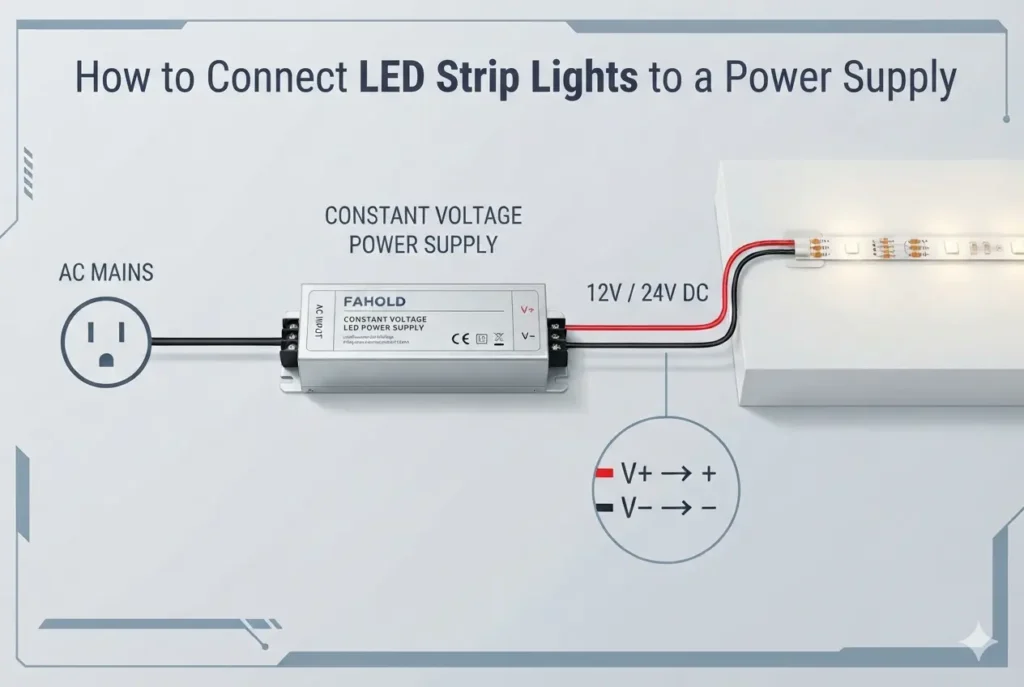
A 12V strip needs a compatible 12V constant-voltage power supply. A 24V strip needs a compatible 24V constant-voltage power supply.
If the project is still at the design stage and both 12V and 24V strip options are available, the choice affects:
- current;
- conductor loading;
- voltage drop;
- practical run/feed design;
- controller compatibility;
- power-supply availability;
- project architecture.
At the same power, a 24V system draws half the current of a 12V system.
That lower current is the main engineering reason 24V is often easier to manage in longer or higher-power linear lighting systems.
However, 24V is not automatically “better” for every application.
The correct choice depends on the actual LED strip, installation length, control system, distribution layout, available products, and project requirements.
For the complete strip-power topic map, start with the LED Strip Power Supply Guide. If the strip voltage is already known and you are selecting the supply itself, use How to Choose the Right Power Supply for LED Strip Lights.
12V vs 24V LED Strip: Quick Comparison
| Factor | 12V LED Strip | 24V LED Strip |
|---|---|---|
| Required power-supply output | 12VDC | 24VDC |
| Current at same wattage | Higher | Half the 12V current |
| Voltage-drop sensitivity | Generally more demanding at equal power/distribution | Generally easier to manage at equal power/distribution |
| Long-run distribution | Can require more feed points / larger conductors | Often more practical |
| Short, compact installations | Often suitable | Also suitable if products/components support 24V |
| Vehicle / battery ecosystems | 12V can align naturally with some systems | May require a 24V architecture |
| Controller compatibility | Must be 12V-compatible | Must be 24V-compatible |
| Strip/product availability | Widely available in many categories | Widely available in many categories |
| Brightness | Product-specific | Product-specific |
| Cut length / segment size | Product-specific | Product-specific |
| Best choice | Depends on project | Depends on project |
The table deliberately avoids universal maximum-run numbers because real strip run length depends on the exact product construction, watts per foot/meter, copper design, feed method, and acceptable voltage drop.
First Rule: The Power Supply Must Match the LED Strip Voltage
Do not begin by asking whether 12V or 24V is “more powerful.”
Begin with the load.
A conventional:
- 12V LED strip → compatible 12V constant-voltage power supply
- 24V LED strip → compatible 24V constant-voltage power supply
A higher-wattage power supply cannot compensate for the wrong output voltage.
Example:
- LED strip: 24V, 60W
- Candidate Supply A: 12V, 100W
- Candidate Supply B: 24V, 100W
Supply A has enough wattage on paper but the wrong voltage.
Supply B has the correct voltage basis, although the remaining specifications still need to be verified.
This is why voltage selection comes before wattage sizing.
Why 24V Uses Half the Current at the Same Power
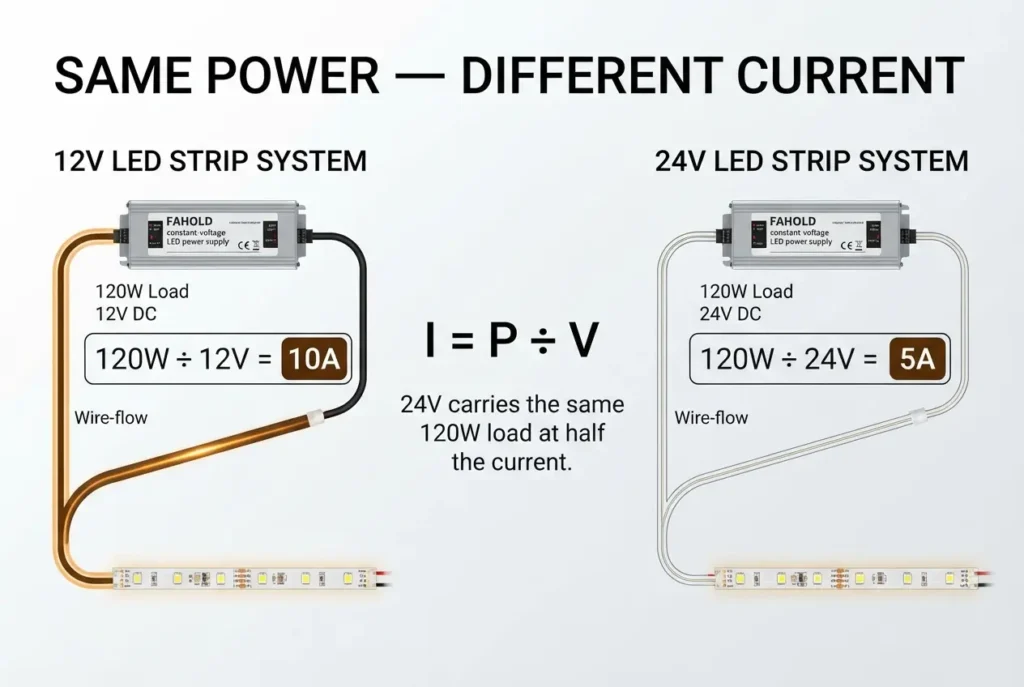
For a DC load:
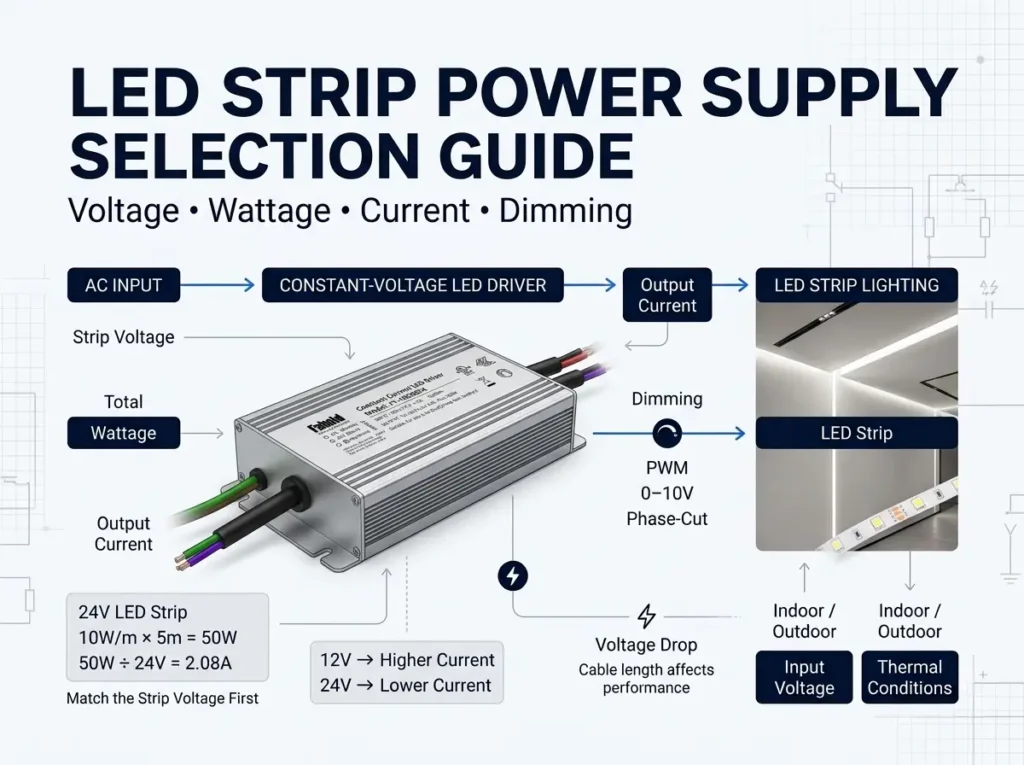
Current (A) = Power (W) ÷ Voltage (V)
Assume the same 120W total strip load.
12V system
120W ÷ 12V = 10A
24V system
120W ÷ 24V = 5A
The 24V system carries the same nominal load power at half the current.
That difference affects the rest of the electrical system:
- cable sizing;
- connector loading;
- controller current;
- branch design;
- voltage drop;
- conductor power loss.
This does not mean 24V consumes half the energy.
Both examples are still nominally 120W LED loads.
The difference is the combination of voltage and current used to transfer that power.
Why Lower Current Helps With Voltage Drop
Voltage drop can be simplified as:
Vdrop = I × R
where:
- I = current;
- R = resistance in the conductor/distribution path.
For the same conductor resistance, lower current means lower voltage drop.
Waveform Lighting’s technical explanation of LED-strip voltage drop makes the same practical point: reducing current helps reduce voltage drop, and moving from 12V to 24V can roughly halve current for the same power level. Waveform Lighting — What Is LED Strip Voltage Drop?.
For the dedicated strip-level voltage-drop topic, continue with LED Strip Voltage Drop Explained: Causes and Solutions.
Worked Example: Same Load, Same Wire Resistance
The following example is intentionally simplified so the assumptions are visible.
Assumptions
- LED load power: 120W
- complete relevant distribution resistance: 0.10Ω
- comparison is only between nominal 12V and 24V architectures
- conductor/material/layout are assumed identical for the calculation
12V system
Current:
120W ÷ 12V = 10A
Voltage drop:
10A × 0.10Ω = 1.0V
Percentage of nominal voltage:
1.0V ÷ 12V × 100 ≈ 8.33%
24V system
Current:
120W ÷ 24V = 5A
Voltage drop:
5A × 0.10Ω = 0.5V
Percentage of nominal voltage:
0.5V ÷ 24V × 100 ≈ 2.08%
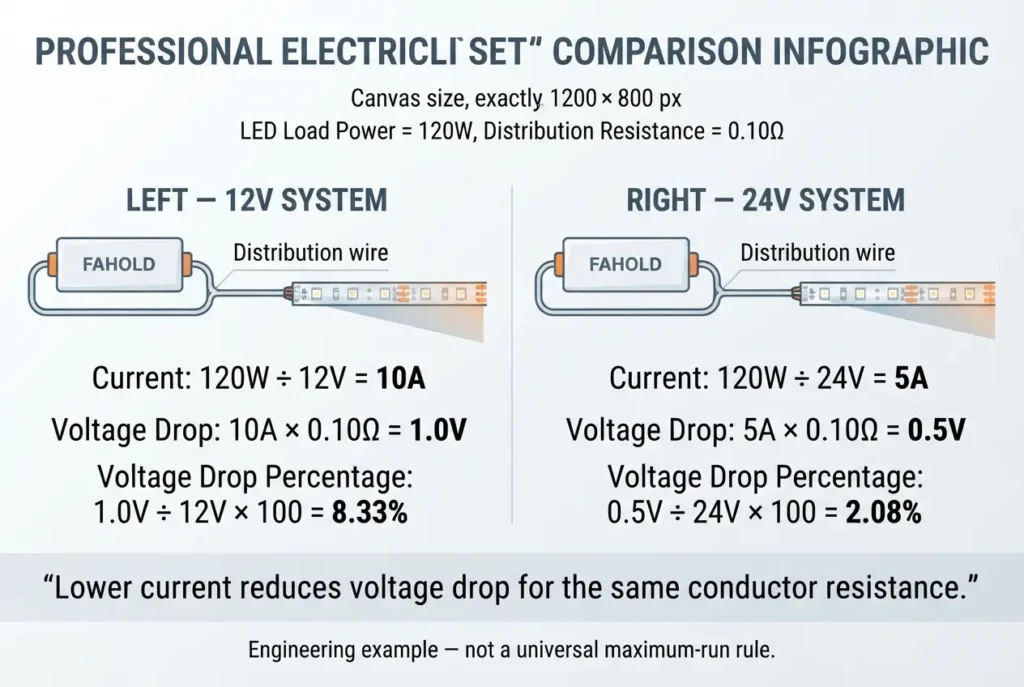
Comparison
| System | Current | Vdrop | Vdrop % |
|---|---|---|---|
| 12V / 120W | 10A | 1.0V | 8.33% |
| 24V / 120W | 5A | 0.5V | 2.08% |
Under these hypothetical assumptions, the 24V system experiences both:
- a smaller absolute voltage drop;
- a much smaller percentage drop relative to nominal voltage.
This is an engineering illustration, not FAHOLD test data and not a universal run-length rule.
Conductor Power Loss Also Changes With Current
Resistive conductor loss is:
Ploss = I² × R
Using the same hypothetical 0.10Ω resistance:
12V / 120W
10² × 0.10 = 10W
24V / 120W
5² × 0.10 = 2.5W
Under identical resistance assumptions, halving current reduces resistive conductor loss to one quarter.
This does not mean a complete 24V LED system is automatically four times more efficient.
Total system efficiency also depends on:
- the power supply;
- the LED strip design;
- controllers;
- temperature;
- actual wiring.
The calculation only demonstrates the effect of current on conductor loss.
Why 24V Is Often Better for Longer Runs
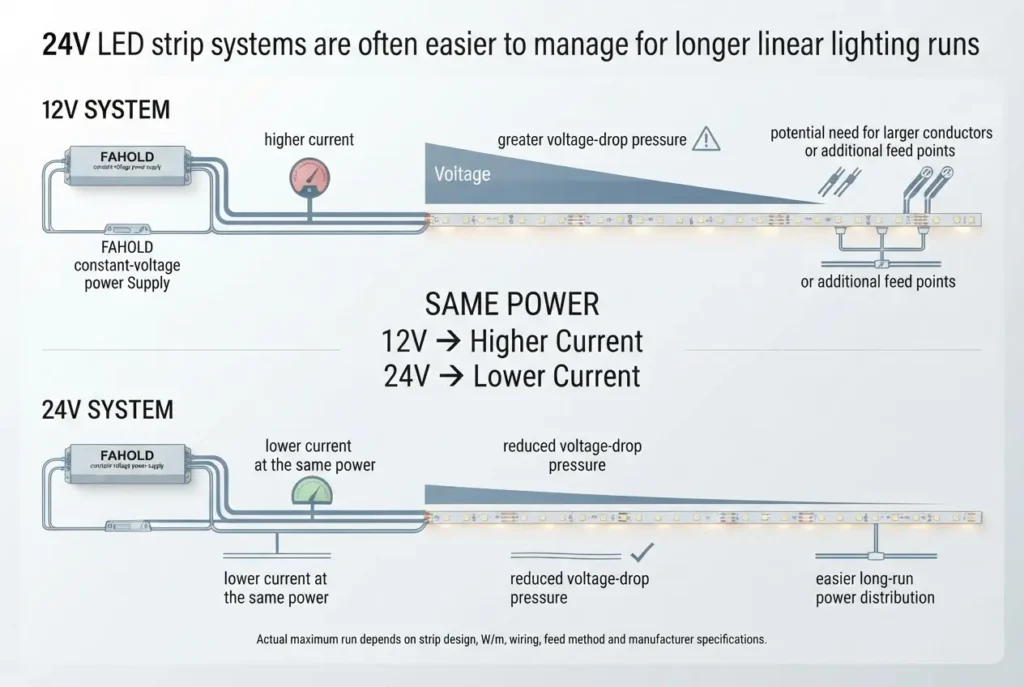
Longer LED-strip projects create more opportunity for resistance to affect delivered voltage.
A 24V architecture can help because the same power is distributed at lower current.
Current market guidance from Super Bright LEDs similarly describes 24V strip systems as better suited to longer continuous runs because of reduced voltage-drop sensitivity, while 12V remains common in shorter and vehicle-oriented applications. Super Bright LEDs — 12V vs 24V LED Strip Applications.
However, this should not be converted into a rule such as:
“12V is limited to X feet and 24V is limited to Y feet.”
There is no single defensible distance for every strip.
The real limit depends on:
- W/ft or W/m;
- strip copper thickness/width;
- conductor size;
- connector resistance;
- feed method;
- allowable brightness variation;
- manufacturer maximum-run instructions.
Why 12V Can Still Be the Correct Choice
12V remains appropriate when the project is designed around 12V equipment.
Examples can include:
- shorter lighting sections;
- installations where 12V battery or vehicle electrical systems are part of the architecture;
- existing 12V replacement systems;
- 12V-only controllers or accessories;
- strip families available only in the required specification at 12V.
The important point is not that 12V is “worse.”
It is that its higher current at the same wattage places more demand on the distribution system.
A well-designed 12V installation can perform correctly.
A poorly designed 24V installation can still suffer from voltage drop.
Project Length: Use Electrical Run Length, Not Just Total Project Length
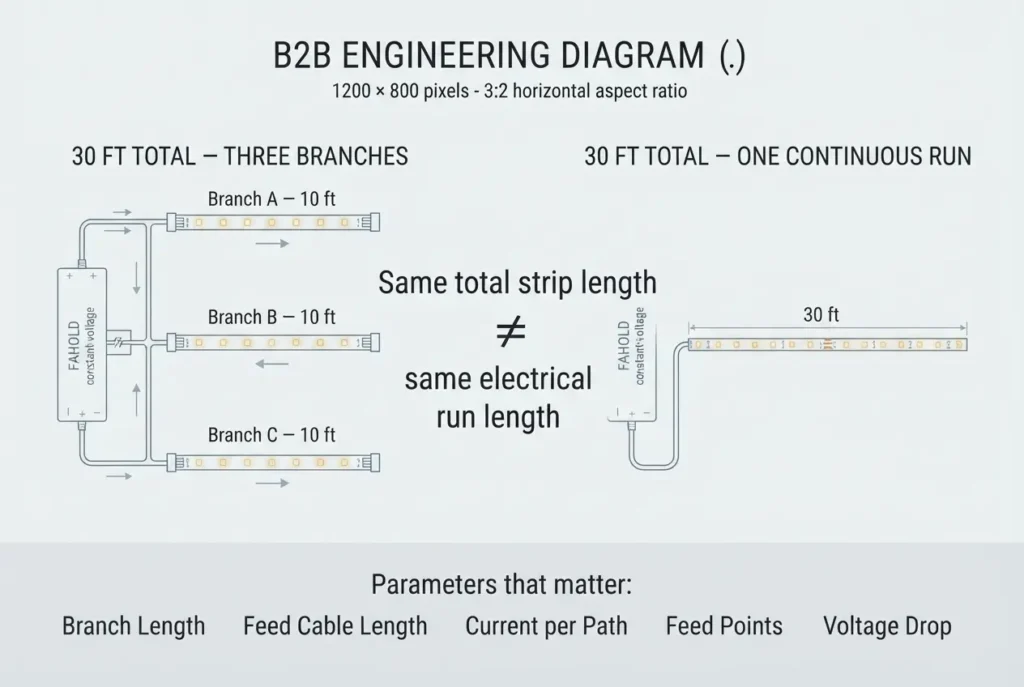
A 30-foot project is not always one 30-foot electrical run.
For example:
Power Supply
   ├── 10 ft Branch A
   ├── 10 ft Branch B
   └── 10 ft Branch C
is electrically different from:
Power Supply ───────────── 30 ft continuous feed/load path
Even if both projects use 30 feet of LED strip.
When comparing 12V vs 24V, define:
- total strip quantity;
- length per powered branch;
- power-injection points;
- cable length from supply to strip;
- current carried by each path.
For multi-branch sizing, see How Many LED Strips Can One Power Supply Run?.
12V vs 24V Does Not Determine Brightness by Itself
A common misconception is:
“24V strips are brighter than 12V strips.”
Voltage alone does not determine final light output.
Brightness depends on the actual strip design, including:
- LED package and density;
- drive current;
- watts per foot/meter;
- optical design;
- thermal conditions;
- product efficiency.
A 12V strip can be brighter than a 24V strip if the products are designed differently.
When comparing products, use the actual:
- lumens per foot/meter;
- watts per foot/meter;
- CCT/CRI;
- LED density;
- optical configuration.
Do not use voltage as a substitute for photometric data.
12V vs 24V Does Not Determine Efficiency by Itself
Similarly, do not claim that every 24V strip is inherently more electrically efficient than every 12V strip.
At the distribution level, 24V can reduce current and conductor losses for the same power.
But complete system efficiency also depends on:
- LED efficacy;
- strip circuit design;
- power-supply efficiency;
- controller losses;
- conductor losses;
- operating temperature.
Therefore, distinguish:
- distribution advantage;
- complete product/system efficiency.
These are not the same claim.
What About Cut Length and Segment Size?
Some installers prefer 12V because certain 12V strip designs use shorter electrical segments and therefore allow shorter cut intervals.
But this is product-specific, not a universal 12V-vs-24V law.
Different:
- COB strips;
- high-density strips;
- RGB strips;
- tunable-white strips;
- constant-current-regulated strips;
- specialty tape;
can use different segment architectures.
Always check the strip’s actual cut marks and datasheet.
Do not select system voltage solely from an assumed cut interval.
Product Availability: Are 12V or 24V Strips Easier to Find?
Both 12V and 24V products are widely available in the North American LED-strip market.
As one current market example, Super Bright LEDs lists strip families and categories covering both 12V and 24V products across multiple strip formats. Super Bright LEDs — 12V and 24V LED Strip Availability.
However, exact availability varies by:
- CCT;
- CRI;
- RGB / RGBW / CCT configuration;
- watts per foot/meter;
- LED density;
- IP/environmental rating;
- width;
- reel length;
- cut interval.
For a real project, select the strip based on the complete optical and mechanical specification first, then verify whether that product family is offered in 12V, 24V, or both.
Power-Supply Availability Must Also Match the Voltage
Selecting a 24V strip requires a compatible 24V constant-voltage power supply.
Selecting a 12V strip requires a compatible 12V supply.
Do not assume a power-supply family supports both voltages just because another model in that family does.
Model-level verification should check:
- output voltage;
- output-current range;
- rated power;
- AC input;
- dimming/control;
- environmental rating;
- certification;
- dimensions.
That is why the voltage choice must be made before exact power-supply model matching.
For the full supply-selection workflow, see How to Choose the Right Power Supply for LED Strip Lights.
Same Wattage Does Not Mean the Same Power-Supply Current
Assume the project needs 96W.
12V strip
96W ÷ 12V = 8A
The power supply must provide at least the required usable 12V output current under project conditions.
24V strip
96W ÷ 24V = 4A
The supply provides the same nominal 96W load at half the output current.
This changes the current specification of:
- the power supply;
- controller;
- wiring;
- connectors.
For exact wattage calculation, continue with How to Calculate Power Supply Wattage for LED Strips.
Controller Compatibility: Voltage Matters Here Too
A controller placed between the power supply and LED strip must be compatible with the system voltage.
Example:
AC Mains
   ↓
24V Constant-Voltage Power Supply
   ↓
24V-Compatible LED Controller
   ↓
24V LED Strip
Do not assume a 12V-only controller can operate safely at 24V.
Likewise, controller current limits must be checked.
A 24V architecture can reduce current for the same load power, which may reduce current demand on the controller—but the controller still needs to be specifically rated for the voltage and load.
Voltage Drop in the Strip and Voltage Drop in the Feed Wire Are Different
Two separate resistance paths matter:
External wiring
The cable between:
- power supply;
- controller;
- LED strip.
LED-strip copper path
The strip PCB itself carries current along its copper traces.
A larger external conductor can reduce cable voltage drop but cannot eliminate resistance inside the strip.
Waveform Lighting’s technical discussion specifically notes that voltage drop occurs both in connecting wires and in LED-strip copper traces as current travels farther from the feed point. Waveform Lighting — LED Strip Copper and Voltage Drop.
This is why manufacturer run-length and feed-point instructions still matter even when the power-supply cable is generously sized.
Wire Gauge: 24V Can Help, but It Does Not Eliminate the Calculation
Because 24V reduces current at equal power, it can make conductor sizing easier.
But do not conclude:
“Use 24V and wire gauge no longer matters.”
Voltage drop still depends on the actual current, cable length, conductor size, material, installation, and acceptable design target.
Southwire’s current engineering calculator uses those variables to evaluate voltage drop and conductor sizing: Southwire Re³ Voltage Drop Calculator.
Use a project-specific calculation rather than one universal “12V uses AWG X / 24V uses AWG Y” chart.
Power Injection: Does 24V Eliminate the Need?
No.
24V can reduce voltage-drop sensitivity, but a sufficiently long or high-power strip can still require:
- center feeding;
- dual-end feeding;
- additional injection points;
- parallel branches.
The exact strategy depends on the strip’s design and manufacturer instructions.
Do not publish a fixed injection distance without a specific strip datasheet.
The P03 cluster separates this topic into LED Strip Voltage Drop Explained so the voltage-comparison page does not become a second voltage-drop guide.
North America: Low Voltage Does Not Automatically Mean Class 2
Both 12V and 24V are low-voltage DC values, but nominal voltage alone does not prove that a power unit or complete lighting installation qualifies for a specific Class 2 claim.
UL Solutions’ discussion of UL 2108 shows that Class 2 low-voltage lighting configurations involve defined power-unit and system requirements rather than voltage alone: UL Solutions — UL 2108 Low-Voltage Lighting Systems.
For a North American Commercial projects, verify the exact power supply, output configuration, listing/certification, and installation requirements.
Do not market every 12V or 24V system as Class 2 without product-specific evidence.
12V vs 24V for Common Project Types
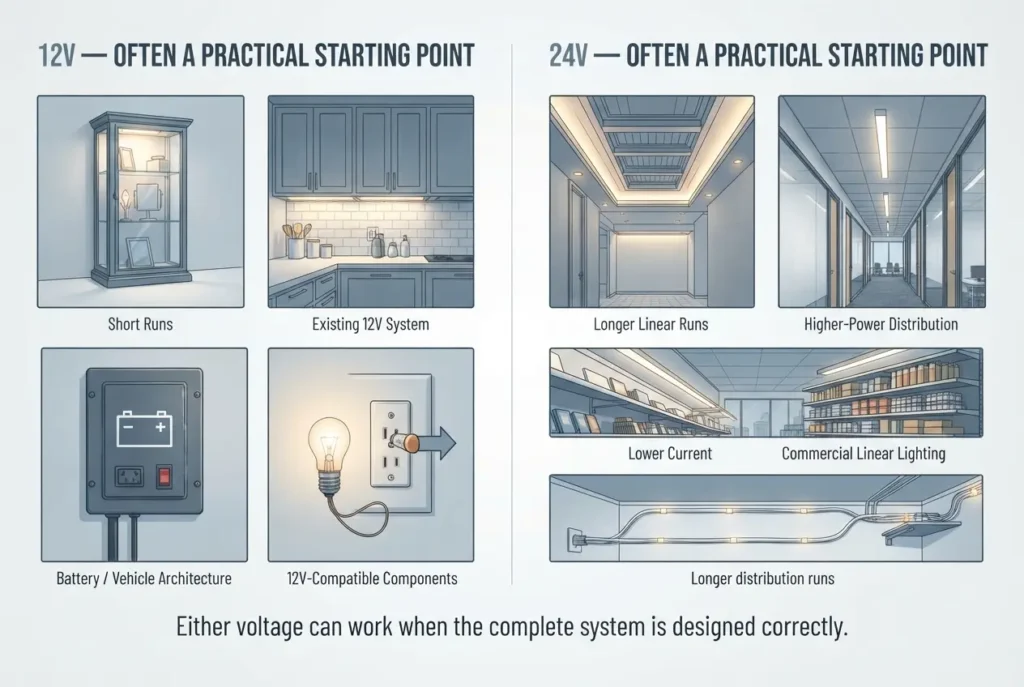
Cabinet and display lighting
Either voltage can work if the strip and power architecture support it.
For short, compact runs, the current advantage of 24V may be less decisive.
The deciding factors may instead be:
- available strip product;
- cut interval;
- controller;
- physical dimensions;
- existing power architecture.
Architectural cove lighting
For longer continuous linear runs, 24V often becomes attractive because it reduces current at the same total wattage.
However, branch layout and feed points still need to be engineered.
See LED Strip Lighting for FAHOLD’s application-level context.
Retail shelving
Short repeated segments can work at either voltage.
If many shelves are supplied from one centralized source, total branch current and distribution distance may make 24V more practical.
Vehicle / RV / marine 12V architecture
Where the existing electrical system is already 12V and the selected strip is designed for that environment, 12V can simplify system integration.
This is an application-architecture reason—not proof that 12V is technically superior in general.
Long commercial linear runs
24V is often the more practical starting point where compatible strip products are available because lower current reduces distribution stress.
For very long projects, however, a proper design may still require multiple feeds or distributed power supplies.
Worked Selection Example 1: Short 36W Display
Assume the project can use either a 12V or 24V version of the same intended strip family.
Load:
36W
12V
36W ÷ 12V = 3A
24V
36W ÷ 24V = 1.5A
If the cable runs are very short, both current levels may be manageable.
The decision may then depend more on:
- strip availability;
- controller compatibility;
- cut interval;
- existing system voltage;
- power-supply availability.
A short project does not automatically require 24V.
Worked Selection Example 2: 144W Architectural Run
Assume:
- total load: 144W;
- strip family available in both voltages;
- multiple feeds will be engineered separately.
12V
144W ÷ 12V = 12A
24V
144W ÷ 24V = 6A
At this power level, halving current can materially affect:
- trunk conductor size;
- controller current;
- connector loading;
- voltage drop.
For a commercial architectural system, 24V may therefore be easier to distribute.
But the final answer still depends on the exact strip layout and feed design.
Worked Selection Example 3: Existing 12V System Replacement
Assume an existing installation already includes:
- 12V-rated LED strip;
- 12V-compatible controller;
- 12V wiring architecture.
Changing only the power supply to 24V is not an upgrade.
It creates a voltage mismatch.
A conversion from 12V to 24V would require verification or replacement of all affected system components.
This illustrates an important rule:
Voltage selection is a system decision, not just a power-supply decision.
12V vs 24V Decision Workflow
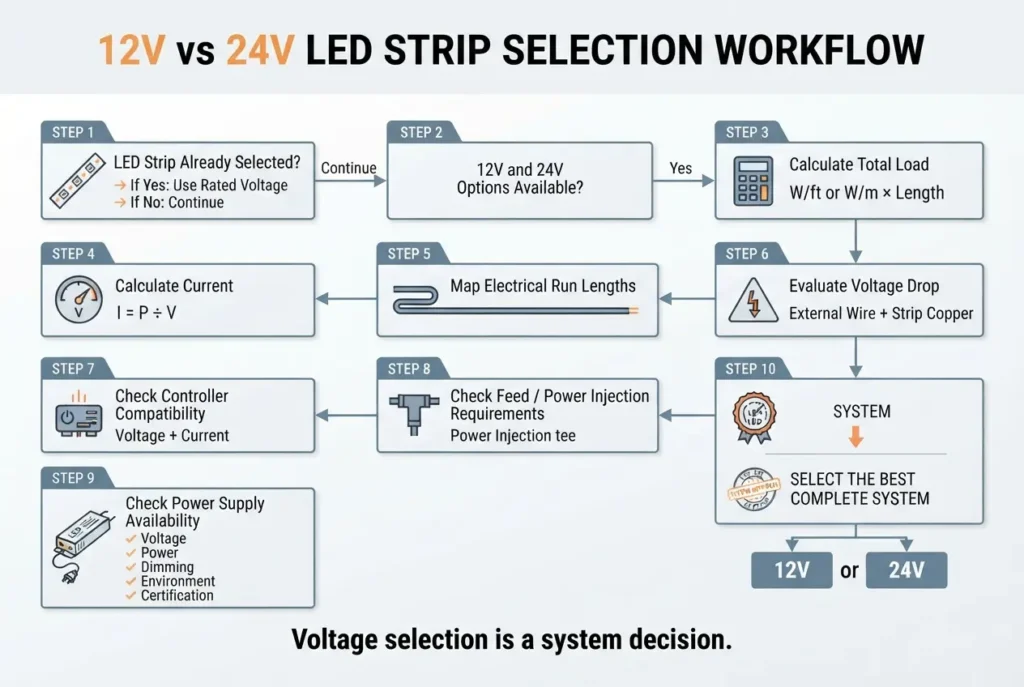
Step 1 — Is the LED strip already selected?
If yes, use the strip’s rated voltage. If no, continue.
Step 2 — Are equivalent 12V and 24V strip options actually available?
Compare real product families—not generic voltage claims.
Step 3 — Calculate total load
Use the strip’s actual W/ft or W/m.
Step 4 — Calculate current at each candidate voltage
Use:I = P ÷ V
Step 5 — Map the real electrical run lengths
Separate total project length from individual powered branch length.
Step 6 — Evaluate voltage drop
Check both:
- external wiring;
- strip copper path.
Step 7 — Check controller compatibility
Confirm voltage and current ratings.
Step 8 — Check feed-point and power-injection requirements
Follow the selected strip manufacturer’s instructions.
Step 9 — Check the available power-supply ecosystem
Verify suitable supply models for:
- voltage;
- wattage/current;
- dimming;
- environment;
- target market.
Step 10 — Select the voltage that produces the best complete system
Do not choose from one factor alone.
12V vs 24V Buyer Checklist
| Question | 12V / 24V Decision Input |
|---|---|
| Is the strip already specified? | Use its rated voltage |
| Total load? | W |
| Current at 12V? | W ÷ 12 |
| Current at 24V? | W ÷ 24 |
| Longest powered run? | Distance |
| Feed cable length? | Distance |
| Strip maximum-run instructions? | Manufacturer data |
| Power injection required? | Manufacturer/system design |
| Controller available in both voltages? | Verify |
| Required strip type available in both voltages? | Verify |
| Power supply available in required voltage/power/control? | Verify |
| Existing system voltage? | 12V / 24V / new design |
| North American certification requirements? | Project-specific |
When 12V Is Usually the Better Starting Point
Consider 12V when:
- the LED strip is already 12V;
- the existing power ecosystem is 12V;
- the project uses short, manageable current paths;
- the required strip/controller is available only in the desired specification at 12V;
- a vehicle/battery architecture is designed around 12V.
When 24V Is Usually the Better Starting Point
Consider 24V when:
- the selected strip is 24V;
- the system has longer linear runs;
- total wattage creates high current at 12V;
- distribution voltage drop is a significant design concern;
- the required strip/controller/power-supply ecosystem is available at 24V.
This is a starting point—not an absolute selection rule.
Once those project conditions are known, contact FAHOLD for specification-based matching.
FAQ
Is 12V or 24V better for LED strips?
Neither is universally better. 24V uses half the current at the same power and is often easier for longer distribution, while 12V can be appropriate for shorter runs and existing 12V systems. The strip and complete project architecture determine the correct choice.
Is a 24V LED strip brighter than a 12V strip?
Not because of voltage alone. Brightness depends on the actual strip design, LED density, power, efficiency, and optical characteristics.
Does 24V have less voltage drop than 12V?
At the same power and comparable conductor resistance, 24V carries half the current of 12V, which reduces resistive voltage drop. Real performance still depends on the strip and wiring.
Can I use a 24V power supply on a 12V LED strip?
No for a conventional 12V strip. The power-supply output voltage must match the strip’s specified input voltage.
Can I use a 12V power supply on a 24V LED strip?
A conventional 24V strip requires a compatible 24V supply. A 12V source is not the correct voltage basis.
Does 24V allow longer LED strip runs?
Often yes when comparing otherwise similar systems, because lower current reduces voltage-drop pressure. Do not use a universal maximum-run number; follow the exact strip manufacturer’s specifications.
Does 24V use less power than 12V?
Not automatically. A 120W load is still nominally 120W whether the system is 12V or 24V. The 24V version carries that power at lower current.
Is 24V more efficient?
It can reduce conductor losses for the same power and wiring resistance, but complete system efficiency depends on the strip, power supply, controller, wiring, and temperature.
Are 12V or 24V LED strips easier to buy?
Both are widely available. Exact availability depends on the strip type, CCT, CRI, wattage, IP rating, density, width, and other product specifications.
Should I choose voltage before the power supply?
Yes. Select or verify the LED-strip voltage first, then choose a compatible constant-voltage power supply with sufficient usable power/current and the required control, environment, and certification characteristics.
Find the Right LED Power Supply for Your Project
Share the core electrical and application requirements. We will narrow the available FAHOLD platforms to the options most relevant to your project.